Linus B. Plimpton House (1884)

Designed by architect John C. Mead and built in 1884, the Romanesque-style Linus B. Plimpton House is located at 847 Asylum Street in the Asylum Hill neighborhood of Hartford. In 1865, Linus B. Plimpton (who was originally from Southridge, MA) established a business in Hartford manufacturing envelopes. The Plimpton Manufacturing Company won an important contract in 1874 to produce stamped envelops for the U.S. government. The prize was awarded by Postmaster General Marshall Jewell, a Hartford resident and former governor of Connecticut. The modern descendant of the old manufacturing firm continues to exist as Plimpton’s, a stationery retail store in West Hartford Center. The old Plimpton House on Asylum Avenue is now used for elderly housing. For further reading on the Plimpton Manufacturing Company, see the following pdf files: The History of Envelopes and “A Specialized Study of the Plimpton Manufacturing Co., Hartford, Connecticut High Value U.S. Postal Stationer.”

Boce W. Barlow Jr. House (1926)

At 31 Canterbury Street in Hartford is a house featured in Tour 8 of my new book, A Guide to Historic Hartford, Connecticut. Built in 1926, it was later the home of Boce W. Barlow, Jr. (1915-2005), the first African-American in the Connecticut judiciary, being appointed judge of Hartford’s municipal court in 1957 and, later, a hearing examiner for Connecticut’s Civil Rights Commission. He also became Connecticut’s first African American state senator when he was elected in 1966. When Barlow and his wife, Catherine Swanson Barlow, first moved to the house in 1958, they were Canterbury Street’s first black family. Born in Americus, Georgia, in 1915, Boce W. Barlow, Jr. moved to Connecticut with his family the following year. He graduated from Hartford Public High School in 1933 and went on to attend Howard University and Harvard Law School. Boce Barlow Way, a street in Hartford, was named in his honor in 1987.

Haley Manors (1898)

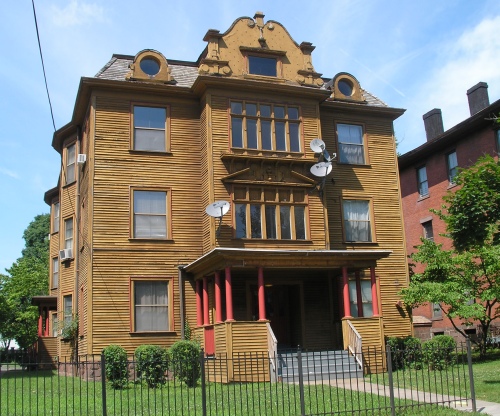
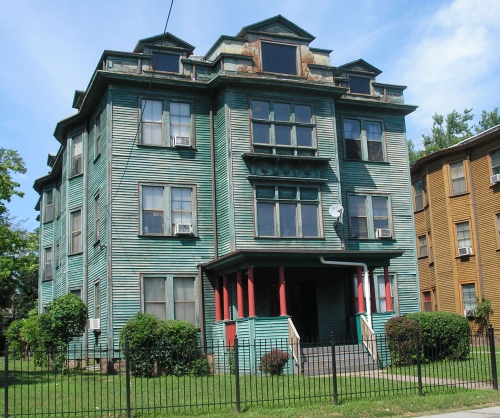
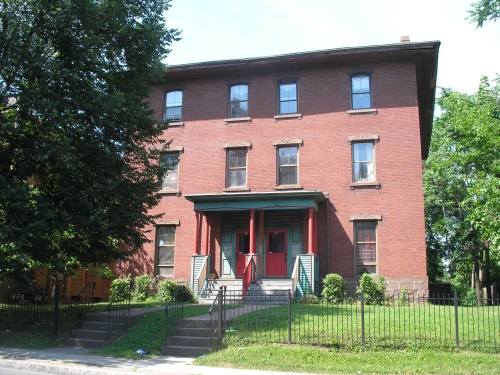
In 1981-1982, three nineteenth-century buildings on Capen Street in Hartford, each with 6-units, were converted into cooperatively-owned housing and namedHaley Manors” after Alex Haley, the author of Roots. The property for the project was donated by Rev. Dr. Lincoln J. Davis Sr., founder and President of Lincoln Enterprises, one of the first minority-owned business development corporations in Hartford. Two of the buildings, at 42-44 Capen Street (see image above) and 46-48 Capen Street (see image below), are wood-frame structures that follow the same basic plan with different decorative details on each building. They were built in 1898 by Henry D. Ely. The third building, located at 36-38 Capen Street (see image below), is a brick Italianate, built around 1875. These buildings are mentioned in Tour 8 in my new book, A Guide to Historic Hartford, Connecticut. (more…)

Thomas-Bradstreet House (1838)

Born in Wolcott in 1785, Seth Thomas first worked in the clock business under Eli Terry and later purchased Terry’s clock-making business in 1810. Thomas moved to Plymouth Hollow (later named Thomaston in his honor) in 1813 and founded the famous Seth Thomas Clock Company, which continued in business until the 1980s. In 1838, Seth Thomas purchased the house at 237 Main Street in Thomaston from Marvin Blakeslee. It had probably been built in about 1825 and is the only remaining of the five houses owned by the Thomas family on Main Street. In 1850, Thomas sold it to his daughter, Amanda Thomas Bradstreet, whose husband, Thomas Jefferson Bradstreet, was a descendant of the Puritan poet, Anne Bradstreet. The house remained in the family until the death of Miss Edith Bradstreet Mather in 2004. The following year, the Town of Thomaston bought the property from her surviving sister, Clara-Louise Mather Riggs. The Thomas-Bradstreet House, restored by the Thomaston Historical Commission, is now a house museum open to the public.