220 High Street, Hartford (1855)

Across from the Isham-Terry House, which is preserved as a museum in Hartford by Connecticut Landmarks, is another mid-nineteenth century Italianate house. Built around 1855, the house at 220 High Street is not in the best condition today but, together with the Isham-Terry House, it is a reminder of an era when the area around High Street had many middle class residences. The house is attributed to architect William G. Allen. The porch is enclosed and perhaps has been since it was built.

Samuel E. Amidon House (1888)

The house at 290 Prospect Street in Willimantic was built in 1888 for Samuel E. Amidon, a successful grocery store owner. After Amidon’s death, the house had other owners. In 1984 it was purchased by the Roman Catholic Diocese of Norwich. Called Newman Hall, it is now the Catholic Office of Campus Ministry for members of the Eastern Connecticut State University community. According to the Commemorative Biographical Record of Tolland and Windham Counties (1903):

Samuel E. Amidon was born July 24, 1844, at Sturbridge, Mass., and was but a child when his parents removed to Ashford, Conn., and located on the old Amidon homestead. (more…)

Gerhard F. Drouve House (1914)

The house at 2137 North Avenue in Bridgeport was built in 1914 by Gerhard F. Drouve. As described in the History of Bridgeport and Vicinity, Volume 1 (1917):

The G. Drouve Company, 40 Tulip Street, are manufacturers of the Anti-Pluvius puttyless skylights. The firm was incorporated in May, 1896. The officers of this concern are: G. F. Drouve, president and treasurer; William V. Dee, secretary.

Drouve also manufactured various devices, including a “Straight-Push” sash operator and the Lovell Window and Shutter Operating Device.

Andrews-Olney House (1800)

A battle is currently being waged in Southington over the fate of a c.1800 brick Federal-style house at 116-118 North Main Street. The YMCA next door has plans to demolish this historic structure to make way for a parking lot!!!

The house was built by Samuel Andrews, Sr., a veteran of the Revolutionary War. It is commonly called the Olney House for a later owner, Jesse Olney, an educator and author of influential geography books and atlases that were second only to Noah Webster’s spelling book in textbook sales in the nineteenth century. Olney also served in the state legislature for ten terms and was state comptroller for two years. The house once had a front porch that was later removed.

During the summer, local preservationists were involved in negotiations with the YMCA in an attempt to save the house. When the YMCA halted the talks and withdrew an offer to sell the house, the Connecticut Trust for Historic Preservation sought an injunction, which was issued by a New Britain Superior Court judge in August preventing the demolition of the Olney House until Jauary 20. The Y does have permission to proceed with the destruction of the later addition to the rear of the house, an Italianate ell.

It is important that this house be preserved architecturally because it is Southington’s only example of a brick Federal house and historically because of its association with an important Connecticut educator and author.

Timothy Higgins House (1828)

Timothy Higgins House

(Update: above is a new picture of the house taken on July 10, 2014). The Timothy Higgins House in Plantsville in Southington is a Greek Revival residence built in 1828. Deacon Timothy Higgins (1800-1887) was born in Wolcott. He came to Southington and started a tannery on Prospect Street, on Eight Mile River. According to Chapter Sketches: Connecticut Daughters of the American Revolution; Patriots’ Daughters (1904):

Jennette Carter was born in Southington September 5, 1803, the third child in a family of five. She was married to Timothy Higgins November 4, 1824, and became the mother of eleven children, only three of whom are now living. Nearly ten years after their marriage, Mr. and Mrs. Higgins became members of the Congregational Church in Southington. Forty years later their church membership in Southington was transferred to the church in Plantsville.

Edward Twichell, the father of Rev. Joseph Twichell, the friend of Mark Twain, was Higgins’ apprentice and later business partner. (more…)

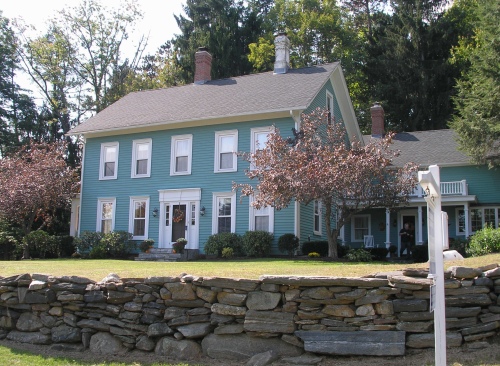
49 Barnes Hill Road, Burlington (1803)

The house at 49 Barnes Hill Road in Burlington is currently for sale. One of the present owners of the house has provided me the results of some of her research into the history of the property. She writes that

The property was purchased/settled we believe in 1803 (previous owners found a dated cornerstone in the cellar) when Burlington was a part of Bristol (Burlington was incorporated in 1806). The original owners were Amzi [Barnes (1784-1865)] and Sophoronia [Mills] Barnes. We think they built the original structure. They had 10 children, many of whom stayed in the area. Many also died in childhood and are buried in a local Burlington cemetery.

The house has clearly been expanded over time and has been thoroughly renovated for modern living inside. The current main structure we believe dates back to the 1880s and shows up on the Burlington land records then. Our current family room originally served as the “birthing barn” for the new calves on the farm and was later finished as a family room and connected to the main house in the 20th century via a connecting “mud room”.

One of Amzi and Sophronia‘s sons was Isaac Barnes (1830-1909), a meat merchant and lumber dealer who was a member of Connecticut state house of representatives from Burlington in 1867. Another son was Cromwell Barnes, who was the father of Adna North Barnes. Adna had five children with his second wife, Anna Delight Upson Barnes, who are pictured on page 81 of the Images of America volume on Burlington. One of the children was Louis Barnes.

One descendant who lived in the home, Louis Barnes, [was] born during the 1888 blizzard. He was noted as a prize cattle breeder in CT. I believe he is credited with bringing some of the first Swiss cows to America.

(more…)