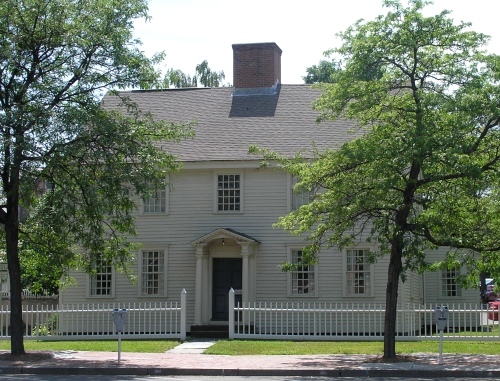
George Langdon House (1865)

6887 Main St., Plymouth

Born in Plymouth in 1826, George Langdon graduated from Yale in 1848. After experiencing a financial reverse as an industrial entrepreneur in Colchester after the Panic of 1857, he returned to Plymouth, where he owned a farm. He became the wealthiest man in town. He served as state representative in 1859 and as first selectman from 1859 to 1865. His Gothic Revival house was built at 688 Main Street in Plymouth circa 1865.

William Southmayd House (1747)

William Southmayd House

At 73 Main Street in Middletown is a house (pdf) that originally stood on William Street. It was built in 1747 for William Southmayd, who died before it was completed. His widow, Mehitable, was the house’s first occupant. It remained a residence until 1975 and was then slated for demolition. The house was saved in 1977, when it was moved to its current address and converted to serve as offices.

(more…)

Dr. Frank T. Simpson House (1912)

Dr. Frank T. Simpson House

Frank T. Simpson helped lead Connecticut’s first civil rights organization. Born in Alabama in 1907, he moved to Hartford in 1929. Active in social work, in 1944 he became the first employee of the Connecticut Inter-Racial Commission, now the Connecticut Commission on Human Rights and Opportunities. Simpson eventually became executive secretary and worked to end discrimination. In 1952, Dr. Simpson purchased a 1912-13 Tudor Revival house at 27 Keney Terrace in Hartford. He lived there until his death in 1974. The Waverly School, at 55 Waverly Street in Hartford, was renamed the Dr. Frank T. Simpson-Waverly School in his honor.

Cashman Farmhouse (1841)

1002 Middlebury Rd, Watertown

The Italianate farmhouse at 1002 Middlebury Road in Watertown (pdf) was built in 1841 by James Bishop, on part of the Hamilton Farm, which had been purchased that year by his father, Leverett Bishop. In 1854, the property was sold to the Partree family. In 1903, the house was purchased by Rollin and Howard Cashman, who ran a dairy farm on the property for nearly 40 years. For a time, the house was operated as The Graham House Bed and Breakfast, but it is now again a residence.

Truman A. Warren House (1851)

Truman A. Warren House (1851)

The ashlar granite Italianate house at 5 The Green in Watertown was erected in 1851 by Truman A. Warren. He was the son of Alanson Warren, of the manufacturing firm of Warren, Wheeler & Woodruff. Alanson Warren was also the first president of a company that grew out of that firm: Wheeler & Wilson, manufacturers of sewing machines. Truman A. Warren was a Republican politician. The house has been attributed to New Haven architect Henry Austin or it may have been designed by an architect copying Austin’s style of Italianate villa.