
The house at 814 Laurel Avenue in the Statfield section of Bridgeport was built in 1914. It was the residence of Morris I. Rome, a wholesale tea and coffee dealer.
The house at 814 Laurel Avenue in the Statfield section of Bridgeport was built in 1914. It was the residence of Morris I. Rome, a wholesale tea and coffee dealer.

Not to be confused with the earlier David Parmelee House next door (68 Water Street; built in 1780), the David Parmelee House at 74 Water Street in Guilford is a Federal house, built in 1807 by architect Abraham Coan for the younger David Pamelee, who was a blacksmith. The house has a rear ell thought to have once been part of an outbuilding dating to c. 1640 which belonged to Samuel Desborough, an original settler of Guilford.

The house at 208 Broad Street in Windsor was built in 1822 for Colonel James Loomis (1779-1862). Built of bricks manufactured by the Mack Brick Company in Windsor, it was once one of a number of residences that once stood on Broad Street across from Broad Street Green. A descendant of Joseph Loomis, who settled in Windsor in 1639, Col. Loomis was the proprietor of the village store, which stood just south of his house. His wife, Abigail Sherwood Chaffee Loomis (1798-1868), inherited Nancy Toney (1774-1857), Connecticut’s last enslaved person, in 1821. The children of James and Abigail would found what is now the Loomis Chaffee School. The house remained a residence until 1970, when it was converted into a bank.

The building at 30 Church Street in Waterbury was built as a house for John Booth Burrall (1879-1920), an industrialist, in 1916, the year he married Mrs. Margaret Fallon Barber. It was designed in the Georgian Revival style by Aymar Embury II, the noted New York City architect. A wing was added to the rear of the house in 1919. Burrall died suddenly the following year while spending the winter in Palm Beach, Florida. The house later became Notre Dame Academy, a co-ed Catholic school. A modern brick classroom wing was added in 1965. Today the building is the Enlightenment School, an alternative learning program for Waterbury students with behavioral and truancy problems.

In 1761, David Greenleaf, a goldsmith, purchased land in Norwich on which he soon built a house, perhaps in 1763, the year he married Mary Johnson. David Greenleaf sold the house, located at 2 Town Street (near the Christopher Leffingwell House), in 1769 and moved to Boston. It was then the home of Jesse Williams until 1772, then of Capt. William Billings, whose widow sold it in 1796 to the cabinet maker Timothy Lester. His heirs sold the property in 1854. In recent years, the Society of the Founders of Norwich acquired the house and restored it.
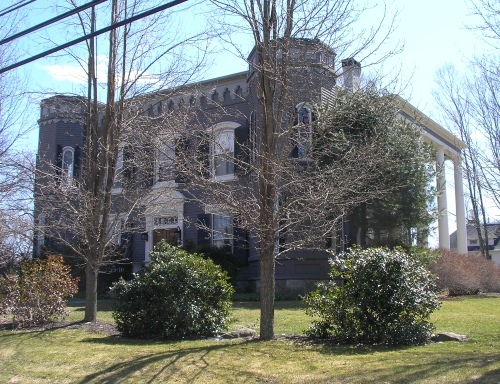
The Charles T. Woodruff House is a Gothic Revival-style residence at 7 Woodbury Road in Watertown. It was built in 1859. Charles T. Woodruff invested heavily in Watertown’s industries.

Dating to 1775 (and probably later modified in the Federal style) is the home of Rev. John Rathbone (1729-1826) at 87 Water Street in Stonington. Rev. Rathbone was the first minister of the Baptist church in Stonington Borough, organized in 1775. According to the Brown Genealogy, Vol. II (1915), by Cyrus Henry Brown,
He was a Baptist, a patriot of the Revolution, member of the Stonington Committee of Correspondence and Inspection, and signer of the memorial to the Connecticut Assembly praying for cannon to protect the town of Stonington against the British attack on Long Point, in 1777. He organized the Baptist Church at Westford, Mass, in 1780, and became its first pastor, in 1781. He preached at Saratoga, NY, in his ninety-fifth year.

You must be logged in to post a comment.