David Brainerd House (1874)

David Brainerd House

The Mansard-roofed house at 127 Pearl Street in Thompsonville, Enfield, was built c. 1874-1880 for David Brainerd. As recorded in The Genealogy of the Brainerd-Brainard Family in America (1908), by Lucy Abigail Brainard, David Brainerd

was registrar of voters, notary public and justice of the peace, collector of taxes, and represented the town of Enfield in the state legislature in 1862. He was appointed assistant assessor of internal revenue in the first congressional district by Abraham Lincoln, in 1862, a position he held for nine successive years. He has always been active in politics and is a Republican and ready to aid in all advancement for improvements in town, school or church. He has been Elder in the First Presbyterian Church in Thompsonville, Conn., where he resided, and is honored for his sterling worth and noble character.

David Brainerd married Caroline King in 1844. After her death in 1859, he married his first wife’s sister, Henrietta King, who died in 1901. One of his sons, Horace, worked with his father in his agricultural warehouse business, then became purchasing agent for the Bigelow-Sanford Carpet Company, and later was manager of the Overbrook Carpet Company. In 1932, the house was acquired by the Masons, who converted for use by a Masonic Lodge and added a ballroom. In 2007, the house was purchased by Enfield Pearl Ballroom & Dance Studio. It was renovated to have four apartments and a ballroom studio, called the North American Dance Academy, which has two dance floors.

Lilley House (1926)

Lilley House

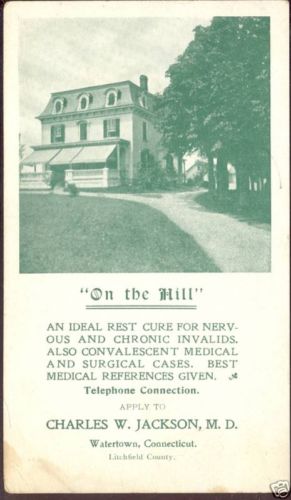
The Georgian/Colonial Revival mansion at 325 Woodbury Road in Watertown was built in 1926 for Theodore Lilley, son of Connecticut Governor George L. Lilley, who served from January 6 until April 21, 1909, when he died in office. The land for the house was purchased from Dr. Charles W. Jackson, who ran a sanatorium on Hamilton Avenue. Theodore Lilley (1888-1967), a graduate of Yale who became a developer in Waterbury, was married to Sylvia Page Lilley (1890-1970). The house has recently been restored.

Zaccharias Walker House (1691)

Zaccharias Walker House

A sign on the house at 337 Main Street South in Woodbury reads “Built by Zaccharias Walker 1691.” Also known as Zechariah or Zachary Walker, Rev. Zaccharias Walker led a group of religious dissidents from the church in Statford to found the town of Woodbury in 1673. He became the new town’s first Congregational minister. The house was probably built for Rev. Walker’s son, also named Zaccharias (Deacon Zachariah Walker). Born in Statford in 1670, he married Elizabeth Miner around 1689/1690, about a year before the house was built.

Stephen Spencer House (1754)

Stephen Spencer House

Built in 1754, the house at 43 Park Street in Guilford was originally home to Stephen Spencer, a blacksmith who had his forge on the south side of the house. In the 1840s and 1850s an upstairs room was rented for use as a schoolroom. In the 1870s, the south wing of the house was added by owner Daniel Auger. Elias Bates bought the house in 1894 and it remained in the Bates-Burton family for over a century.

Rev. Andrew Storrs House (1766)

Storrs House

Rev. Andrew Storrs was the second minister of the Plymouth Congregational Church. He built a house on the Green (4 Park Street), c. 1764-1766, where he lived during his pastorate of twenty years (he died in 1785). In front of the house, which once had a center chimney, is a sycamore tree that was planted by Rev. Storrs. The property also includes a large nineteenth-century barn. In 1853, Rev. Isaac Warren founded the Hart Female Seminary, which was located in the Storrs House and remained in operation until 1857. A wing, which Rev. Warren had added for the school, was later detached from the house to become a private residence (2 Park Street), serving as the Congregational parsonage after 1865. (more…)