Barbour-Cooper-Jensen Cottage (1905)

Jensen Cottage

The summer cottage at 9 Pettipaug Avenue in the Borough of Fenwick in Old Saybrook has been described as a gem that is “particularly illustrative of shingle style architecture” (by Christopher Little in “A Summer Place,” Places, Vol. 1, No. 3, 1984). It was built in 1905 by Lucius B. Barbour (1878-1934) of Hartford (whose 1865 house on Washington Street still survives). Their daughter Alice was a childhood friend of Katharine Hepburn. In 1953, after the death of Barbour’s widow Charlotte Cordelia Hilliard Barbour, the cottage was sold to Richard F. Cooper and in 1961 it was sold again to Oliver Jensen (1914-2005), a co-founder of American Heritage Magazine. He was also one of the founders and the chief visionary for the 1971 revival of the Connecticut Valley Railroad (today part of the Essex Steam Train and Riverboat attraction). You can read more about the cottage in Marion Hepburn Grant’s The Fenwick Story (Connecticut Historical Society, 1974), pages 110-114.

Rock Ledge (1913)

Rock Ledge

James A. Farell (1863-1941), who was president of U.S. Steel from 1911-1932, built a Tudor Revival mansion in Norwalk in 1911. Designed by Edward Moeller, the original half-timbered building building burned down in 1913 and a new mansion, designed by Tracy Walker and Leroy Ward, was constructed to replace it. A granite structure, the mansion was modeled on Elizabethan country homes, the architects having been sent to England at Farell’s expense to do research for the building. Called Rock Ledge, it was used as a summer home by Farell. The mansion’s later owners included the Sperry Rand Corporation, which developed the UNIVAC business computer on the property, and Hewitt Associates. Located at 40 Highland Avenue in Rowayton, The mansion is now owned by Graham Capital Management LP and is known as the Rock Ledge Financial Center.

Austin F. Williams House (1842)

Austin F. Williams House

Austin Williams was an abolitionist and conductor on the Underground Railroad in Farmington. In 1841 he constructed a building on his property where the Amistad captives stayed until their return to Africa. After their departure, he built his own house (127 Main Street) just to the southeast and converted the dormitory into a carriage house. After the Civil War, Williams was a director of the Freedman’s Bureau of New England and New York.

Greenfield Hill Congregational Church Parsonage (1874)

Greenfield Hill Congregational Church Parsonage

At 3192 Bronson Road in Fairfield is the parsonage of the Greenfield Hill Congregational Church. It is a Greek Revival residence built in 1874. As related in Ye Church and Parish of Greenfield (1913), by George H. Merwin:

About the time Mr. Smith accepted the call to Greenfield, the parsonage matter was agitated again, perhaps to some extent due to the suggestion in the pastor’s letter of acceptance in regard to a home “for himself and family free from rent.” A committee consisting of Morris M. Merwin and Oliver Burr was appointed to investigate the matter. This committee, on June 24, 1873, reported that Dea. William B. Morehouse had that day purchased an acre of land of B. B. Banks for $1,000, and offered the same to the society for $400; and in addition Dea. Morehouse offered $1,000 more as his subscription towards a building. Other subscriptions were coming in rapidly, and the parsonage question was now solved. The following were appointed as a building committee: Oliver Burr, M. M. Merwin, Rev. H. B. Smith, Dea. W. B. Morehouse and Dea. N. B. Hill. Work was started at once by the contractor, Mr. Uriah Perry, but the building was not entirely completed until the spring of 1874, the pastor’s family living in the meantime in the small house owned by Mr. B. B. Banks.

Some of the items of expense in connection with the building of the parsonage are these:

  • One and one-fourth acres land $1300.
  • Contract for house $3575.
  • Extras on house $150.
  • Barns and out-buildings $405.
  • Well, etc. (dug by Joel Banks) $231.
  • Fences, painting, etc. $325.
  • Flagging stone, drain, etc. $200.

A vote of the society ordered that no more be spent on the parsonage than should be subscribed for that purpose, so no indebtedness was incurred.

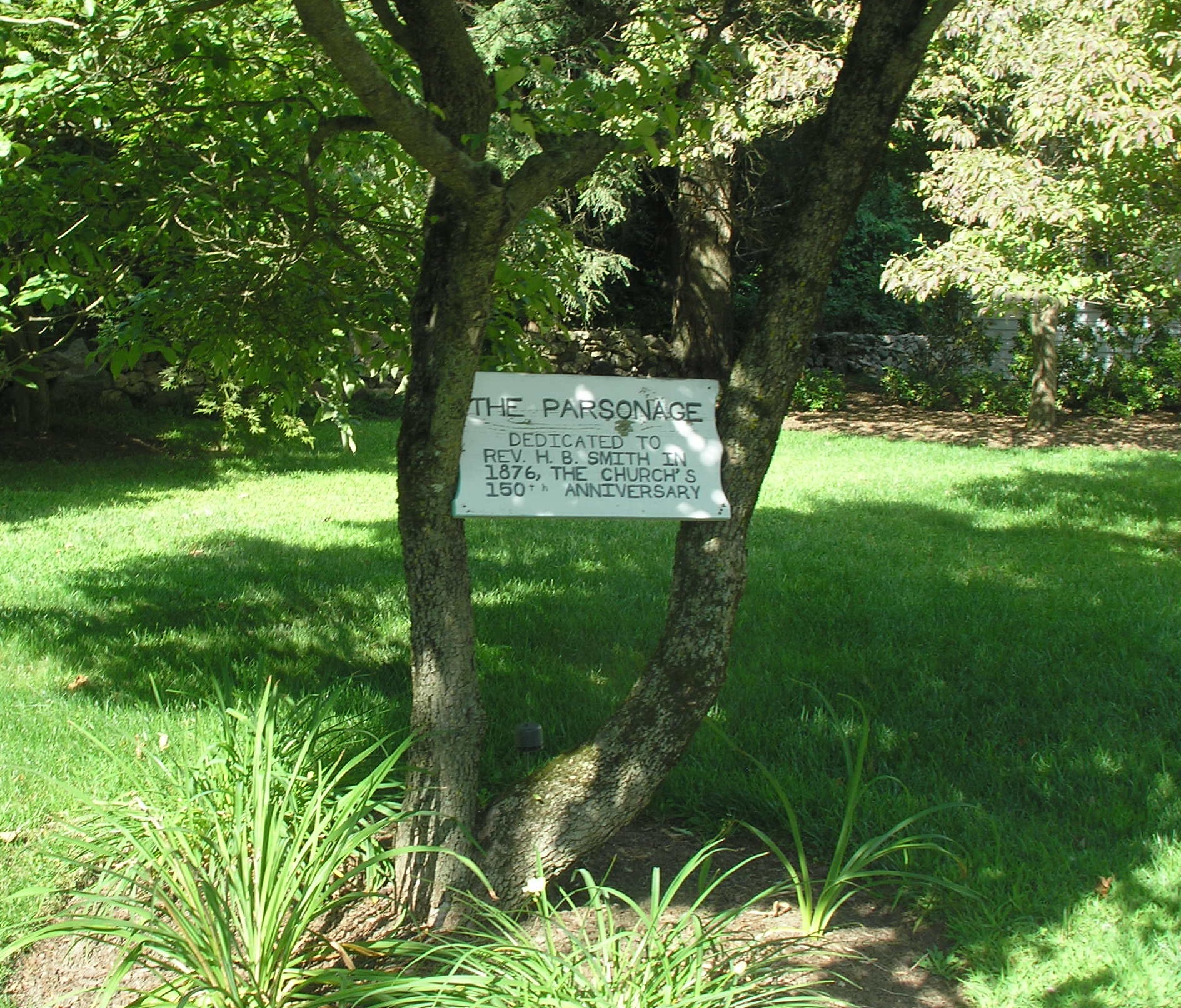
A sign on a tree on the Parsonage property reads:

The Parsonage
Dedicated to
Rev. H.B. Smith in
1876, the Church’s
150th Anniversary