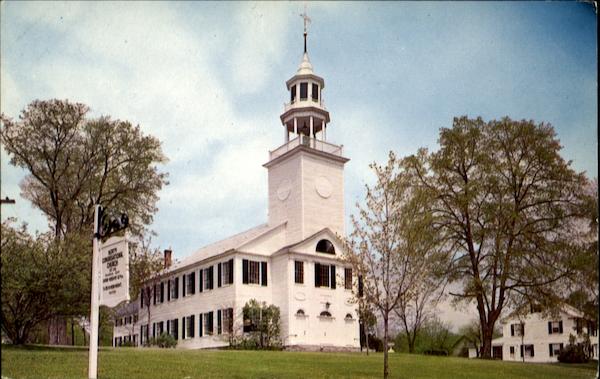
North Congregational Church Parsonage, Woodbury (1828)

North Congregational Church Parsonage

Next to the North Congregational Church in Woodbury is the church parsonage. It was built circa 1828-1829 as a residence by Leman Sherman, who died in 1831. It passed through other owners until 1871, when it became the parsonage and has been a home to the ministers of North Church ever since. The parsonage, which was in danger of collapsing, was extensively restored and the interior modernized in 2012-2013.

Stone Store – Church House (1773)

10 Kirby Rd., Washington, CT

The building at 10 Kirby Road, on the Green in Washington, was built in 1773 as the store of Joel and Leman Stone, who lived in the “Red House” just to the east. Joel was a loyalist and Leman was a Patriot. After 1811 the store was converted into a one-and-a-half story house for Bennett G. Fenn (1800-1834) and his wife Phebe Susannah Gunn, who was the sister of Frederick W. Gunn, founder of The Gunnery school. Henry James Church acquired the house in 1861. He expanded it to two-and-a-half stories and built an ell on the south side. The house remained in the Church family until 1961. A recent realty listing describes the house as the “Edward Church House.” perhaps a reference to Henry James Church’s son Edward W. Church (1863-1941).

Ashlawn (1790)

Ashlawn

At the intersection of Potash Hill Road and Westminster Road in Sprague is a house built in the eighteenth century (c. 1790) by Joshua Perkins (1740-1832). It is known as Ashlawn for the ash trees that once stood in front of the house. The rear ell was built c. 1740 (second quarter of the eighteenth century), probably by Joshua Perkins’s father, Captain Matthew Perkins (1713-1773). Both men were prominent farmers and members of the Hanover Society (Congregational Church). Ashlawn‘s nomination form for the National Register of Historic Places gives its address as 1 Potash Hill Road, but the house‘s address is now 179 Potash Hill Road.

Col. Joshua Huntington House (1771)

Colonel Joshua Huntington House

Colonel Joshua Huntington (1751-1821), a merchant and ship owner, occupied the house at 11 Huntington Lane in Norwich, built for him by his father, Jabez Huntington, in 1771. During the Revolution Joshua Huntington served as a Lieutenant in the militia at Bunker Hill. He also outfitted privateers to attack British ships. He was an agent for Wadsworth & Carter of Hartford, engaged in supplying the French army at Newport with provisions, and he had charge of the prizes sent by the French navy to Connecticut. He is described by Lydia Huntley Sigourney in Letters of Life (1866):

Colonel Joshua Huntington had one of the most benign countenances I ever remember to have seen. His calm, beautiful brow was an index of his temper and life. Let who would be disturbed or irritated, he was not the man. He regarded with such kindness as the Gospel teaches the whole human family. At his own fair fireside, surrounded by loving, congenial spirits, and in all social intercourse, he was the same serene and revered Christian philosopher.