First National Bank, Hartford (1899)

The State House Square building complex, located just north of the Old State House in Hartford, was completed in 1985. It is the latest structure to occupy a block of state street which has had a number of interesting buildings over the years. Near the end of the nineteenth century, the First National Bank occupied the right end of a commercial block that also included the United States Hotel. Adjacent on the east was the 1834 Greek Revival building of the Hartford National Bank. From 1896 to 1899, the First National Bank moved to a temporary location on Main Street while its new building was constructed. Designed by Ernest Flagg and completed in 1899, the Beaux Arts-style Fist National Bank building had a fireproof construction consisting of steel structural columns and cinder-covered brick vaults under the floors. The facade of the building has survived to become part of State House Square.

Chase Brass & Copper Company Headquarters (1919)

Designed in 1916 by Cass Gilbert and constructed between 1917 and 1919, the former headquarters building of the Chase Brass & Copper Company is located on Grand Street in Waterbury, opposite the city hall, which was also designed by Gilbert. Both buildings were part of a plan of development for Waterbury by the Chase Company’s president, Henry S. Chase, who died in 1918, a year before his company’s office building was completed. He was succeeded as president by his brother, Frederick. The Chase brothers had rejected the use of brick for the new building, so that it would contrast with the colonial style of the nearby city hall. The company left Waterbury in the 1960s, selling the building to preservationists in 1963 for one dollar. In 1966, it was purchased by the city for use as offices and is now known as the Chase Municipal Building.

Apothecaries Hall Building (1894)

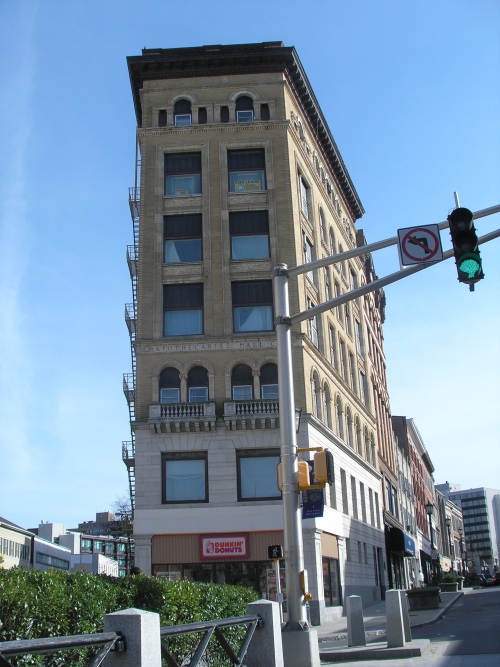
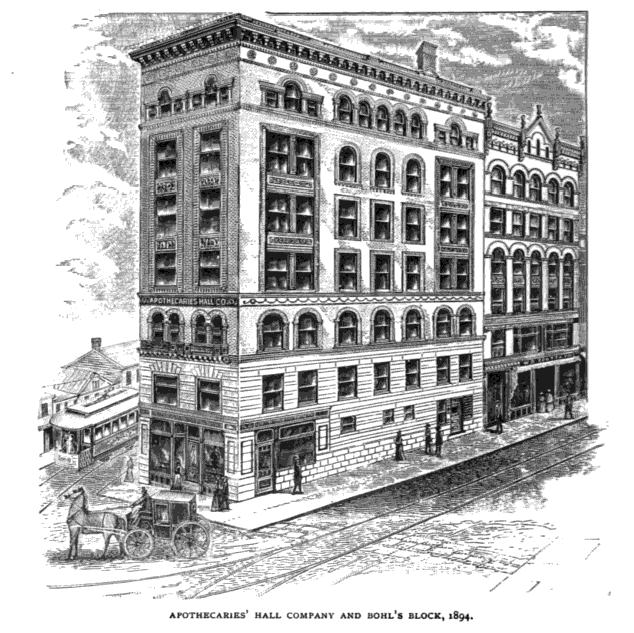
Another Waterbury landmark is the Apothecaries Hall Company building, a “flatiron” structure, located at Exchange Place, where several important city thoroughfares intersect. In 1849, Dr. Gideon L. Pratt opened a drugstore at Exchange Place in a Greek Revival-style building that had been built in 1829 by by Benedict and Coe as a general store. Called Apothecaries Hall, the business continued and grew under various owners for many years. In 1892, the original building was torn down and replaced, at the same spot, by the current structure in 1894. Designed by Theodore Peck, the Renaissance Revival building is constructed of marble, granite and Roman brick.

Putnam Building, Hartford (1860)

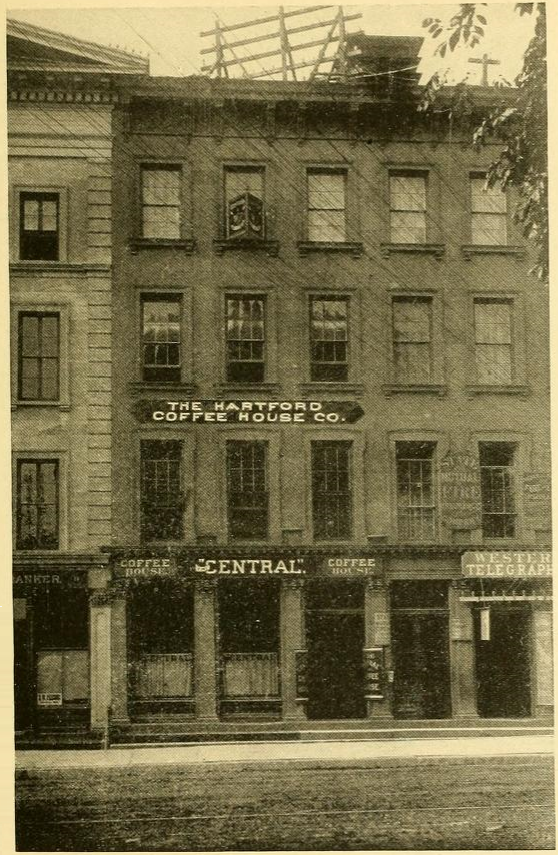
The Putnam Building is on Central Row in Hartford, sandwiched between two early skyscrapers, the Hartford-Connecticut Trust Company building of 1920, on the right, and the Travelers Insurance Company building of 1928, on the left. Built around 1860, the Putnam Building is typical of the many brownstone commercial buildings, influenced by the style of the Italian Renaissance, that were constructed in downtown Hartford at the time. A historic photo in the collection of the Connecticut Historical Society shows the building in 1904, with the two skyscrapers’ predecessors on either side of it: the old Hartford Trust Company building on the right and the Marble Block on the left. Another historic photograph, found in the 1895 book, Hartford and its Points of Interest, shows the building when the Hartford Coffee House Co. was one of its tenants.

The presence of the Putnam Building was acknowledged when the Hartford Trust Company skyscraper was built (to the right) in 1920, as the limestone base section of that later building matches the height of its nineteenth-century neighbor. In turn, the ground floor of the Putnam building was remodeled in granite in the 1920s, reflecting the style of the then recently built adjacent structure.

Holmes Building (1904)

Located along a row of commercial buildings, across from the post office on Grand Street in Waterbury, is the Holmes Building, constructed in 1903-1904. It was one of many structures built in the area after the devastating Waterbury Fire of 1902. The building was home to C.L. Holmes & Company, which became Holmes and Burr in 1905. As described in the History of Waterbury and the Naugatuck Valley, vol 3 (1918), “The building is a three story structure with sixty foot frontage on Grand street, the upper stories being used for offices, while a part of the lower story is occupied by the Waterbury Trust Company. The firm of Holmes & Bull conducts a general brokerage business, handling investment securities, and they have an extensive clientage.” The Waterbury Trust Company, established in 1907 with C.L. Holmes as its president, eventually gave its name to the entire building. The Elks Club occupied rooms in the building until the Lodge constructed the a new Home in 1910. The WBRY radio studios were also in the building in the early 1940s.

New Britain National Bank (1927)

The New Britain National Bank building is on on West Main Street, next to the buildings which now serve as New Britain’s City Hall. It was built for the Commercial Trust Company in 1927, which failed during the Great Depression and was bought out by the New Britain National Bank in the 1930s. The building, which is also known as the Anvil Bank for the anvil motif which recurs frequently in its intricate brickwork, was designed in the Romanesque Revival style, with some Gothic elements as well. The bronze doors feature designs of beehives and Mercury and Buffalo coins. The building’s interior is also impressive: the lobby makes use of marble and bronze and has a 30-foot ceiling. The structure has been mostly vacant since 1996 and has suffered from deferred maintenance. After several years of planning to restore and adapt the bank building to new uses, work began a few years ago to covert it for stores and residential units, although progress was later halted by the economic downturn.

Charter Oak Bank (1861)


In the nineteenth century, many brownstone-faced commercial buildings were constructed in downtown Hartford. Most of these have since been demolished, but the Italianate building at the northeast corner of Asylum and Trumbull Streets survives. The ground floor has been altered, but the floors above have original brownstone moldings over the regularly-spaced windows, a different design for each floor. The building was constructed in 1861 for the Chater Oak Bank, which occupied it until 1915, being succeeded by City Bank, which closed in 1932.

YouTube player