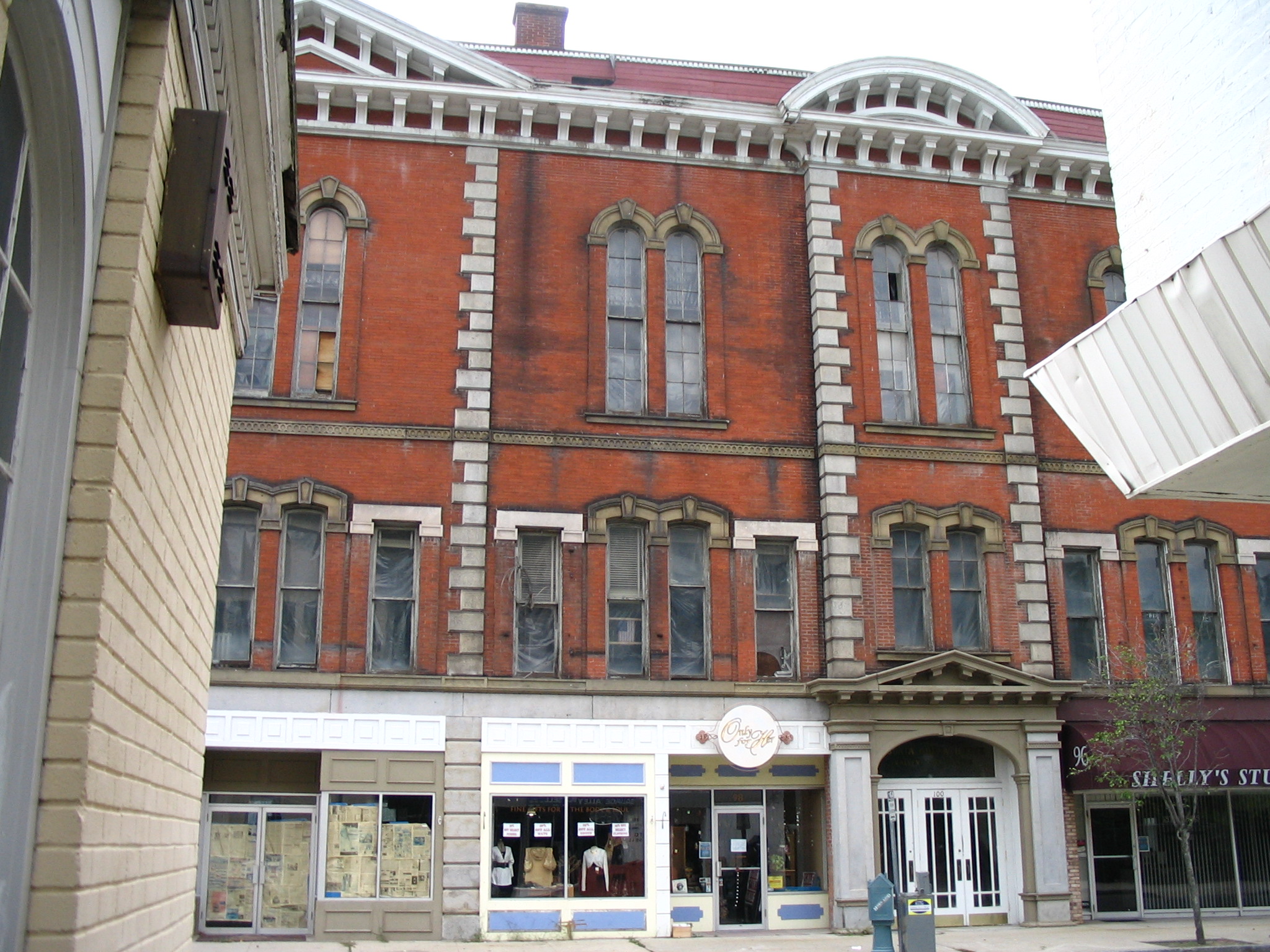
Ansonia Opera House (1870)

Built at 100 Main Street in Ansonia in 1869-1870, the Ansonia Opera House served as the lower Naugatuck Velley’s premier theater and public hall until the Sterling Opera House was built in Derby in 1889. The Ansonia Opera House’s hall is on the third floor of the the building, while stores are located on the first floor. Until 1910, the hall was run by a corporation called the Ansonia Hall Company, in which Jeremiah Bartholomew and his descendants held a controlling interest. Connecticut’s oldest opera house, for sixty years it was the center of Ansonia’s civic and social activity and entertainment, including graduations, dances, recitals, basketball games and boxing matches. Sometime after 1896, additional windows were added to the building‘s second floor. In 1971, the state fire marshal’s office closed the hall to public assemblies. It was later rented out as a gym and then as storage space and is currently in need of restoration.

Hotchkiss Block (1894)

The Hotchkiss Block is a late-nineteenth-century commercial/residential building at 598-614 Main Street in Middletown. A large structure, it has Renaissance Revival elements and its impressive roof cornice, bay windows and first floor cornice are clad in pressed metal. The building is named for Frederick Hotchkiss, who built it c. 1894 and whose family owned it until 1919. It was then owned by Israel Mittleman, whose ground-floor clothing store had been in the building since 1910.

Ward-Cody Building (1890)

This week the focus is on buildings in Middletown. The Ward-Cody Building, at 502-508 Main Street, is one of many surviving Victorian commercial buildings in downtown Middletown. It was built in 1889 or 1890 by George N. Ward, who developed much of the north section of Main Street in the later nineteenth century. In 1919, the building was purchased by Richard E. Cody, whose shoe store was located here for many decades. A marker on the building notes that this was, on November 26, 1899, the birthplace of Major General Maurice Rose, a son and grandson of rabbis, who was commander of the Third Armored Division (“Spearhead”) in World War II. On March 30, 1945, Rose became the highest-ranking American to be killed by enemy fire in the War’s European Theater of Operations.

Flatiron Building, Hartford (1896)

This is my 200th Hartford Post! To celebrate this milestone, I’m announcing that I have a book coming out later this summer called A Guide to Historic Hartford, Connecticut, published by The History Press.

Please watch this site for more announcements soon and “like” the Facebook page for the book:
http://www.facebook.com/AGuideToHistoricHartfordConnecticut

Also visit the site I’ve created for the book at
http://guidetohistorichartford.historicbuildingsct.com/.

The Flatiron Building in the above picture (called flatiron for its distinctive shape, resembling the famous Flatiron Building in New York City) is at 529-543 Ann Uccello Street in Hartford, between Ann and High Streets. The Neoclassical Revival commercial structure was designed by Frederick R. Comstock and was built in 1896. It has been vacant since a fire in 2004.

Barnum-Thompson and Staples Buildings (1892)

On State Street in Bridgeport are two connected Queen Anne-style buildings constructed in 1892. The Barnum-Thompson Building, at 177-181 State Street, and the Staples Building, at 189 State Street, were designed by George Longstaff. This was the last structure contracted by P.T. Barnum before his death in 1891. A section of the building facing Court Street (now Markle Court) was razed for a parking lot by People’s Savings Bank in 1941. A recent tenant, for a decade at 177 State Street, was Playhouse on the Green.

Steamboat Dock, Essex (1878)

The old Steamboat Dock in Essex was built in 1878 by Phoebe Hayden, widow of William S. Hayden. Originally a warehouse and general store, the building has been used for various purposes over the years. In 1944, it was acquired by the Lovell family, owners of the nearby Griswold Inn, who put a restaurant on the second floor. After they sold the building in 1962, it began to fall into disrepair, but was eventually saved and converted to become home to the Connecticut River Museum. The building’s roof was damaged by a fire in 2010. The museum has since been fully repaired and restored.

Scottish Union and National Insurance Company (1913)

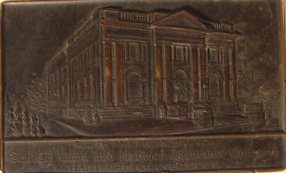
Now used by Connecticut’s Appellate Court, the building at 75 Elm Street in Hartford was built in 1913 as the American headquarters of the Scottish Union and National Insurance Company. The Scottish Union Insurance Company was established in 1833 and merged with the Scottish National Insurance Company in 1877. The building, later used as state offices, was designed by Edward T. Hapgood.