
The two-story apartment building at 2050-2052 Park Street in Hartford is constructed of contrasting tawny brick and has a corner storefront. It was designed by Burton A. Sellow and was built in 1917.
The two-story apartment building at 2050-2052 Park Street in Hartford is constructed of contrasting tawny brick and has a corner storefront. It was designed by Burton A. Sellow and was built in 1917.

In the post-Revolutionary War era, the Upper Wharves at Brewster Street were the commercial center of the trading port of Black Rock in Bridgeport. The oldest surviving storehouse from that period is at 51 Brewster Street. Built in 1772, it has been greatly altered since then. It was built by the partners Samuel Smedley and Samuel Sturges. Both men were patriots during the Revolutionary War, Smedley being a prominent privateer. Later used as a residence, the old storehouse was purchased by the Fayerweather Yacht Club in 1937 to become their clubhouse.

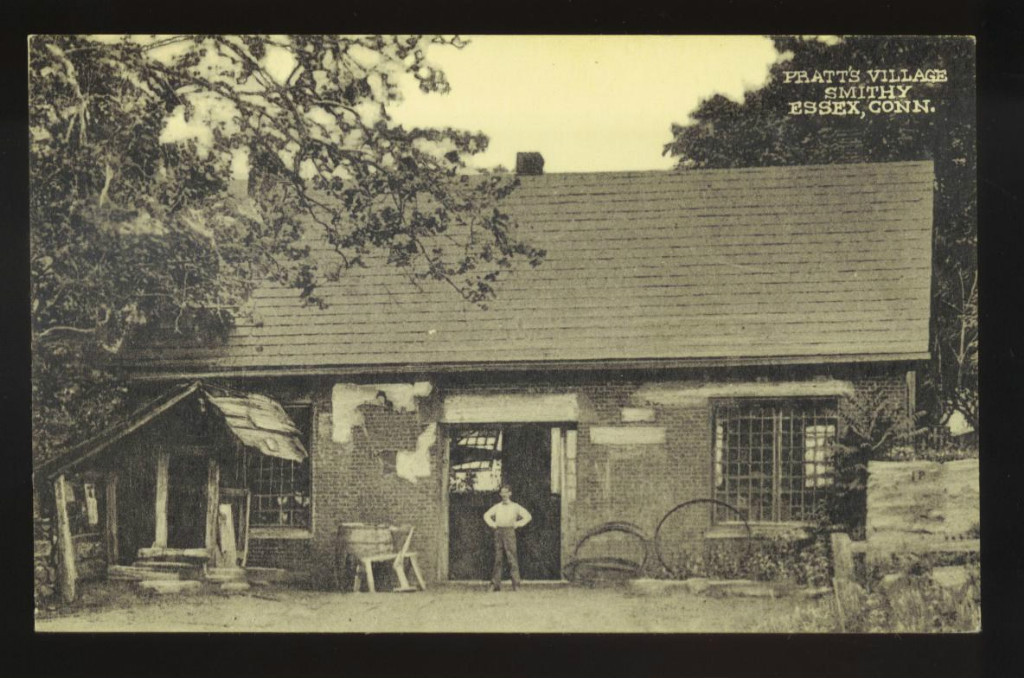
Several generations of the Pratt family continuously operated a smithy in Essex for almost three centuries. It was established by John Pratt, Sr., who began his shop in Saybrook and then moved it to Essex. His son, John Pratt, Jr., was a part-time blacksmith who built the Pratt Homestead in Essex. Next to operate the smithy was Lt. John Pratt, who passed it to his son Asa Pratt, followed by Asa’s son John Pratt, John’s son Elias Pratt, Elias’s son Edwin Pratt, James Lord Pratt (who was featured in the September, 1938 issue of National Geographic Magazine) and finally James’s nephew Edwin Pratt, who closed the smithy due to difficulties obtaining raw materials during World War II. At that time it had been the oldest continuously run family business in America. The old smithy building that survives today was built in 1848 by Elias Pratt. After the smithy closed, the building was used for various different businesses.

One of the many buildings constructed in the wake of the 1902 fire in downtown Waterbury (or was it built in 1900, before the fire?) is the Mullings Building at 95-103 Bank Street. It was originally home to John Mullings‘s clothing store.

Founded in 1857 by D.M. Read, Read’s Department Store in Bridgeport became a retail landmark, evolving into a chain of stores that provided upscale merchandise for over a century. In 1869, the D.M. Read Company moved into a grand Second Empire-style building at the corner of Main Street and Fairfield Avenue in Bridgeport. The store moved again in 1925-1926 into a Neoclassical building at the corner of John and Broad Streets. It was designed by Monks and Johnson of Boston. The downtown Bridgeport store was closed in 1981. In the 1990s, the building, now called Read’s Artspace or Sterling Market Lofts, was converted into apartments for artists as live-work spaces.

Built in 1927, the Langrock Building, at 268 York Street in New Haven was designed to fit in with the architecture of neighboring Yale University. The building, designed by Jacob Weinstein, was built by David T. Langrock to house his men’s clothing store. At the time, New Haven had become a center of custom tailoring shops. Langrock also had other clothing shops near Ivy League schools, in Princeton and Harvard Square. Although bankrupt at the time of his death, Langrock owned real estate in Providence, Rhode Island, which was sold. Part of the funds were used to establish the David T. Langrock Foundation. In 1982, the Foundation established The David T. Langrock Old Masters Art Fund, which promotes classical art and the study of classical art in the Greater New Haven area. The Langrock Building has housed many businesses over the years.

On the northeast corner of New Haven Green, at 205 Church Street, is the Union and New Haven Trust Building, built in 1927-1928. It was designed by Cross and Cross of New York to reflect the architecture of the three churches on the Green. The cupola mirrors that of United Church on the Green. The Union Trust Company moved its headquarters to Stamford in 1981, but a branch office was maintained on the ground floor of the building. After various acquisitions and mergers it is now a Wells Fargo branch. The above picture was taken when the building was undergoing restoration work.


You must be logged in to post a comment.