Ives Building (1877)

Ives Building

The brick commercial building at 2977 Whitney Avenue in Hamden was built in 1877 (or possibly earlier, circa 1853, unless it replaced an earlier building on the site) by James Ives (1815-1889). A prominent manufacturer and developer of local business, Ives operated a factory, built by his father Elam Ives, on the Farmington Canal that produced brass carriage hardware. He later built a new factory on the Mill River. He also engaged in other manufacturing endeavors, including the Mt. Carmel Screw Works. The area around the factory was known as Ivesville and the intersection of Whitney Avenue and Ives Street, where the Ives Building is located, is known as Ives Corner. Ives rented out the building as a general store. There was also a post office, where Ives’ brother Lucius was postmaster, and a meeting hall in the building. After 1913, the building was home for many years to Levine’s Market. In 1934, Sydney Levine devoted a section of the market to the sale of alcoholic beverages, a business which has since grown into today’s Mt. Carmel Wine and Spirits. (more…)

Roderick Block, Baltic (1898)

Roderick Block

The Roderick Block is a “flatiron”-shaped Victorian Eclectic commercial building in the industrial village of Baltic in Sprague. It was built in 1898 by Raymond J. Jodoin, a businessman who was Baltic’s largest landowner. He also served several terms as Sprague’s First Selectman and in the state legislature. Born in St. Hyacinth, Quebec, Jodoin‘s family came to Baltic in 1865, when he was seven weeks old, during a period of mass immigration of French-Canadians. According to the Legislative History and Souvenir of Connecticut, Vol. VII (1910):

At the age of nine years he went to work in the mill at Baltic. He saved his earnings until he was able to buy a small livery stock and successfully conducted this business several years. In April, 1888, Mr. Jodoin went to Providence, where he secured a position as traveling salesman in the wholesale grocery house of Waldron Wightman & Co. He remained with them ten years and then accepted a similar position with Daniels & Cornell, of Providence, with whom he has since remained. His territory covers Eastern Connecticut. Southern Massachusetts and Western Rhode Island.

As related in an article in the Bridgeport Herald of April 3, 1910 (“Representative Jodoin Urged for Democratic State Ticket”):

Mr. Jodoin is much attached to his home village, Baltic, and some years ago when he began to invest his savings in real estate there, he met with dark phrophesies of financial loss from all his friends, but his judgment has been justified since by the increase in the value of his investments. He is one of the heaviest individual owners of real estate in the town, and has been found always ready to back any movement that promised to be of advantage to the place. Throughout the village are seen many evidences of his public spirit, and he is most popular with all classes. Kindly and charitable, he is ever ready to help those less fortunate, but with his characteristic modesty he dislikes to have his good deeds known.

Jodoin and his wife, Azilda Bourque, adopted two children, Antonia and Roderick (1894-1982). The Roderick Block was named for his son. (more…)

Danforth Pewter Shop (1756)

Thomas Danforth Pewter Shop

As described in yesterday’s post, Thomas Danforth I (1703-1786) was a prominent maker of pewter in Norwich. One of his sons, also named Thomas, established himself as a pewterer in Middletown in 1756. He handcrafted pewter in a combination workshop and store that was originally located in an artisans’ neighborhood along Henshaw Lane, now called College Street. Thomas Danforth II (1731-1782) had six sons who became pewterers. A grandson continued the trade in Middletown until 1846. The Danforth Pewter Shop was dismantled in 1979, when its College Street location was slated to become a parking lot. It was reassembled a few years later next to 11 South Main Street, at the intersection of South Main, Pleasant and Church Streets, near Union Green. The former pewter shop is privately owned and not open to the public.

Stueck Building (1893)

Stueck Block, Middletown

One of the surviving nineteenth-century commercial buildings on Main Street in Middletown is the Stueck Building, built in 1893 (or perhaps as early as 1880?) at nos. 460 to 470. The building was constructed by Jacob W. Stueck, who operated a bakery. In 1914, his son, Philip Stueck, constructed an attached building on Washington Street that was home to a restaurant called Stueck’s Modern Tavern.

Dutchland Farms Windmill (1932)

Windmill

When the Lord & Taylor at Bishops Corner in West Hartford (later a Caldors and now the location of Marshalls and other stoes) was built in the early 1950s, it replaced the Dutchland Farms restaurant and ice cream shop (which by then was known as Dutchland City). The restaurant’s building was notable for the prominent windmill above its front entrance. The building was taken down, but the windmill survives. An article in the Hartford Courant of July 13, 1952 (“Bishop’s Corners Windmill Moved To Pool At Nursery”) describes how the seven ton windmill was removed from atop the building and transported to its current home at Gledhill Nursery, 660 Mountain Road in West Hartford. The article notes that the windmill had been a familiar site for 20 years, so it would have been built c. 1932. Dutchland Farms was a chain and some of its other restaurants also featured ornamental windmills of various sizes.

Hartford National Bank & Trust Company (1967)

777 Main Street

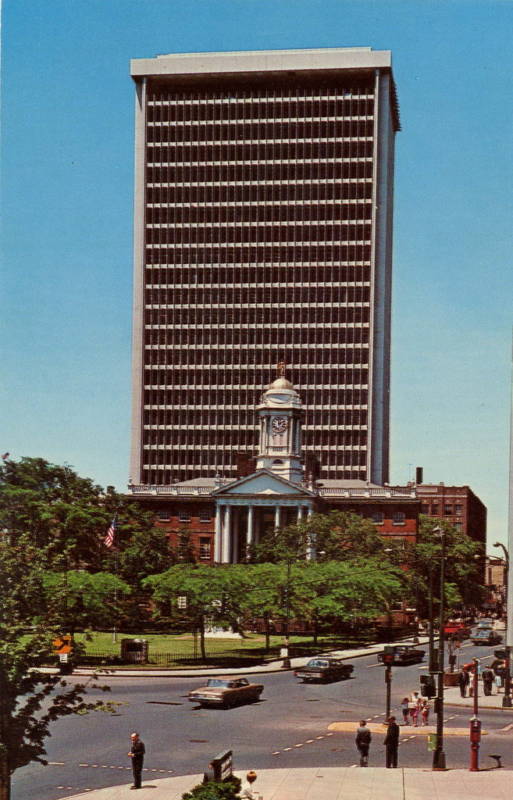
The twenty-six-floor office tower at 777 Main Street in Hartford (at the corner of Pearl Street) was built between 1964 and 1967 as the headquarters of the Hartford National Bank & Trust Company. The city’s oldest bank, the Hartford National Bank, had its origins on this very same block back in 1792. From 1811 to 1912, the bank was located in a Greek Revival building on State Street. It then moved to a new building (demolished in 1990) at the corner of Main and Asylum Streets (considered to be Hartford’s first skyscraper). In 1915 it became the Hartford-Aetna National Bank. It merged with the United States Security Trust Company in 1927 to become the Hartford National Bank and Trust. At that point, the bank moved to the United States Security Trust Company’s building, located at the corner of Main and Pearl, which had been built for the Connecticut Mutual Life Insurance Company in 1870. This building was demolished in 1964, along with the neighboring State Bank and Phoenix Bank buildings, to make way for the current office tower on the site. Designed by Welton Becket and Associates of New York, the building has gone by several names through various bank mergers: Shawmut, Fleet and, most recently, Bank of America. Vacant since 2011 and up for sale, plans are being discussed to convert the building into into mixed-income apartments.