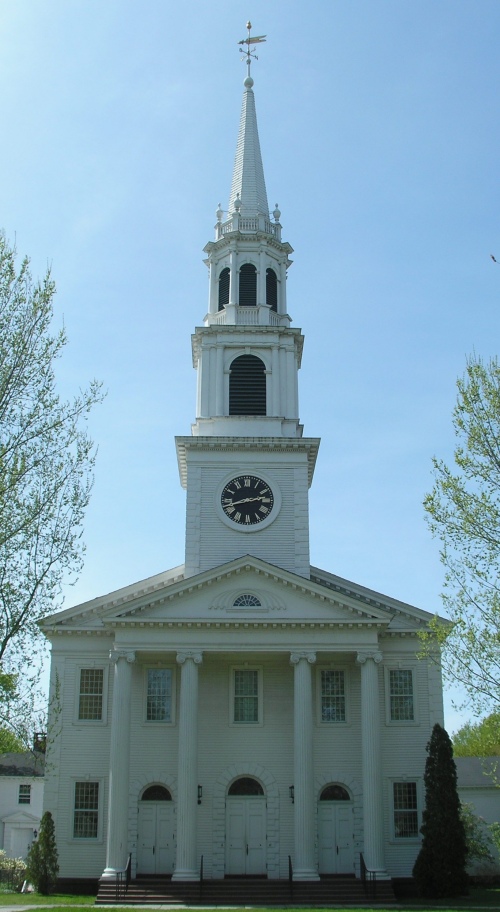
First Congregational Church of Coventry (1849)

first-congregational-church-coventry.jpg

The first Congregational meetinghouse in Coventry was built on the green in 1715. In 1842, the congregation became divided over the issue of whether to build a new church or retain the original structure. One group built the current church building, known as the “Village Church,” on Main Street in 1849, while the other repaired the original building and turned it to face the green. The two churches coexisted separately until they were reunited in 1869, thenceforward using the 1849 building, now called First Church. The steeple was destroyed by lightning in 1903 and a replacement was soon constructed.

Collinsville Congregational Church (1858)

collinsville-congregational-church.jpg

The Collins Company paid for the construction of the first Collinsville Congregational Church building in 1836. It was built as part of Collinsville, the village set up in South Canton by Samuel Collins for his workers. When the original church burned in 1857, the company again provided funds (added to the insurance settlement), as did Sam Collins and others in the village. The new Greek Revival-style Collinsville Congregational Church was completed in 1858.

First Church of Christ, Simsbury (1830)

first-church-simsbury.jpg

The first meeting house in Simsbury was built in 1683. In 1736 there were lengthy debates over where to build a new and larger second meeting house, which was eventually constructed on Drake’s Hill. Construction commenced in 1740, but in 1743 services began in what was still an unfinished building, only completed in 1777. This was replaced by the current church, at the same location, in 1830. The minister at the time was Rev. Allen McLean, whose grandson, George Payne McLean was later a senator and governor of Connecticut. The First Church of Christ in Simsbury has undergone various restorations and several additions over the years.

First Congregational Church, Canton Center (1814)

first-church-canton-center.jpg

A separate Ecclesiastical Society for western Simsbury was established in 1750, although a meetinghouse was not constructed until 1763. In 1806, it became the First Ecclesiastical Society of Canton when that section of Simsbury was incorporated as its own town. In 1814, a second and larger meetinghouse was constructed on the site of the first, on Cherry Brook Road in Canton Center. In 1873, the church was remodeled inside and Gothic stained glass windows were added. Since 1967, the windows and interior have been restored to an approximation of the earlier style. The church’s address is 184 Cherry Brook Road.

Also, if you have not yet read my latest article on architecture, it is now available! The subject is Greek Revival Houses!

First Congregational Church of Old Lyme (1910)

First Congregational Church of Old Lyme

Lyme’s First Ecclesiastical Society‘s first Meeting House was constructed in 1665-6 and the first minister was Moses Noyes. A second was built in 1689 and in 1738, both earlier structures were dismantled to build the even larger third Meeting House. All three were located on Johnny Cake Hill. When the third church was destroyed after being hit by lightning in 1815, the fourth Meeting House was built in 1816-17 on Lyme Street in Old Lyme. Its architect was Samuel Belcher, who also designed the John Sill and William Noyes houses on Lyme Street. The fourth Meeting House burned on July 3, 1907–the 92nd anniversary of the burning of the third meetinghouse. It was replaced in 1910 by the current Meeting House of the First Congregational Church of Old Lyme, a replica of its predecessor. The American impressionist artists who frequented Lyme in the early twentieth century often painted the church, most notably Childe Hassam.

First Congregational Church of Litchfield (1829)

first-congregational-church-of-litchfield.jpg

Litchfield‘s first meeting house was built on the Green in 1723, the second in 1761 and the third in 1829. In 1873, a fourth church, in the High Victorian Gothic style, was built and the 1829 Federal-style structure, with its steeple removed as was typically done with deconsecrated churches, was moved around the corner. In the coming years it would serve as a community center and theater, known as Amory Hall or Colonial Hall. In the early twentieth century, tastes had shifted back from favoring the Gothic to an interest in the Colonial Revival. In 1929, the Gothic church was demolished and the 1828 church returned to its original site on Torrington Road and restored, complete with a new steeple (1929-30). Reconsecrated, it continues today as the First Congregational Church of Litchfield.