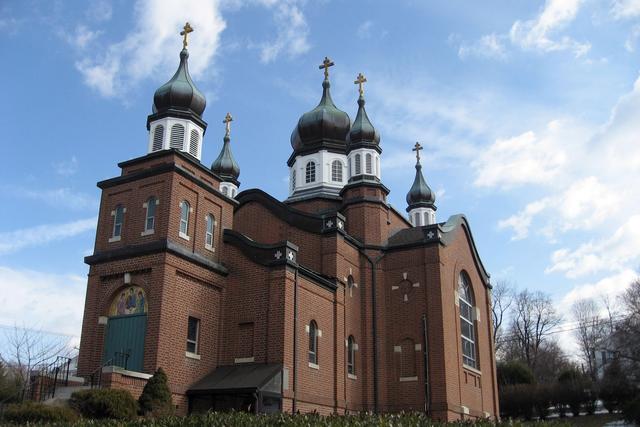
St Josaphat’s Ukrainian Catholic Church (1975)

st-josaphats-ukrainian-catholic-church.jpg

In 1951, a time of Soviet persecution of Ukrainian Catholics in their homeland, Ukrainian exiles settling in the New Britain area founded Saint Josephat’s Ukrainian Catholic Parish. The growth of the parish led to the purchase, in 1955, of a former Assyrian Church on Beatty Street, soon enlarged with materials from a dismantled six-family building from East Hartford, that had been purchased by the parish. In 1966, a house was purchased on Eddy Glover Boulevard to become a rectory and, in 1974, there was a ground breaking on the same Boulevard for the building of a new church. The church was designed by the James P. Cassidy architectural firm of West Hartford and parishioners of St. Josephat’s provided most of the labor for its construction. Completed in 1975, the church has three gold and blue domes, copied from those in St. Sophia Church of Holy Wisdom in Kyiv, the capital of Ukraine. In 1985, St. Josaphat’s Ukrainian Catholic parish and St. Mary’s Ukrainian Orthodox parish worked together in having a new section of Route 9 through New Britain named the Taras Shevchenko Expressway, in honor of the great Ukrainian poet. In 1991, the parish celebrated the independence of Ukraine from the old Soviet Union.

Deep River Congregational Church (1834)

deep-river-congregational-church.jpg

The Saybrook Colony, later the town of Saybrook, eventually divided into several towns. Lyme broke off as early as 1655, with Chester, Westbrook, Essex and Old Saybrook (the earliest settled area of Saybrook) following in the nineteenth century. The second Congregational Church to be founded in what had been the Saybrook Colony (and the earliest in what is now the town of the Essex) was established in Centerbrook in the 1720s. The residents of the area of Saybrook called Deep River attended this church until 1833 (Centerbrook remained part of the town of Saybrook until it was added to Essex in 1859). Deep River’s own Congregational Church was built in 1833. Worship was held in the church as soon as it was completed, although it was not officially dedicated until it was entirely paid for the following year. The town of Saybrook was renamed Deep River in 1947. Earlier this year, the Church celebrated its 175th anniversary.

First Church of Christ in Saybrook (1840)

first-church-saybrook.jpg

Saybrook Colony was established in 1635 at the mouth of the Connecticut River. It was Connecticut‘s third oldest settlement and first military fortification. A fort was constructed at Saybrook Point and in 1646 the Congregational Church was founded in the Great Hall of Fort Saybrook. The congregation’s first two meeting houses were built at Saybrook Point, the first in 1647 and the second in 1681. The third meeting house was built in 1726, further north in Old Saybrook on the Church Green. It’s steeple was only added in 1793 and a bell in 1794. This church was taken down in 1840 and the fourth church building was constructed across the street. Greek Revival in its style, the First Church of Christ in Saybrook was one of the first prefab churches in the country. The church was extensively renovated in 1977.

Saint Mary’s Ukrainian Orthodox Church (1911)

st-marys-ukrainian-orthodox-church.jpg

The origins of St. Mary’s Ukrainian Orthodox Church in New Britain go back to the late nineteenth century (New Britain’s first Ukrainian immigrant arrived in 1889). Many of the Ukrainians who settled in New Britain and elsewhere in the United States (such as the coal regions of eastern Pennsylvania) were from Transcarpathia and Galicia. Transcarpathia is a region of the Carpathian mountains which includes parts of modern Poland, Slovakia and Ukraine. Galicia (named after the city of Halych) is the western section of modern Ukraine. Early on, in New Britain, the Halychany (Galicians) attended Holy Trinity Byzantine Catholic Church, a Ruthenian Church, whose leadership and clergy were dominated by Carpatho-Rusyns, also known as Uhorsky Rusyny, or Rusyns (Ruthenians) who had been living in the Austro-Hungarian Empire under Hungarian rule. Conflicts between the two groups led to a riot in the church in 1908 and the decision of the Galicians the following year to form their own parish. Initially holding services in rented space in the basement of Sacred Heart Church on Broad Street, the new parish soon constructed St. Mary’s Ukrainian Orthodox Church, on the corner of Winter and Clark Streets. It was built in two stages. The basement section, designed by the architects Unclebach and Perry, was dedicated in 1911. With the growth of the parish, the upper structure, designed by Clarence Palmer, was built in 1915-1917. The Eastern Basilica-style church was later repaired, after being damaged by a fire in 1973.

Holy Trinity Byzantine Catholic Church (1928)

holy-trinity-catholic-church.jpg

The Carpatho-Rusyn people come from from the region of the Eastern Carpathian Mountains in Europe, an area where today the borders of Ukraine, Slovakia, and Poland meet. Many Carpatho-Rusyns (also known as Ruthenians) were members of the Ruthenian Catholic Church, a Greek Catholic Church which is in communion with Rome, but which uses the Byzantine liturgical rite. Carpatho-Rusyn immigrants in New Britain founded the Holy Trinity Byzantine Catholic parish in 1900. A small wood-framed church was built on Beaver Street in 1901. After this building burned in 1909, a second wood church was constructed in 1910. With the parish growing, resources were gathered to build a larger church on the same site. The present steel and brick structure, designed by Hartford architect Frederic C. Teich, was completed in 1928.

Holy Trinity Orthodox Church, New Britain (1913)

holy-trinity-orthodox-church.jpg

Carpatho-Russian immigrants settling in New Britain founded SS Cyril and Methodius Othodox Church, built on Beatty Street in 1902. In 1913, the old church was sold to a Greek Orthodox parish and a new and larger church building, on Washington Street, was consecrated to the Holy Trinity. The church’s missionary work in the region led to the founding of other Russian Orthodox parishes, including All Saints Orthodox Church in Hartford in 1914.