First Baptist Church of West Hartford (1938)

first-baptist-church-west-hartford.JPG

The First Baptist Church of West Hartford was established in 1858 and a meeting house was built in 1858-1859 on the north-west corner of Main Street and Farmington Avenue, just around the corner from the no-longer extant third meeting house of the town’s Congregational Church. By the early twentieth century there were great commercial pressures on the church to sell their property. In 1938, a new church was built not far away on North Main Street. The new building was modeled on the Greek Revival 1858 church and has the same stone steps, cornerstone, bell and weathervane, which were salvaged from the old building.

Durham Grange Hall (1836)

durham-grange.jpg

The Methodist Episcopal Church in Durham was organized in 1815, with the South District School House being used for worship. Membership soon dwindled after conflicts within the church, but in 1830, according to William Chauncey Fowler’s History of Durham (1866):

Dr. Chauncey Andrews being in the practice of medicine in the town, secured a place for holding Methodist meetings, and at his own expense fitted up a room in the Academy on the Green and hired a Local Preacher from Middletown by the name of Isham, to preach six Sabbaths, incurring the responsibility of paying him without any orders from the Society or Class. From that time forward Methodist meetings were held regularly on the Sabbath, and the students and Professors from the Wesleyan University at Middletown, supplied the pulpit.

Membership now increased quickly until a Methodist church building was constructed on Main Street in 1836. Durham Methodists joined with Congregationalists in 1941 to form the United Churches of Durham, using the North Congregational Church building for their united worship. The old Greek Revival-style Methodist church then became a Grange Hall and is now used as office space (see also: pdf).

St. Peter’s Episcopal Church, Cheshire (1840)

st-peters-episcopal-church.JPG

The Episcopal parish in Cheshire was formed in 1751, under the leadership of Rev. Ichabod Camp, an Anglican priest born in Durham, who later traveled to the west. The first Episcopal church was built in 1760, replaced by a new one ten years later. According to Old Historic Homes of Cheshire (1895), compiled by Edwin R. Brown, “This second church building was low between joints. In 1795 a very high steeple was added—much out of proportion to the building. It is stated that when the Bishop of the Diocese first saw this high steeple, he remarked: ‘They had better now build a church for the steeple.'” The oldest part of the current St. Peter’s Church, the Nave, was built in 1840 and the hipped-roofed front section was added to it in 1889.

First Congregational Church in Canterbury (1964)

first-church-canterbury.jpg

Four successive Congregational church buildings have stood on the same spot on Canterbury Green for three hundred years. The church in Canterbury was established in 1711 and work then began on the first meeting house at the Green‘s highest point. The second meeting house was built in 1735 and the third in 1805. When it was destroyed by fire in 1963, the current church was constructed the following year.

Colchester Federated Church (1842)

colchester-federated-church.jpg

Colchester’s First Ecclesiastical Society was formed in 1706 and a meeting house built on Old Hebron Road. The second meeting house was built in 1714 and the third in 1771. Needing repairs, the third meeting house was pulled down and replaced with the current Congregational church, built in 1841-1842. The church was renovated with a Victorian interior and stained glass windows in 1885, but was remodeled to its current appearance in 1929. The church’s steeple, like a number of others in Connecticut, had to be replaced after the 1938 hurricane. A Baptist church was built on South Main Street in Colchester in 1835-1836. In 1949, the Colchester Federated Church was established, combining the First Congregational and Baptist Churches. The Congregational church was now the united place of worship and the old Baptist church building was sold.

First Congregational Church of Cromwell (1840)

Congregational Church, Cromwell

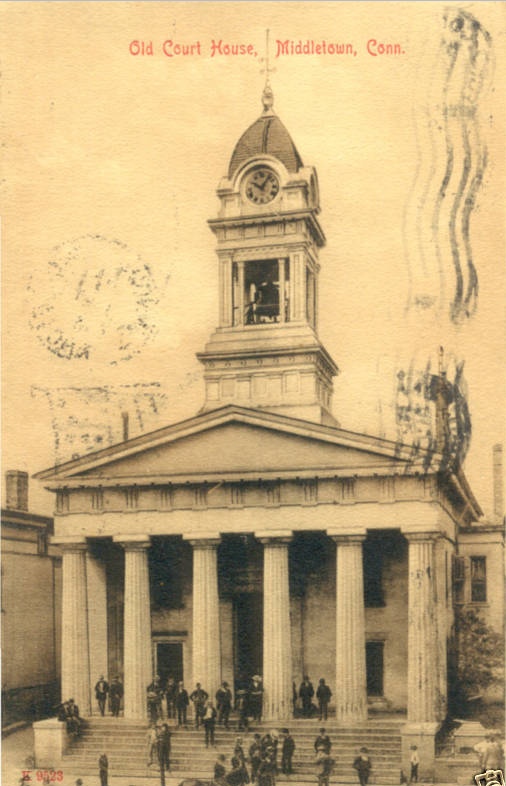
Middletown’s Second or North Ecclesiastical Society was incorporated in 1703 in the community known as “Middletown Upper Houses,” now the Town of Cromwell. A minister was settled in 1715 and the congregation had their first meeting house on Pleasant Street. This was succeeded by a larger second meeting house, built in 1735-1736 on the town green. When Rev. Zebulon Crocker was pastor, the congregation undertook several ambitious building projects, constructing an Academy (1834), Parsonage (1835) and the third meeting house (1840), all designed in the Greek Revival style. The foundation stones of the church were dragged by volunteers across the ice on the Connecticut River from the Portland brownstone quarries. The architecture of the church was influenced by the Greek Revival of the old Middletown Court House, designed by Town and Davis. The upper tier of the steeple was lost in the 1938 hurricane and replaced in 1976. (more…)

First Congregational Church, Ansonia (1865)

first-church-ansonia.JPG

Ansonia‘s First Congregational Church was founded in 1850 and a wood church was built in 1852. This burned in 1865, when a group of women were cleaning the church and a fire started in the flue of the furnace. It was replaced by the current Gothic church building on South Cliff Street, built of stone quarried in Seymour. Anson G. Phelps, who founded Ansonia, donated the land and funds to build the church, which has stained glass windows by Louis Comfort Tiffany.