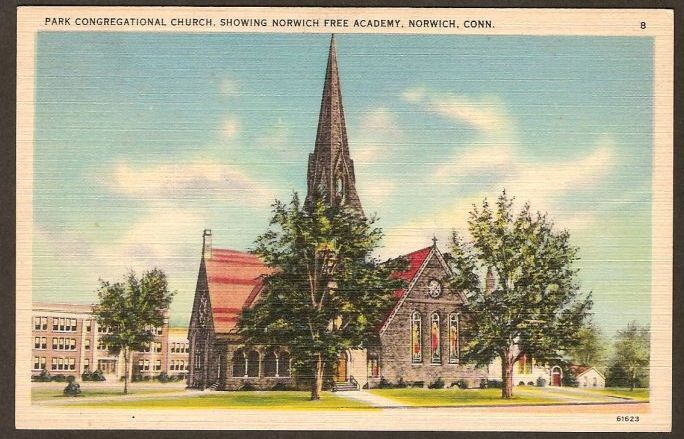
Park Congregational Church, Norwich (1874)

As related in A Modern History of New London County, Connecticut, Volume 1 (1922), during the pastorate of Rev. Malcolm McGregor Dana at the Second Congregational Church of Norwich:

The feeling that its helpfulness to the community would be increased by removal to the suburban district near the Academy led to marked differences of opinion with the majority of his parishioners, and in 1874 Dr. Dana resigned and, with one hundred and five of his old members, formed the Park Congregational Church.

The church, built in 1874, was designed by Stephen C. Earle of Worcester in the Romanesque Revival style.

Church of the Epiphany, Southbury (1867)

An Episcopal Church in Southbury was established in 1843 at a meeting in the Bullet Hill School. Organized as the Church of the Resurrection, it was renamed the Church of the Epiphany in 1858. According to the History of New Haven County, Connecticut, Vol. II (1892), edited by J. L. Rockey, “The corner stone of the church, on the Shadrach Osborn lot, was laid November 5th, 1863, and the church was consecrated by Bishop Williams September 19th, 1867.” The main part of the building is stone, but the belfry is made of wood.

Elm Grove Cemetery Chapel (1893)

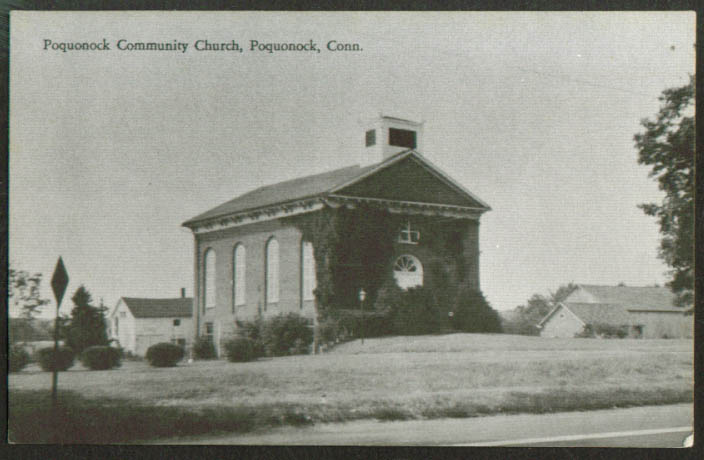
The Ecclesiastical Society of Poquonock in Windsor was first established in 1726 and a meeting house was built the following year. This was replaced by a second meeting house in 1798. By 1820, church membership had completely diminished, but in the 1840s a new Congregational Church of Poquonock was formed (now the Poquonock Community Church), which built a new meeting house in 1854. The old Society’s church was eventually torn down in 1882, but in 1893-1894 a mortuary chapel for the adjacent Elm Grove Cemetery (earliest stone 1738) was constructed on the same site.

First Baptist Church of Wallingford (1870)

The Baptist church in Wallingford begun as a branch of the Waterford Baptist church in 1731 and was organized as the Third Baptist Church in Connecticut in 1735 and then the First Baptist Church of Wallingford in 1786. The church used a dwelling house in Meriden (then a part of Wallingford) as a house of worship starting in 1801. After Meriden became a separate town, the Wallingford members established their own church in Wallingford and built a meeting house in 1821. After the church burned down in 1869, the current church was constructed and dedicated in 1870. Located at 114 North Main Street, it is a brick building in the Romanesque Revival style.

Congregational Church in Killingworth (1820)

In 1735, responding to a petition from the farmers residing in the north section of Killingworth, the town was divided into two separate Ecclesiastical Societies, north and south. The southern section of town was later incorporated as the town of Clinton in 1838. The northern society‘s first meeting house (1736) was located on “Stoney Hill, just north of the bridge across Bear Swamp,” (near the intersection of the present Routes 80 and 81). This initial building was replaced by a new one in 1743. The third and current house of worship of the Congregational Church in Killingworth, at 273 Route 81, was built between 1817 and 1820. The bell was installed in 1870 and the organ in 1875. The addition of the Parish Hall was begun in 1959 and was dedicated in 1961, the same year the church voted to join the United Church of Christ.

First Church of Bethlehem (1836)

At the time of its settlement, Bethlehem was the northern part of the Town of Woodbury. As related in the History of Ancient Woodbury (1854), by William Cothren,

Four years after the first settlement, the number of families amounted to only fourteen; yet this handful of people felt able to support a minister a part of the time, and accordingly petitioned the General Assembly at its October session, 1738, for liberty to have “winter privileges,” for five months,” in the most difficult season of the year, viz., November, December, January, February and March,” as they lived so far from church, it was impossible to attend. […] In May, 1739, they petitioned to be released from parish taxes as long as they should hire a minister, and from school taxes, on establishing a school of their own, “the school in the first society being so far off it was of no use to them.” The request was granted, and they were permitted to hire a “minister and set up a school.” At the October session of the same year, they petitioned that the “east half of the North Purchase” might be set off as a distinct ecclesiastical society.

The Society voted to build a meeting house in 1740 and, again quoting the History of Ancient Woodbury, “The clerk of the society in 1743, reported the house covered, and in May, 1744, that materials were provided for finishing the inside of the house.” This building was later replaced:

The first house in the society after a time was deemed too small for its accommodation. Accordingly on the 4th of January, 1764, when there were about one hundred within its limits that paid taxes, they voted to build a second church. On the 28th of the next month, they voted again to build the house, “and to begin and go on moderately and Little by Little.” […] By a vote of the society, October 20th, 1768, directing the society’s committee to “seat the new Meeting House,” “and dignify the Pues [sic]” therein, we learn when it was finished and ready for worship. In December, 1793, a tax of sixpence on the pound was laid to build a steeple, provided money enough to purchase a “good decent bell and a Lightning rod” for the same should be raised by subscription. Eighty pounds were soon subscribed, and the bell was obtained.

The current First Church of Bethlehem was built as the Society’s third successive meeting house in 1836. It is a Greek Revival, Doric tetrastyle, clapboard church.

United Church of Christ, Southbury (1844)

The United Church of Christ in Southbury was constructed in 1844 as the the meeting house of the First Ecclesiastical Society of Southbury. It was the Society’s third meeting house, as described in Vol. II of the 1892 History of New Haven County, Connecticut (edited by J. L. Rockey):

For more than half a century the settlers of Southbury worshipped in Woodbury church, and were tributary to the First Ecclesiastical Society of that town. In May, 1731, the Southbury parish was incorporated, and November 29th, 1732, this society voted to build a meeting house, and asked the assembly for a committee to locate a site. In May, 1733, the committee selected a final place, “setting the stake down on the hill between Lt. Andrew Hinman’s and the house that was Elnathan Strong’s.” This site was in the highway nearly in front of the present White Oak school house. The building was a plain frame, 35 by 45 feet, with 23 foot posts, and was not fully completed for 20 years.

[…] It was not many years before the first meeting house was too small to accommodate the congregation, and a new house was demanded. As in the first instance, the question of site proved troublesome, and it was several years before an agreement could be reached. Finally, after four years’ effort, a site was selected on Southbury street, south of the old site, on which was begun in 1764 one of the largest and finest meeting houses in this part of the state. It was twelve years before it was fully completed and was a noteworthy object many miles around, with its high spire, in which was a good bell and also a clock. These were purchased by general subscriptions of the citizens of the town, which were secured in December, 1773.

The meeting house stood at the head of the lane leading to the middle cemetery, which it fronted, and was used until the present house was occupied in 1844, when it was taken down and the material removed.

Attached to the rear of the church is the former Southbury Methodist Church building. Also in the Greek Revival style, it was built in 1847 and was moved and attached to the Congregational church in 1957.