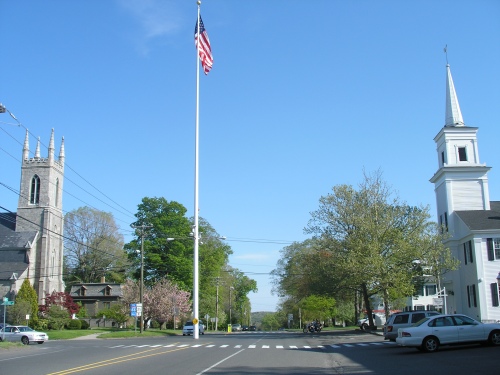
St. James Episcopal Church, Haddam (1873)

St. James Episcopal Church is located at the intersection of Killingworth and Ponsett roads in Haddam. A Carpenter Gothic building, Saint James’s was constructed between 1871 and 1873. The church was organized by Rev. William Clark Knowles, who had begun a Sunday School in his home on Hubbard Road in 1861 and held the first service of the Ponsett Episcopal Church around 1866. For thirty-six years, Rev. Knowles served as pastor of both St. James’s and Emmanuel Episcopal Church in Killingworth. A resident of the Haddam village of Ponsett until his death in 1933, at the age of 92, Rev. Knowles was the author of By Gone Days of Ponsett, published in 1914.

Former Methodist Church, Essex (1849)

At the corner of Prospect and Main Streets in Essex is a former Methodist church, built in 1849. The Methodists had earlier used a smaller building, also located on Prospect Street, that had been built in 1827. The 1849 church was used until the Methodist Society disbanded, at which time it was given to the Essex Fire Engine Company in 1945. When the existing firehouse was enlarged rather than being moved into the former church, ownership of the building reverted to the town. It was sold to Verplex Realty Company in 1949 and used as a warehouse for many years. The building was later sold again and was eventually converted into a residence. The original steeple has been replaced by a much shorter cupola with glass walls.

United Congregational Church of Tolland (1838)

In 1719, Tolland‘s first settlers decided to build a meeting house. This simple initial structure, first used in 1723, was never entirely completed. A larger building, with a steeple and bell, was later constructed at the south end of Tolland Green. First used in 1755, it was later suprceeded by the current building, located on the west side of the Green and dedicated on October 25, 1838. In 1893, adapting to changing styles, typical Victorian-era alterations were made to the interior of the church. This included replacing the pained glass windows with stained glass. In 1977, the church was again remodeled to its original appearance and the stained glass was removed. A wing was also added at that time to the south side of the church. Declining membership in the both the Congregational and Lee Methodist churches in Tolland led to their merger as the Federated Church of Tolland in 1920. The Lee Methodist Church was dissolved in 1959 ad the following year the Federated Church was renamed the United Congregational Church of Tolland.

Saints Peter and Paul Orthodox Church (1955)

Saints Peter and Paul Orthodox Church, at 54 Park Avenue in Meriden, was built in 1954-1955 and the icons were painted by Ivan Dikey in the early 1960s. Dikey was one of the only trained iconographers in America at the time. The parish was originally formed in 1911 and the first church building on Bunker Avenue, completed the following year, was later destroyed for the construction of Interstate 691.

St. Peter Church, Torrington (1928)

St. Peter parish in Torrington was formed in 1907, when Bishop Michael A. Tierney named Father Joachim C. Martinez as pastor to the city’s Italian immigrants. Beginning in a basement chapel on Center Street, the parish later faced closure, but a parish committee successfully appealed for the restoration of a permanent pastor in 1914. The parish then expanded, building a new church at 107 East Main Street in 1927-1928 and opening a parish school in 1956, which combined with St. Francis School in 2005.

Newtown Meeting House (1812)

Newtown’s first meeting house was built in 1720 on Main Street, where the flagpole stands today. In 1792, this building was moved 132 feet to the middle of West Street. As explained in Newtown’s History and Historian, Ezra Levan Johnson (1917):

Nothing more appears on the society minutes about the meeting house, either for its adornment or repairs, until 1792, when the Church of England people having the consent of the town to build a church for public worship on the ground where the town house was standing, provided they would remove the Town house to some other site, without expense to the town. The meeting house standing near to. and in front of, the Town house made an objection to putting the Church of England house there without removing the meeting house also, and it was proposed to them that their house be removed to the opposite side of the north and south road

The meeting house was replaced with a new one in 1812, which was improved over the years. Quoting from the same book as above:

During the Rev. Jason Atwater’s ministry, between 1845 and 1852, the exterior of the building was very much improved, the belfry was closed in, a new steeple was built, the building newly covered and painted. Twelve hundred dollars were spent in renovating the exterior and in 1852 the basement was fitted up, the main floor raised to its present level, [and] new seats and a pulpit were provided for the audience room

By 1873, the meeting house looked much as it does today. In 1988, the Newtown Congregational Church moved to a new building and sold the old meeting house to the town. The Heritage Preservation Trust of Newtown, Inc. then restored and now maintains the Meeting House, which serves as a place for concerts, meetings, weddings and other events.