Saint Mary’s Orthodox Church, Waterbury (1974)

The original Saint Mary’s Orthodox Church in Waterbury, founded primarily by Ukrainian and Russian immigrants, was built in 1906-1908 on Crown Street. In 1968, the parish purchased 12 acres of land on North Main Street for the future site of a new church. Work began in 1972 and the cornerstone of the Crown Street church was transferred to the newly completed Nativity of the Holy Virgin Mary Church in 1974. Adjacent to the church, a new rectory was built in 1975 and the new Saint Mary’s Orthodox Center in 1980-1981.

Update 2/15/2021: As per the comment below, this building has been demolished: Demolition begins at St. Mary’s Russian Orthodox Church in Waterbury // WITH VIDEO | Republican American Archives (rep-am.com)

(more…)

St. Paul’s Episcopal Church, Bridgeport (1868)

According to A History of the Old Town of Stratford and the City of Bridgeport, Connecticut, Volume 1 (1886), by Rev. Samuel Orcutt:

St. Paul’s Church (Episcopal), was organized June 4, 1858, at the house of William H. Noble, on Stratford avenue, and the Rev. G. S. Coit, D.D., of St. John’s Church, was chosen rector. The Sunday school met, at first, in the coal office of D. W. Thompson, near the east end of the Centre Bridge, afterwards in rooms over a store upon the corner of Crescent avenue and East Main street. The Rev. N. S. Richardson, D.D., was the first settled pastor of this parish, his ministry beginning in January, 1868. The corner-stone of St. Paul’s Church, a handsome stone building upon Kossuth street, fronting Washington Park, was laid by Bishop Williams, October 6, 1868; the edifice was dedicated and occupied for worship July 29, 1869, but not consecrated until May 18, 1880. It cost about thirty thousand dollars.

The church was designed by E.T. Littell of New York. Today, it is St. Luke’s/St. Paul’s Church. (more…)

Copper Hill United Methodist Church (1839)

Copper Hill United Methodist Church is located at 27 Copper Hill Road in East Granby. As related by Charles Horace Clarke in The Memorial History of Hartford County:

The Methodist church at Copper Hill was built in 1839, and in 1850 was thoroughly repaired, and moved about five rods westward. Like all Methodist churches, it has had regular changes of pastor. In the ministry of Lemuel Richardson, in 1871, there was an extensive revival of religion, attended with remarkable manifestations. The writer, at a single evening meeting in the church, which lasted from seven o’clock until midnight, witnessed as many as fifteen persons who became apparently unconscious. Some were stretched upon the floor; others were lying or being supported upon the seats. This visitation of “the Spirit” was regarded as a great blessing, and it certainly did strengthen the church in numbers. Mr. Richardson was a large, powerful man, full of strength, zeal, and boldness, and possessed of a strong, loud voice, which he used in singing as well as in preaching and prayer.

Scotland Congregational Church (1842)

The town of Scotland began as a parish within the town of Windham in 1732, incorporating as a separate town in 1857. As described in the 1889 History of Windham County:

The new society met to organize June 22d, 1732, at the house of Nathaniel Huntington. […] After settling some disputes as to the law in regard to electing officers, the society unanimously set to work to locate and build a meeting house. The site decided upon was ” a knoll, east side of Merrick’s brook, south side of the road from Windham to Canterbury.” Nathaniel Huntington, who owned the land, promptly made over a quarter of an acre for that purpose. June 25th, 1733, it was voted to build a house 43 by 33 feet and twenty feet high, the roof and sides to be, covered with chestnut sawed shingles and clapboards. The work went bravely forward and by November 20th a society meeting was held in the house. Then the windows were glazed, and rough board seats provided, as well as a ” conveniency for a minister to stand by to preach.” […]

[In 1772], it was voted to build a new meeting house, the vote calling out 98 “yeas” and 20 “nays.” It was agreed to give Mr. Elisha Lillie £750 for building the house. It was several years in course of construction. It was completed enough to be seated in December, 1778, and in the following May the work was formally accepted from the hands of Mr. Lillie, the contractor. The old building then being offered for sale at auction, brought seventeen pounds.

The third and current meeting house on the Scotland Green was built in 1842 and, again quoting from the History of Windham County, “A neat and convenient chapel was purchased and fitted up adjoining the church in 1867.” The Chapel had been built in 1842 and had been the Town Hall. (more…)

First Congregational Church of Barkhamsted (1845)

The First Congregational Church of Barkhamsted, also known as Barkhamsted Center Church, was gathered in 1781. The first meetinghouse was built in 1784 and was used until the current, second meeting house was built in 1844-1845. As written in Barkhamsted, Conn., and Its Centennial, 1879:

the old Meeting House was raised in 1784, and used for religious purposes until about 1843 or 1844, and also for town purposes. It was used but little, if any, after the new house was built, and being neglected, of course, rapidly fell into decay. After some changes in ownership, it eventually came into the possession of George Merrill and his sons, Charles and Sheldon, and was f1nally sold to the Greenwoods Company of New Hartford, and by them taken down in 1865, and part of it used in the buildings at the west end of the Greenwoods Company’s dam, near the Scythe Shop. The large stone steps at the east door were used by Bela Tiffany; those at the south door by Charles Merrill; those at the west door by Sheldon Merrill, as steps for their residences respectively.

The second meeting house’s belfry tower was removed in the 1920s, but was recently rebuilt.

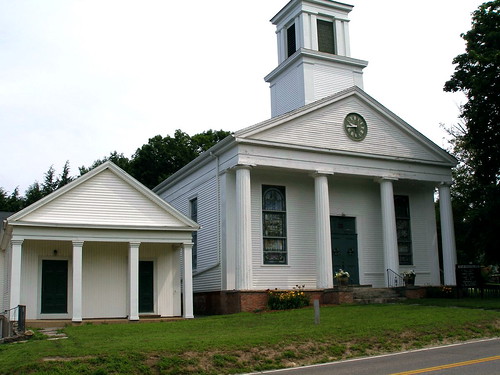
Congregational Church of New Canaan (1843)

The first meeting house of the Congregational Church of Canaan Parish was built in 1732-1733 in New Canaan on Church Hill (known as God’s Acre because of the burying ground one located on the hill, until the graves were later moved elsewhere). A second, larger meeting house was built in 1750-1752. Canaan Parish was incorporated as the Town of New Canaan in 1801. After the second church building was damaged by a lightning strike, it was replaced by the current church, completed in 1843. The church was incorporated as the Congregational Church of New Canaan in 1902.

Former Methodist Church, Rockville (1867)

The building at 26 Park Place in Rockville in Vernon, which now serves as a Senior Center, was originally dedicated in 1867 as a Methodist Episcopal Church. As related in William T. Cogswell’s History of Rockville (1872):

During the years from 1850 to 1860, the Methodist[s] built a comfortable meetinghouse in West street. This house took fire and burned on a Sabbath morning. The German Lutheran Church was a Baptist Church till after the Methodist Church burned. It was bought and occupied by the Methodist society up to the time of building the present Methodist Episcopal Church.

According to A Century of Vernon, Connecticut, 1808-1908, published in 1911:

The first service in the vestry of the new church was held on June 16, 1867. It was a love feast. The bell was raised to its place in the tower June 28, 1867. The vestry was inadequate to accommodate the congregations and the audience room of the church was dedicated on Tuesday, November 26, 1867, Bishop Simpson preaching the sermon.

The church was built in what was then a rapidly developing commercial area and the first floor originally contained the People’s Savings Bank. As further related in A Century of Vernon:

From the time that Messrs. White and Corbin took the front basement rooms of the church, long used as banks, it was the intention of those gentlemen that this property should revert to the trustees of the church. When Cyrus White died this had not been attended to and Lewis A. Corbin bought the banks. The subject was frequently mentioned by pastors and others, but it was not until the pastorate of Rev. W. J. Yates that it was definitely arranged. Then Mr. Corbin executed deeds which are duly recorded, conveying the banks to the trustees. He reserved the income during his life. Then a portion was reserved for a fund for contingencies, but at last all the income goes to the trustees. Certain annual contributions to benevolent interests are provided for and the balance may be used for the current expenses of the church.

The former church no longer has its original two steeples.