St. Mary Church, Meriden (1912)

German Catholic immigrants settling in Meriden first attended Mass at St. Rose of Lima Church and later joined with French-Canadians to establish St. Laurent Church in 1880. A decade later, their numbers were large enough that an independent parish was organized. The first St. Mary parish church, built of wood on Church Street, was dedicated on December 6, 1891. Bishop John J. Nilan blessed the cornerstone of a new church on October 27, 1912 and dedicated the completed Gothic church on October 19, 1913. The church continues to have a German-American congregation residing in Meriden and other nearby towns. Its parishioners share their clergy with St. Joseph’s Church in Meriden. St. Mary School opened in 1894 and closed in 2006.

St. Anthony Church, Ansonia (1915)

Lithuanians in Ansonia sought to establish an ethnic parish when they incorporated a lodge of the Lithuanian Society of St. Anthony in 1907. Bishop John J. Nilan of the Diocese of Hartford rebuffed their request, insisting that the Lithuanians remain within Assumption parish. The Lithuanians began to build a church in 1912 without episcopal approval, hoping that the bishop would reverse his decision, but he maintained his previous position. In 1915, an appeal directly to Rome succeeded and St. Anthony parish was given sanction by the Pope to operate as an independent parish. St. Anthony’s Church was dedicated on Thanksgiving Day 1915 by Father Matthew Pankus of Bridgeport.

Update: In 2015, the church celebrated its 100th anniversary and then closed.

St. Augustine Cathedral (1868)

The first Catholic church in Fairfield County was Saint James the Apostle Church, a brick building built on the corner of Arch Street and Washington Avenue in Bridgeport in 1843. The church eventually became too crowded and the cornerstone of a new church was laid in 1866. Built of stone from the abandoned Pequonnock quarry in Black Rock, the new church, renamed Saint Augustine’s, was dedicated on on Saint Patrick’s Day, 1868. The church became the cathedral of the Diocese of Bridgeport, when that diocese was founded in 1953. The cathedral went through a major renovation in 2003-2004.

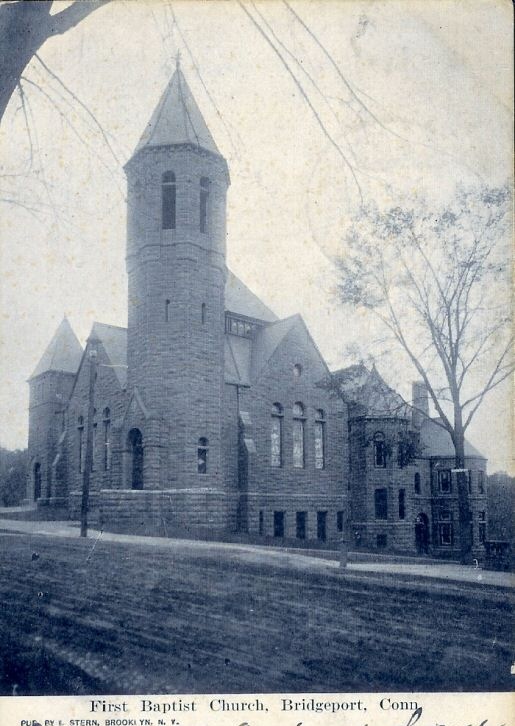
First Baptist Church of Bridgeport (1893)

The First Baptist Church of Bridgeport is a Richardsonian Romanesque structure located at 126 Washington Avenue. Built in 1893, it was the work of architect Joseph W. Northrop. According to Volume I of the History of Bridgeport and Vicinity (1917):

The first Baptist society was organized July 24, 1837, and was composed of six members, namely: Benjamin Wakeman, Raymond Whitney, Roswell Whitney, Bennett Whitney and two others not known. The church was constituted September 20, 1837, with thirty-nine members, eleven of whom were males and twenty-eight females. Rev. Joseph Eaton was the first regular pastor in 1838 and under him the membership increased to 136. Succeeding him the following have served as pastors of the First Baptist Church: Revs. Daniel Harwington, William Smith, William Reid, J. L. Hodge, A. McGregor Hopper, M. H. Pogson, W. V. Garner, C. C. Luther, G. W. Nicholson, and John Richard Brown.

Under Rev. J. L. Hodge a new church was constructed. In 1892 this structure was sold and a new location purchased at the corner of Washington and West avenues, where a stone church was erected and dedicated October 28, 1894. Rev. Dr. Samuel F. Smith, author of “America” participated in the ceremony. This church was incorporated in 1908.

St. Michael’s Roman Catholic Church, Hartford (1906)

Mentioned in Tour 8 of my new book, A Guide to Historic Hartford, Connecticut (which is now available on Amazon’s Kindle e-reader), is St. Michael’s Roman Catholic Church, located at 7 Clark Street in Hartford. Originally serving Irish-Americans, St. Michael’s parish was created out of the northern portion of St. Anthony’s parish in 1900. That year, a basement chapel was dedicated, with the upper portion being dedicated in 1906. The Renaissance Revival-style church, designed by Irish American architect John J. Dwyer, today serves a predominantly African American and Latino congregation.

Emanuel Lutheran Church, Hartford (1924)

And yet another church in Hartford founded by Scandinavian immigrants is Emanuel Lutheran Church, founded in Frog Hollow in 1889 as the Swedish Evangelical Lutheran Emanuel Church (Svenska Evangelisk Lutherska Emanuelförsamlingen). The church’s first building, built in 1892 at the corner of Babcock and Russ Streets, is now the George J. Rau-Arthur F. Locke Post 8 of the American Legion. In 1913, the basement of a new church on Capitol Avenue was finished and the first services in the completed structure were held in 1924.

Our Saviour’s Danish Evangelical Lutheran Church (1891)

Another Scandinavian church in Frog Hollow in Hartford was built in 1891 at the corner of Russ Street and Babcock Street. Our Saviour’s Danish Evangelical Lutheran Church was organized in 1883, making it the oldest Lutheran Church in continuous existence in the Hartford area. It was located in Frog Hollow until the 1950s, when the congregation moved to West Hartford Road in Newington. In 1967, the church merged with Holy Trinity Lutheran Church, which had been founded by Swedish immigrants in 1945. The church, unified under the name Our Savior’s Lutheran Church, is located at 1655 Main Street in Newington. The old church building in Hartford is now home to Iglesia Adventista Del 7mo Dia.