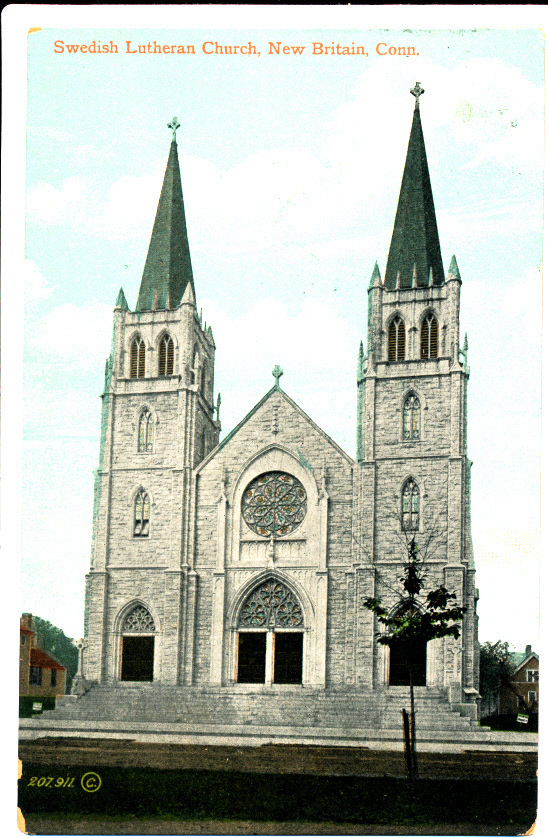
First Lutheran Church of the Reformation, New Britain (1906)

First Lutheran Church of the Reformation, New Britain

With its prominent location on Franklin Square, New Britain’s First Lutheran Church has been a notable landmark since it was built in 1906. The church began as the Swedish Evangelical Lutheran Church, Maria, as described in David Nelson Camp’s History of New Britain (1889):

The first regular mission of the Swedish Evangelical Lutheran Church was established in New Britain in the latter part of 1877. The meetings were held in the chapel of the Methodist Church, the preaching services being conducted by Rev. J. Medlander of Portland, Conn., Rev. T. O. Linell of Rhode Island, and Rev. A. P. Monten of Philadelphia. Students from the Lutheran Seminary of the latter place occasionally visited New Britain and assisted in the services. In March, 1881, the congregation or church was organized. There were different preachers for the first few months, but Rev. O. A. Landell was installed as pastor soon after the organization of the church. In 1883-85, a small but convenient church edifice was erected at the corner of Elm and Chestnut streets. The corner-stone of this edifice was laid in July, 1883, and the church was dedicated March 8, 1885. The building is of wood with a belfry and a basement, which is used for Sunday-school and for other meetings. The main audience room, including gallery, has seating capacity for about six hundred. Rev. O. A. Landell was dismissed in 1836, and Rev. O. W. Form was installed pastor September 27,1887.

Rev. Sven Gustaf Ohman, who served as pastor from 1895 to 1922, oversaw construction of the church’s current grand edifice at 77 Franklin Square. A Gothic building of light Vermont granite, it was designed by New Britain architect William Cadwell and was inspired by Uppsala Cathedral in Sweden. In 1924, the church became known as the First Lutheran Church of New Britain. In 1974, the church merged with Reformation Lutheran Church in New Britain, which had been established in 1906, to become the First Lutheran Church of the Reformation.

The church‘s two towers were originally topped by tall spires, but these were removed in 1938 because of structural weakness. By the twenty-first century, deferred maintenance over the years had led to the towers starting to become separated from the main body of the church. The prospect of an extensive restoration, requiring that the towers be dismantled and rebuilt, led the church to consider tearing down the building and starting over. An innovative and less expensive solution was found using the Cintec System, which uses stainless steel anchors instead of masonry for tower stabilization. The restored church continues to be an important part of New Britain’s architectural heritage.

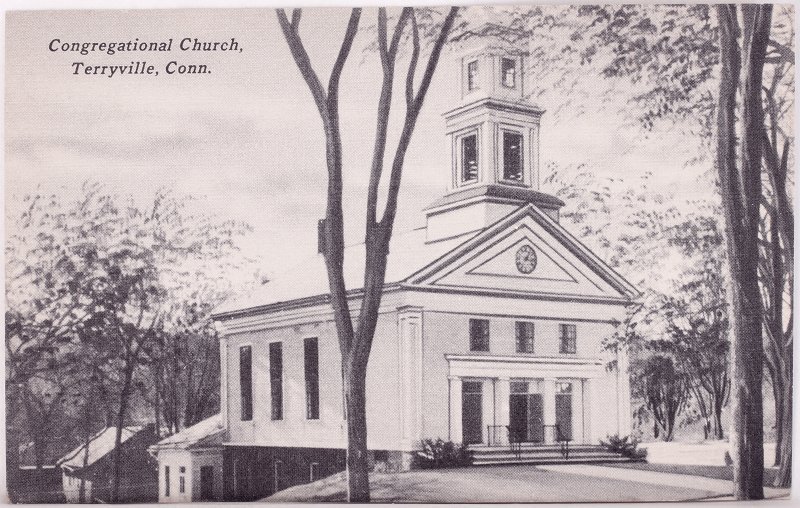
Terryville Congregational Church (1970)

Terryville Congregational Church

In 1838, members of the Plymouth Congregational Church who wanted to have a church that was closer to the industrial area of Terryville formed the new Terryville Congregational Church. Clock maker Eli Terry, Sr. was a member and he donated the clock which he manufactured for the front facade of the church. The church was destroyed by fire in 1967 and the current Terryville Congregational Church, rebuilt on the same location (233 Main Street), was dedicated on October 18, 1970. (more…)

St. Andrews Episcopal Church, Thompsonville (1859)

St. Andrews Episcopal Church, Enfield

St. Andrew’s Episcopal Church, at 28 Prospect Street in Thompsonville, Enfield, was built in 1859. According to the Memorial History of Hartford County, Vol. II (1886): “The Episcopal Church of Thompsonville was organized as a mission in 1851, and as St. Andrew’s Parish in 1855, and is gathering to itself an increasing number of adherents.” St. Andrew’s Church merged with two other Episcopal parishes in 2007. The former St. Andrew’s Church is now Amazing Grace Church.

Hazardville United Methodist Church (1872)

Hazardville United Methodist Church

Happy Easter! Built in 1872 with funds provided by Col. Augustus Hazard (whose powder mill was 100 yards away), the Hazardville United Methodist Church is located at 330 Hazard Avenue in Enfield. The church‘s earlier building, constructed in 1835, still survives further west on Hazard Avenue. In 1923, a three story addition was built in the rear of the 1872 church that provided space for a Ladies Parlor, classrooms, kitchen and a heating plant.

Tempolo Sion Pentecostal Church, Hartford (1900)

Tempolo Sion Pentecostal Church

At 1886 Park Street (corner of Amity Street) in Hartford is Tempolo Sion Pentecostal Church. The church was built in 1900 as St. Paul’s Methodist Church. Designed by George W. Kramer, it replaced an earlier St. Paul’s built in 1894. The Romanesque Revival church has a flexible design (following the Akron Plan) adapted to its relatively small urban lot. The church lost its steeple in the 1938 hurricane.

First Congregational Church of Lebanon (1804)

First Congregational Church of Lebanon (1804)

The First Congregational Church of Lebanon was organized in 1700. Its first two meeting houses were built in 1706 and 1732. These were followed by a brick meeting house on the green, designed by the Revolutionary War-era artist John Trumbull, which was built in 1804-1809. It is the only surviving example of Trumbull’s architectural work. The historic building was nearly destroyed in the hurricane of 1938. The church decided to restore the meeting house in its original form. Work began in 1938 and, delayed by the Second World War, was completed in 1954.