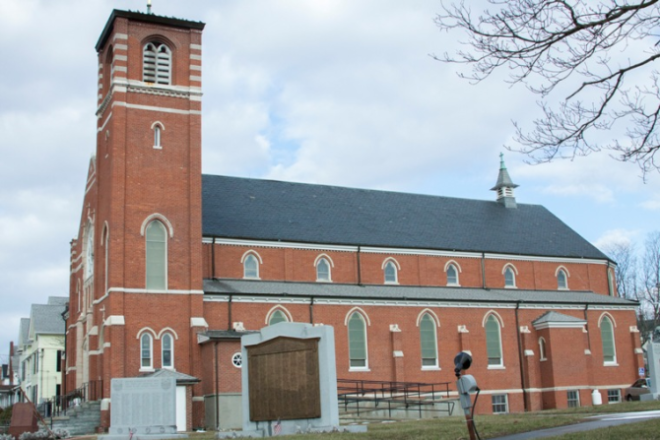
St. Joseph’s Church, Suffield (1952)

St. Joseph's Church, Suffield

Polish immigrants in Suffield organized the St. Joseph Polish Society in 1905 and purchased land for a church. Suffield had been under the care of priests from Windsor Locks, but the town’s Polish Catholics wanted a pastor of their own. St. Joseph’s Parish in Suffield was organized in 1916, the first parish church being the Edwin D. Morgan stable, purchased earlier by the St. Joseph Society. The parish‘s current church was built in 1951-1952.

Gilead Chapel (1876)

Gilead Chapel

In 1836, Henry P. Haven (1815-1876; A biography of Haven by Henry Clay Trumbull, entitled A Model Superintendent, was published in 1880) established the Gilead Sunday School in Waterford. In 1876, Gilead Chapel was built at the corner of Foster Road and Parkway North to serve as the home of this interdenominational school. After the school closed in the early 1940s, the building was used for a decade by the Church of Jesus Christ of Latter Days Saints. Vacant several years thereafter, in 1969 it was purchased by Raymond Schmitt for his his Historic Johnsonville Village in Moodus in East Haddam. The building was taken down and reassembled in Moodus at the intersection of Johnsonville Road and Neptune Avenue.

United Presbyterian Church, Thompsonville (1901)

UNITED PRESBYTERIAN CHURCH

In 1841 there was a dispute in the First Presbyterian Church in Enfield over whether an organ could be used in church services. Those in opposition to using an organ (their rallying cry was “No fiddle in the Kirk”) formed the separate United Presbyterian Church in 1845. They built a meeting house in Thompsonville in Enfield the following year. The church was built on land acquired from Orrin Thompson’s carpet company for a dollar with the requirement that they return the property when asked. This eventually happened fifty-five years later when the company built an expansion. A new church building was erected at 100 High Street in 1901. The church had an organ, the original cause of separation having long disappeared by that time. The church was damaged by a fire in 1943 but was repaired after eleven months of work. The church merged with the First Presbyterian Church in 1973 to form the Calvary Presbyterian Church, located on King Street in the southwestern corner of Enfield. The old church building on High Street then served as the Enfield Senior Center from 1974-2003 and afterward housed town offices, a local theater group and the New Life Community Church. This year, the Town of Enfield solicited proposals for development of the property, which is now called the Village Center. The town requires adaptive reuse of the building that will preserve its impressive stained glass windows.

Franklin Congregational Church (1863)

Franklin Congregational Church

The town of Franklin was originally a part of Norwich and was called West Farms. A separate Ecclesiastical Society was established in 1716 and the first meetinghouse, on Meetinghouse Hill, was completed two years later. As related in The Celebration of the One Hundred and Fiftieth Anniversary of the Primitive Organization of the Congregational Church and Society in Franklin, Connecticut, October 14th, 1868 (1869) [also printed in A Historical Address Delivered in Franklin, Connecticut, October 14th, 1868, on the Two Hundredth Anniversary of the Settlement of the Town, and the One Hundred and Fiftieth Anniversary of its Ecclesiastical Organizations (1870)]:

It will thus appear that the same building materials which constituted an important part of the meeting house built by John Elderkin, at the Town Plot [what is today Norwichtown in Norwich] in 1673, entered somewhat largely into the first church built upon Meeting House Hill more than forty years subsequent to that date. This, in turn, was taken down and re-erected in 1746, in what was afterwards the eighth society in Norwich [the Portipaug Society, which existed from 1761 to c. 1861], and after battling with the elements for nearly forty years longer, it had to succumb a third time, and parts of it were finally converted into a dwelling house [built by Comfort Fillmore], where very possibly some remnants may be found at the present time.

After bitter debates over where to build a replacement for the original meetinghouse, the second was eventually constructed c. 1745-1747, again located on Meetinghouse Hill. This was replaced by another building about twenty years later. The current Franklin Congregational Church edifice was built in 1863 and was renovated in 1989.

St. Mary’s Church, Jewett City (1907)

St. Mary's Church, Jewett City

St. Mary, Our Lady of the Rosary parish was established in Jewett City 1872. In 1866, when the parish was still a mission, Father James Quinn purchased a small fieldstone church, which had earlier been owned by Episcopalians and then Congregationalists. The seating capacity of this church was increased in 1875 and its stone walls were covered with white-painted siding. In 1891 the Enoch Hawkins estate, located behind the small church, was purchased and it was on this land that construction of the current St. Mary’s Church began in 1906. The cornerstone was laid on Sunday, August 19, 1906 and the church, at 34 North Main Street, was dedicated on on Trinity Sunday, May 26, 1907. Its exterior was built of red brick, Indiana limestone and Portland brownstone with terra cotta trimming. The church’s bell is the same one installed by the Congregationalists in the small fieldstone church in 1838. The church originally had a tall steeple, but it was so weakened by the hurricane of 1938 (it was displaced almost a foot off its base) that it had to be removed.