Salem Town House (1749)

Salem Town House

Another notable building along Salem Green is the Town House. This structure was originally built in Norwich in 1749 on Washington Street as an Episcopal church, which later took the name of Christ Church. A new Christ Church was dedicated on Main Street in 1791. The current Christ Episcopal Church was built back on Washington Street in 1849. By that time, the original church on the site had been moved away. In 1829, this old building had been sold to the Episcopal Society in Salem. It was moved to Salem Green circa 1831 and reconstructed. It was at this time that the building’s lancet windows and columned portico were added, resulting in an unusual mix of Gothic and Greek Revival styles. By 1840 the church had closed and the building was acquired by the Town of Salem for general meetings. Since 1969, it has been the home of the Salem Historical Society.

Warren Congregational Church (1818)

Warren Congregational Church

When Warren was settled in 1737 it was still part of the Town of Kent. A separate ecclesiastical society, called the Society of East Greenwich, was established in 1750 and Warren was incorporated as a town in 1786. Early church services were conducted in a log schoolhouse, located about a mile west of the present center of Warren. In December 1767, services moved to a still unfinished meeting house, which was completed in 1769. By 1815, the building was in such disrepair that the congregation voted to build a new one, sited slightly behind the earlier structure. The current Warren Congregational Church (4 Sackett Hill Road) was built between 1818 and 1820.

St. Agnes Roman Catholic Church, Niantic (1957)

St. Agnes Church

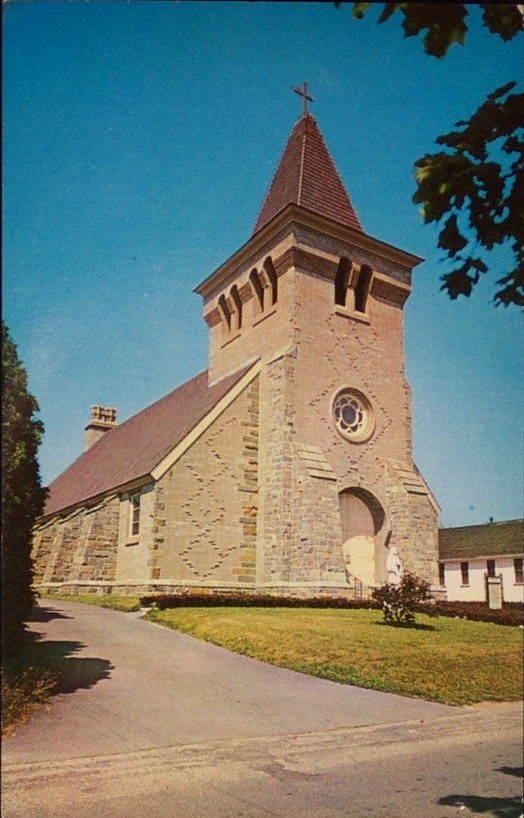
Today we continue with the Catholic theme, but this time with a church in Niantic. St. Agnes Parish was established in Niantic, East Lyme in 1922. The original wooden church on Prospect (now Haigh) Avenue, opened in November, 1924. Construction on the present church was interrupted by World War II. The foundation had been dug, but was covered over until construction was resumed in the mid-1950s. The parish celebrated its first Mass in the new church, at 22 Haigh Avenue, on February 10, 1957. The former wooden church was used as the parish center and church school until it was razed in 1962 to make way for a new church hall. A new rectory was built in 1967 and the current church hall and classrooms in the 1990s.

St. Thomas Seminary (1930)

St. Thomas Seminary

St. Thomas Seminary and Archdiocesan Center is located 467 Bloomfield Avenue in Bloomfield, just across the town line from West Hartford. A Catholic seminary, it was founded in 1897 by Bishop Michael Tierney. The original Seminary was located at 352 Collins Street in Hartford. Increasing enrollment led to a need for a larger space. Bishop John J. Nilan had the cornerstone laid for the current building on Sunday, September 29 1928. Designed by Louis A. Walsh of Waterbury and built by William F. O’Neil, it was opened on September 29, 1930.

Trinity Episcopal Church, Bristol (1949)

Trinity Episcopal Church

Episcopalians in Bristol separated from the dominant Congregational church in 1747. They built a church in 1754, located on the site of the later Thomas H. Patterson School (now Patterson Place Apartments). This early church closed during the Revolutionary War in the face of strong anti-Loyalist feeling. After the war, the dilapidated church was sold to be used as a barn (it later burned in a fire). A new Episcopal church, called Trinity Church, was built in 1834 on Maple Street. This building was sold and moved to Forestville to become the a Methodist Church. It was later destroyed in a fire. The next Trinity Church building was constructed on Main Street in 1862. It was moved around the corner to High Street, across from the Bristol Public Library, in 1889. When this church was destroyed by fire in 1945, Dudley S. Ingraham donated land on Summer Street–the site of a house that had been destroyed by fire–for a new Trinity Church, which was dedicated on Easter Day, 1949. The church’s rose window, facing Summer Street, was given by Ingraham in memory of his son, Dudley, Jr., who was killed in action during World War II. The church’s tower and parish house were added in 1954. At the start of the twenty-first century, Trinity Episcopal Church became one of the “Connecticut Six,” a group of Episcopal churches whose orthodox beliefs conflict with those of the state’s Episcopal hierarchy. Threatened with a lawsuit by the Episcopal Diocese of Connecticut, the congregation vacated the church building on Summer Street in 2008 and became Holy Trinity Anglican Church, affiliated with the Convocation of Anglicans in North America, a mission of the Anglican Church of Nigeria.

Jewett City Baptist Church (1841)

Jewett City Baptist Church

The earliest Baptist Church in what would become Jewett City was established in 1786. It met in the house of Amos Read in Lisbon and was known as the Preston and Canterbury Baptist Church. As related in the History of New London County (1882), compiled by D. Hamilton Hurd,

They united with the school district in building a school-house sufficiently large for meeting purposes. This house stood on the site of the old “Fenner store.” In 1813 they united with the Episcopalians in building a regular house of worship. They now numbered 162, and had as a pastor Rev. Caleb Read, a son of their former pastor. A majority of the stock in this house was bought up by a single individual and the house closed against them.

As explained in the Jewett City Souvenir (1896)

The church building was allowed to pass into other hands, and the Baptists were compelled to betake themselves to the school-house which they had previously occupied and which they had helped to build. Soon they lost this place of worship and then followed their extinction.

Again as related in the History of New London County (1882):

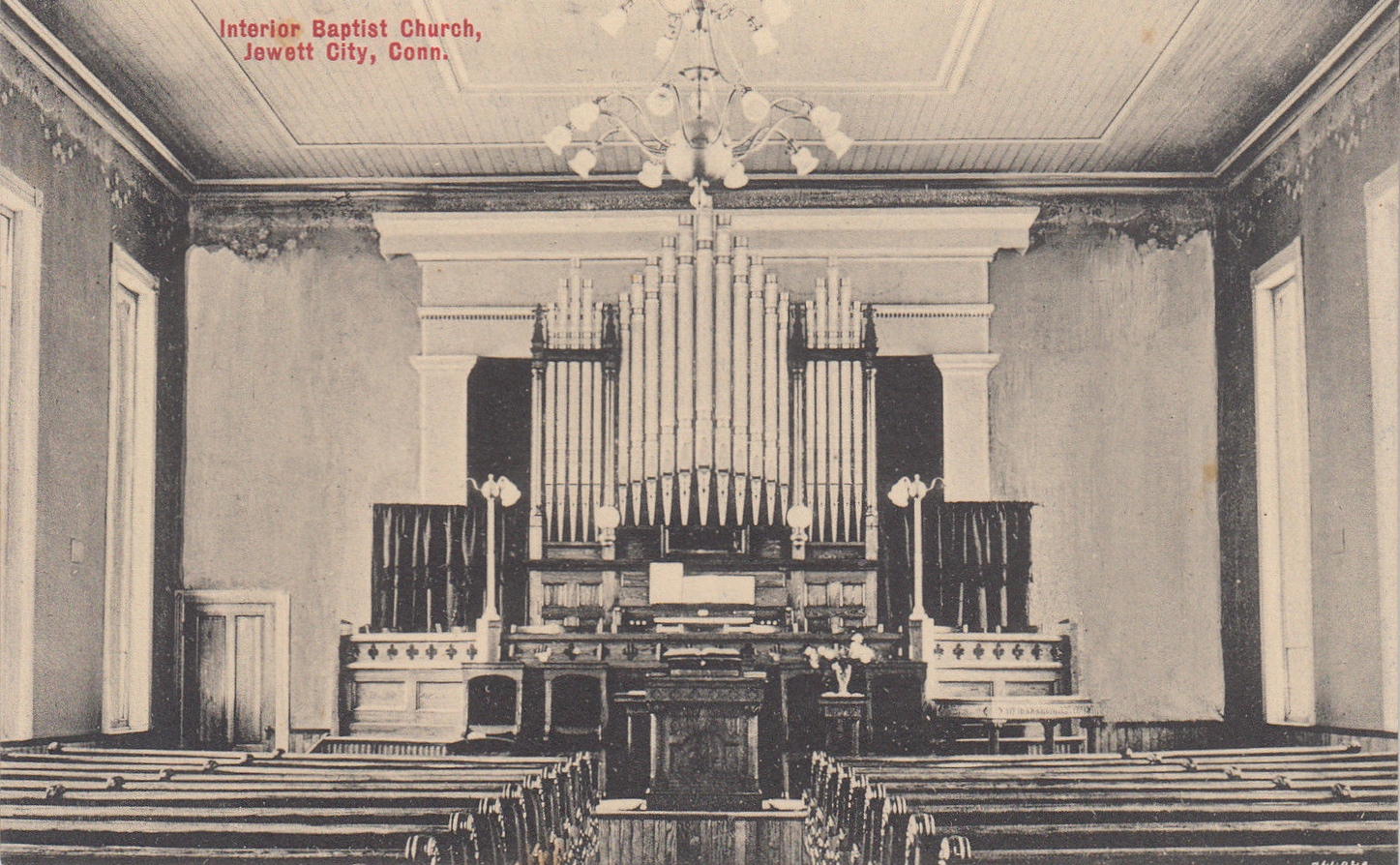
In the spring of 1840, Rev. Benajah Cook came among them to labor. He found the church disorganized and dispirited. However, he succeeded in gathering a band of thirty-seven, who on Sept. 13, 1840, were organized into what is still known as the Jewett City Baptist Church. They elected Reuben Barber and Rufus Williams to be deacons. They built and dedicated a house of worship Nov. 30, 1841. This same house, twice enlarged and remodeled, is still used. Its estimated value, with its surroundings, is eleven thousand dollars.

The church appears to have since lost the upper section of its steeple.