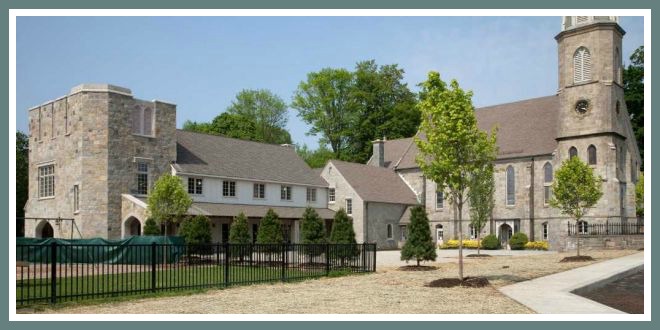
Norwalk United Methodist Church (1860)

Norwalk United Methodist Church

Jesse Lee, the minister who established Methodism in New England, preached his first sermon in New England in June of 1789 in the center of Norwalk. The town’s first Methodist church was built in South Norwalk in 1816. By 1858, the congregation had grown so large that it divided. Planning for a new church, which is now called the Norwalk United Methodist Church, began at a meeting on April 25, 1858 at “Phoenix Hall,” which was then located at the Norwalk River Bridge on Wall Street. Work on the church edifice at 724 West Avenue started in 1859 and the building was dedicated on December 6, 1860. An Italianate structure, it was designed by architect Tappan Reeve of Brooklyn, New York. Ornamentation, removed from the church’s towers in the wake of storm damage in the 1920s, has more recently been replicated and the church repainted in its original colors.

Stony Creek Church of Christ Congregational (1903)

Church of Christ Congregational, Stony Creek

The Congregational Church in the village of Stony Creek in Branford was gathered in 1877 and soon purchased a building known as Union Chapel for its services. Union Chapel had been constructed in 1866 by the Union Religious Society, formed in 1865 by Baptists, Methodists, Episcopalians, and Congregationalists in Branford as a missionary outreach to Stony Creek. The old wood structure was destroyed by fire in 1900. It was replaced by the current Stony Creek Church of Christ Congregational, a Norman Gothic edifice constructed between 1901 and 1903 of Stony Creek red granite. A basement kitchen and meeting room were added in 1907.

Christ & Holy Trinity Episcopal Church of Westport (1863)

Christ & Holy Trinity Episcopal Church of Westport

Christ & Holy Trinity Episcopal Church of Westport was formed in 1944 as a merger of two earlier Episcopal parishes. Christ Church (built 1833), which stood at the northeast corner of the Post Road and Ludlow Street, was consecrated on November 2, 1835. As the town grew new residents arrived who wanted a more progressive parish. In 1863 they built another Episcopal church, the Memorial Church of the Holy Trinity at 75 Church Lane. The new church was built on the site of the Disbrow Tavern, where George Washington stopped on June 28, 1775, on his way to Boston to assume command of the Continental Army. The two congregations merged in 1944, selling the former Christ Church and retaining the larger Holy Trinity Church building.

Christ & Holy Trinity Episcopal Church of Westport

Southport Congregational Church (1875)

Southport Congregational Church

According to the Manual of the Southport Congregational Church (various editions):

Southport was for many years a part of the Fairfield parish. The people of Southport, having built a meeting-house in their own village in 1841, resolved at a meeting held February 18, 1843, to form a new church, and therefore called a council of the five neighboring churches for March 7, 1843. This council organized “The Southport Congregational Church,” with a membership of twenty-eight. The sermon in the afternoon was by the Rev. Lyman Hotchkiss Atwater, of Fairfield. In the evening the meeting-house was set apart to the worship of God, the Rev. Dr. Nathaniel Hewit, of Bridgeport, preaching the dedication sermon. The church was received into the Fairfield West Consociation June 6, 1843.

The current Southport Congregational Church, at 524 Pequot Avenue in Southport (Fairfield) was built in 1875. The church’s stained glass window dates to 1907.

Unitarian Universalist Church of Norwich (1910)

Unitarian Universalist Church of Norwich

The Unitarian Universalist Church of Norwich began in 1820 as the “Society of United Christian Friends in the Towns of Norwich, Preston and Groton.” The Society erected a church in 1821, but did not have a settled pastor, the pulpit being occupied by temporary ministers. A church was finally organized in 1836, when the “First Universalist Society in Norwich” was established. A new brick church replaced the old one in 1841 on the same site on Main Street, facing Franklin Square. It was enlarged and rededicated in 1848. The church was demolished for the construction of the Chelsea Savings Bank. A new church, later called the Unitarian Universalist Church of Norwich, was erected in 1910 at 148 Broadway. Constructed of random granite ashlar, the church is also known as the Church of the Good Shepherd for the subject of its large stained glass window. The church’s bell, earlier located in the congregation’s Franklin Square church, was one of several bells salvaged from sacked churches after an uprising in Spain in 1833 that were shipped to New York for sale. With a dwindling congregation, the Unitarian-Universalists sold the church in 2009. It then became the Fount of Salvation Missionary Church.

Middlefield Federated Church (1866)

Middlefield Federated Church

On December 21, 1866, the Middlefield Methodist Church was dedicated in commemoration of the hundredth anniversary of Methodism. The Middlefield Congregational Church, built on the town green in 1842, stood across the road. By the turn of the century, the number of Congregationalists had decreased. In 1921 the Congregational and Methodist churches became federated and the united congregation rotated services between the two churches each month. After almost a decade this practice was deemed too expensive, so services were afterwards held only at the Methodist Church, the older Congregational edifice being considered unsafe. It was eventually torn down in 1942. Additions have been made over the years to the current Federated Church building, which is located at 402 Main Street.

Church of the Holy Spirit, West Haven (1906)

Church of the Holy Spirit

Christ Episcopal Church in West Haven, the second oldest Episcopal parish in Connecticut, was established in 1723, supported by the missionary work of Rev. Samuel Johnson of the state’s oldest parish in Stratford. A wood frame church was constructed in West Haven by 1740. A traprock Gothic Revival church was built on Church Street, across from the West Haven Green, in 1906 and consecrated in 1907. It was designed by Bertram Grosvenor Goodhue of Cram, Goodhue & Ferguson. The church is connected to the Parish House, built in 1916. In 2006, Christ Church merged with another Episcopal church, St John’s by the Sea, to form the Church of the Holy Spirit. The former church building of St. John’s by the Sea, built in 1953 on Ocean Avenue in West Haven, was secularized in 2008 and sold.