Former Baptist Church, Cromwell (1853)

Former Baptist Church/American Legion Hall

The building at 349 Main Street in Cromwell was built in 1853 as a Baptist church and later served as an American Legion Hall. The church was organized in 1802. According to Rev. Myron Samuel Dudley’s History of Cromwell (1880):

In 1803 the church built a plain frame edifice Meeting-House on the West Green, and held their public meetings there until 1833, when the house was moved to the central part of the village and placed on a lot nearly opposite the present site of the Post Office. Worship continued in this house until Nov. 3, 1853, on which day a new house of worship, located a little North of the old one, built during the pastorate of the Rev. C. W. Potter and largely through his instrumentality, was dedicated. This latter edifice was remodeled, somewhat, internally in 1872, and is the house of worship of the church at the present time.

The church disbanded in 1936 and the building’s steeple was removed.

539 Hopewell Road, Glastonbury (1840)

539 Hopewell Rd., Glastonbury

It is not known who built the house at 539 Hopewell Road in Glastonbury. While in some ways resembling a traditional center-chimney house, it has a less traditional arrangement of windows suggesting a later date. The front roof dormer is a twentieth-century addition. The property was owned in the 1840s and 1850s by Henry Dayton, a farmer who may have been attempting to capitalize on nearby industrial development. The house was later, in fact, owned by a general store that was linked to the textile mills. (more…)

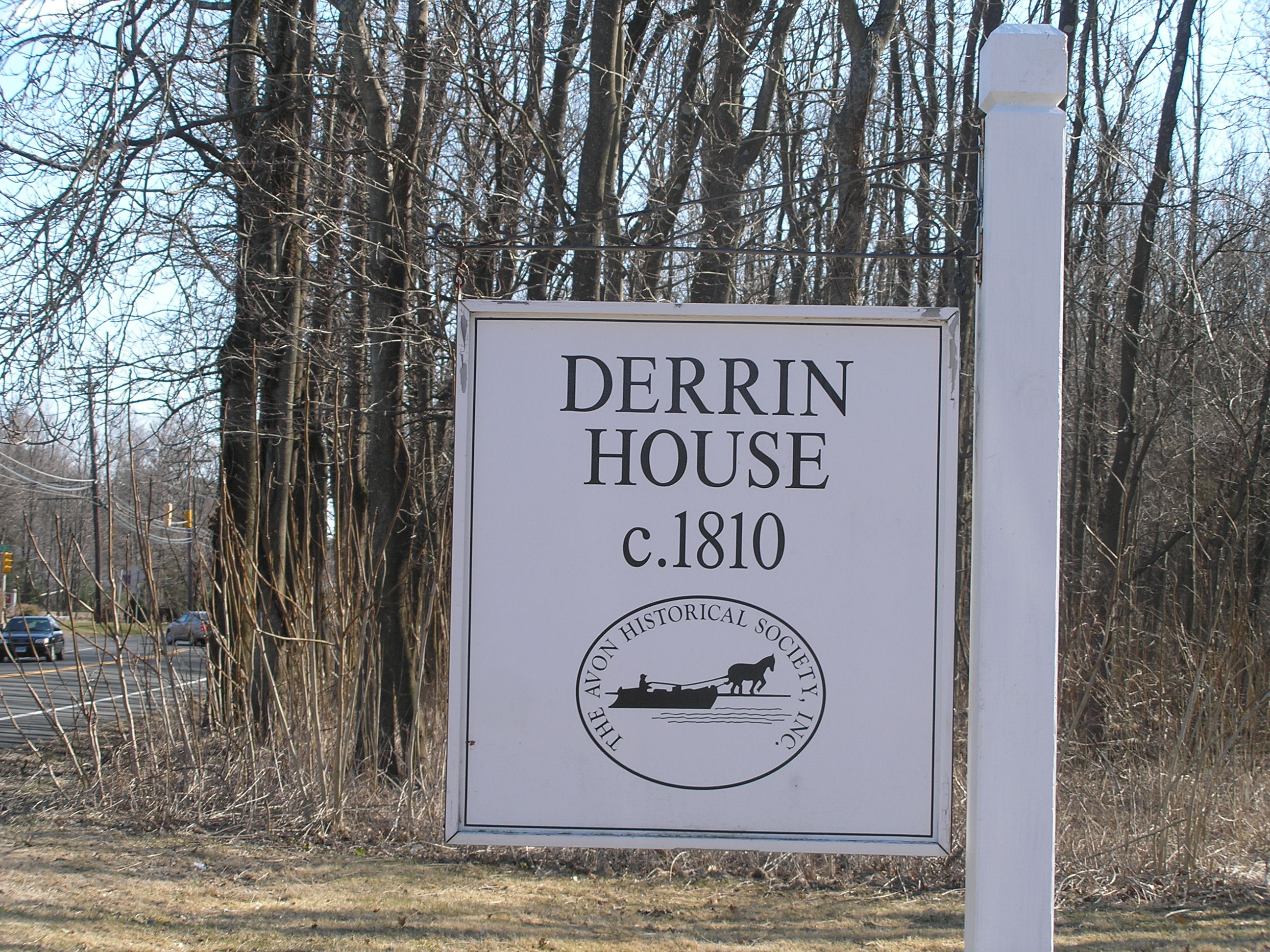
Derrin House (1810)

Derrin House

The Derrin House is a vernacular farmhouse at 249 West Avon Road in Avon. Its oldest sections may date to c. 1747 (could that be 1767?) and it was added to at least four times over the years. The most recent section of the house is closest to the road and the sign for the house reads c. 1810. It was built by the Derrin (or Derring) family. Little is known about the family other than that they built several houses along the same road in the western part of Avon in the eighteenth century on land they acquired in 1766. The house is located in Horse Guard State Park and is owned by the State of Connecticut Military Department for the First Company Governor’s Horse Guard, which is based across the street. The house is currently being restored by the Avon Historical Society.

Music Vale Seminary Barn (1849)

Music Vale Seminary Barn

In the nineteenth century, Salem was home to what is considered to be the first music conservatory (the first degree-granting school of music, or at least music teaching certificate-granting school) in the United States. Founded around 1835 by Orramel Whittlesey, son of the local Methodist minister Rev. John Whittlesey, the school was first called Mr. Whittlesey’s School, later the Salem Normal Academy of Music, and eventually the Music Vale Seminary. Young women from all over the country came to attend the school. After its original rambling classroom building burned down in 1868, it was replaced by an elaborate Italianate structure. The school closed soon after Whittlesey’s death in 1876 and the main building was destroyed by fire in 1897. The school’s large barn, built c. 1849, does survive. It is typical of an “English barn,” a type also called a side-entry or eave entry barn, a “thirty by forty” (based on its dimensions), a “Yankee barn” or a “Connecticut Barn.” The school‘s farm played an important role for the institution, supplying animals and crops. The Bodman family later owned the Music Vale property and donated much of it to the Salem Land Trust. The barn is now part of what is known as Music Vale Farm. (more…)

William Moon House (1850)

214 Cornwall Ave., Cheshire

Like the neighboring house at 224 Cornwall Avenue, the house at 214 Cornwall Avenue in Cheshire was built in the 1850s by Edward A. Cornwall to rent to rent to one of the many miners from Cornwall, England who were emigrating at the time to Cheshire to work in the barite mines. Barite was discovered in Cheshire around 1840 and mining activity continued until 1878. The house was purchased for $850 by William Moon, a miner from Cornwall, in 1862. He paid $$250 down with a $600 mortgage held by Edward Cornwall. The current owners have expanded the house in recent years. (pdf source)