Dr. Daniel Hooker House (1725)

Daniel Hooker – Timothy Griswold House

Built on Main Street in Wethersfield around 1725 for Dr. Daniel Hooker, a grandson of Thomas Hooker. It is the oldest surviving two chimney house in Wethersfield and is transitional because it lacks the Georgian center hallway typical of later two chimney houses. The house was enlarged in 1825 by Timothy Griswold. (Thanks to Anne Kuckro for information on this house).

(more…)

Amos Bull House (1788)

amos-bull.jpg

This house was originally located on Main Street in Hartford. It was built in 1788 for Amos Bull, a dry goods merchant, who had a shop on the first floor and also ran a school in the house. Bull once lived in the Silas Deane House in Wethersfield and one of his five wives was Abigail Webb from the Webb House. He sold the house in 1821 and it has since been moved twice: once in 1940 and a second time in 1971 to its present location on Prospect Street, behind the Butler-McCook House. The Amos Bull House is a Federal style brick half house, a type of townhouse more commonly found in larger cities than Hartford. In recent years, the building housed the Historic Preservation and Museum Division of the Connecticut Commission on Culture and Tourism. Update: A major restoration of the house was completed in 2014 by Connecticut Landmarks. It is now that organization’s archival repository and offices.

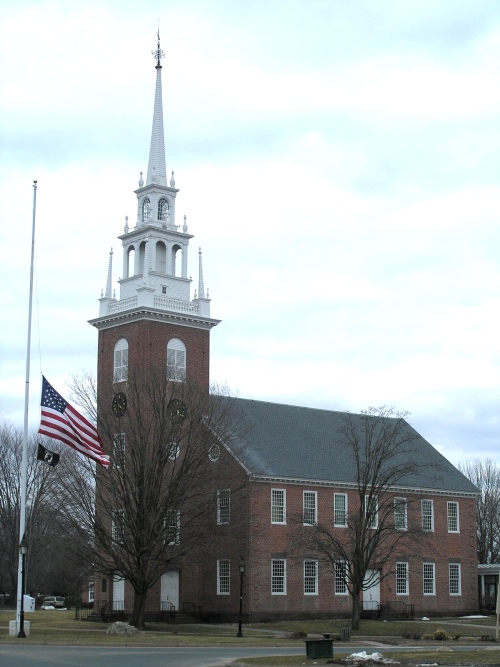
First Church of Christ, Wethersfield (1761)

first-church-wethersfield.jpg

Built in Wethersfield in 1761-1764, the First Church of Christ was the town’s third Meeting House. Designed in the Georgian style, it is a rare survival of a brick colonial meeting house. The steeple was most likely modeled on that of an Episcopal church, Trinity Church in Newport, R.I., which was in turn modeled on Christ Church in Boston. George Washington and the Comte de Rochambeau attended services here on May 20, 1781, during the period they were holding their important meetings in the nearby Webb House. In 1774, John Adams, who was visiting Silas Deane, wrote in his diary:

“We went up the steeple of Wethersfield meeting-house, from whence is the most grand and beautiful prospect in the world, at least that I ever saw.”

Katharine Seymour Day House (1884)

day-house.JPG

Built in 1884 on the corner of Farmington Avenue and Forest Street in Hartford’s Nook Farm neighborhood, for the lawyer and real estate developer Franklin Chamberlin. Chamberlin was also the original owner of of the neighboring Harriet Beecher Stowe House and he sold Mark Twain the land to build his house, which is also next door. The architect of the Chamberlin-Day House was Francis Kimball, who is most well-known for his skyscrapers. It was later owned by Willie O. Burr, owner and editor of the Hartford Times. In 1939, the house was bought by Katharine Seymour Day, the grand-daughter of John and Isabella Beecher Hooker and the grand-niece of Harriet Beecher Stowe. Day was living in the Stowe House and rented the Day House to her cousins. She later used the house to store her collection of art, antiques, and documents, many associated with the Beecher, Stowe, Hooker and Seymour families. In 1941, she founded what would become the Stowe-Day Foundation, now known as the Harriet Beecher Stowe Center. After her death, the Stowe House was restored and the Day House continues today as the offices and research library of the Stowe Center.