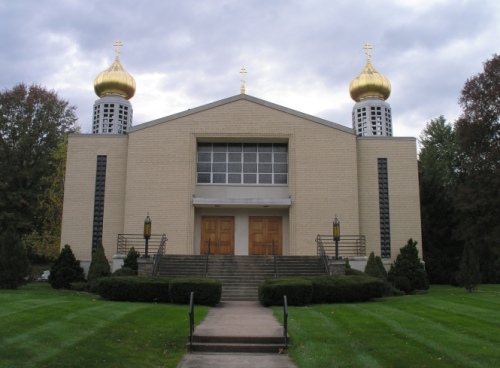
All Saints Orthodox Church (1964)

The congregation of All Saints Orthodox Church was founded in Hartford in 1914. The original church building was on Broad Street, near the State Capitol. In 1956, land was purchased on Scarborough Street for a new church, which was not constructed until 1963-1964. Each November, the church has a Russian Tea Room and Bazaar. Today is Christmas, but some Russian-American Orthodox Christians will celebrate Christmas on January 7, the date of Russian Christmas.

S Razhd?stvOm!

oniondome.jpg

Horace Bushnell Congregational Church (1914)

Hartford’s Fourth Congregational Church, modeled on New Haven’s Center Church on the Green, was built downtown on Main Street in 1850. This original building can be seen in a number of historic photographs. In 1913, the Main Street property was sold for commercial development. William F. Brooks, the architect of Hartford’s Municipal Building and the New Britain Public Library, persuaded the congregation to keep the original church’s steeple and portico and use them on the new church, completed in 1914, at the intersection of Albany Avenue and Vine Street. Thanks to this early work of historic preservation, the later building preserves an important part of a demolished historic structure. The Fourth Congregational Church merged in 1953 with Windsor Avenue Congregational Church to form the Horace Bushnell Congregational Church. The church is now home to Liberty Christian Center International. (more…)

Nathaniel Shipman House (1860)

shipman_house.jpg

Nathaniel Shipman was a lawyer, Federal judge, and a founding partner of the law firm of Shipman & Goodwin, which is still prominent today. His house, on Charter Oak Place in Hartford, was built in 1860 in the Italianate style. Charter Oak Place was a fashionable neighborhood when Shipman moved there, and today has many surviving houses built between 1858 and 1875, including two Italianate double houses, the Kingsbury-Gatling House, the Robinson-Smith House and the Charles Northam House.

Wallace Stevens House (1926)

118-westerly-terrace.jpg

Wallace Stevens was one of the most important poets of the twentieth century. Originally from Reading, Pennsylvania, he came to Hartford in 1916 , where he worked at the Hartford Accident and Indemnity Company, eventually rising to become a vice-president. In 1932, Stevens purchased a 1926 Colonial Revival style house (designed by William T. Marchant) at 118 Westerly Terrace in Hartford. As he did not drive, Stevens would regularly walk the two miles from his home to his office, often walking through nearby Elizabeth Park as well. He would compose poems in his head during these walks. A non-profit group called the Friends and Enemies of Wallace Stevens seeks to increase awareness in the Hartford area of Stevens, who died in 1955, and his work. The house is now owned by Christ Church Cathedral.

Connecticut State Capitol (1878)

capitol.jpg

From 1701 to 1875, Hartford and New Haven alternated as Connecticut’s state capital. Once Hartford won the designation as sole capital city, plans were made to build a new capitol building to replace the Old State House. The new state house was constructed on a hill at the western end of Bushnell Park, on land that had been the original home of Trinity College. The College’s Greek Revival buildings were demolished and the State Capitol building was completed on the site in 1878. The legislature met there for the first time in 1879. The only High Victorian Gothic-style capitol building in America, it was designed by Richard Michell Upjohn, who won the design competitions. He had to make modifications to his plan in order to please the demanding Board of Capitol Commissioners, who were influenced by the contractor commissioned to construct the building, James G. Batterson. The most notable change was the addition of a domed tower. Upjohn had originally planned a traditional Gothic clock tower, but the Board wanted a dome which, while traditional on NeoClassical-style capitol buildings, is highly unusual for a Gothic building.