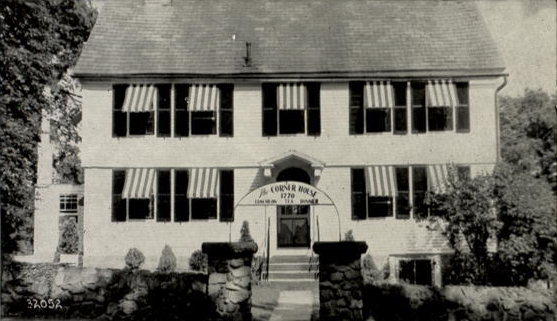
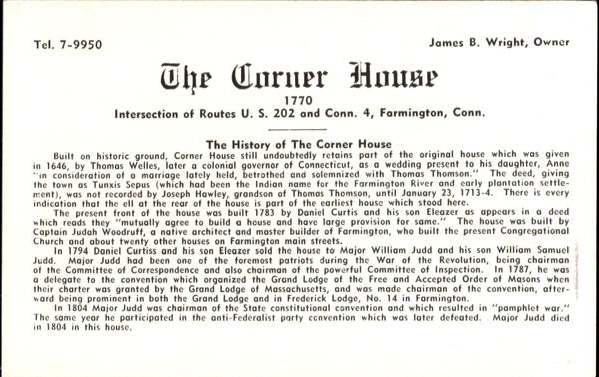
The Corner House (1783)

cornerhouse.JPG

Located at the corner of Main Street and Farmington Avenue in Farmington, the Corner House was built around 1783, perhaps incorporating part of an earlier dwelling that was on the property when it was acquired by the brothers, Daniel and Eleazer Curtiss, in 1774. In 1807, the house was bought by Elijah Cowles, Jr. and Jonathan Cowles. In more recent times the building was a restaurant. Today it is used for offices and the Farmington Inn is attached to it.

The Dexter-Adams House (1781)

dexter-adamshouse.JPG

The Dexter-Adams House, on Centre Street in Mansfield, was built sometime after the land it was constructed on was purchased in 1781 by William and Nathan Dexter. It was purchased in 1803 by Barzillai Swift and was later lived in by his daughter, Lucy, and her husband, Dr. Jabez Adams, one of Mansfield and Windham’s physicians of the late eighteenth and early nineteenth centuries. He worked for a while in partnership with his brother-in-law, Dr. Earl Swift. Dr. Adams’ daughter, Alice, married the builder Edwin Fitch, who possibly made some of the later alterations to the house. The nineteenth century changes include the addition of a mansard roof and a porch.

Beleden (1910)

beleden.JPG

Beleden, one of Connecticut’s great high-style mansions, is located on Bellevue Avenue in Bristol. Designed by the architect Samuel Brown of Boston, Beleden was built for William Edwin Sessions, of the Sessions Clock Company. The Sessions family operated a foundry that had been producing castings for the E.N. Welch Company, a Forrestville clock manufacturer. Around 1900, Sessions purchased E.N. Welch and in 1903 renamed it the Sessions Clock Company. In 1906, William E. Sessions, who had been living in a house on Bellevue Avenue in Bristol, purchased the adjacent house and land of Nathan L. Birge. The Birge House was torn down and over the next 4 years Beleden, completed in 1910, was constructed. The U-shaped brownstone mansion was once the centerpiece of a large estate, which featured formal and English gardens, a pool, greenhouses and grape arbors. These former grounds were later divided by Beleden Gardens Drive and built-up with smaller homes. Two buildings, a coachman’s lodge and a gardener’s cottage, were originally part of the estate but are now separated from the main house by newer structures.

Mark Twain Carriage House (1874)

marktwaincarriagehouse.jpg

Adjacent to the Mark Twain House in Hartford is the Clemens family’s Carriage House, also built in 1874. Like the High Victorian Gothic Twain House, designed by Edward Tuckerman Potter, the Carriage House features architectural details in the Stick style. In the second floor rooms, above where the horses and carriages were kept, Mark Twain’s coachman, Patrick McAleer, lived with his wife and seven children. McAleer served Mark Twain in various homes he lived in, from 1870-1891 and 1905-1906.

Chamberlin Carriage House (1871)

Franklin Chamberlin was a Hartford lawyer who was also involved in the development of the city’s Nook Farm neighborhood in the nineteenth century. Probably as an investment, he built the house on Forrest Street in 1871 that was purchased by Harriet Beecher Stowe two years later. Around the same time, he sold the adjacent land nearby to Mark Twain to build his house. Finally, in 1884, Chamberlin built as his residence the house on Forrest Street, now known as the Katharine Seymour Day House. Earlier, in 1871, Chamberlin built the carriage house, adjacent to the Stowe and Day houses, that is now used as the Visitor Center of the Harriet Beecher Stowe Center. On the east elevation of the building, Chamberlin’s initials, are carved in brownstone above the side entrance. (more…)