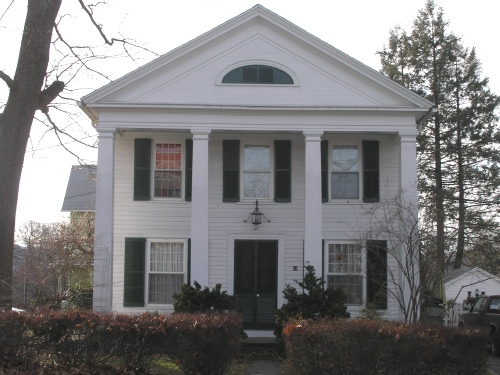
Timothy Root House (1784)

timothy-root-house.jpg

Adjacent to Yale’s Lewis-Walpole Library, on Main Street in Farmington, is the Timothy Root House. It was constructed for Root, an army captain, in 1784 by the builder Judah Woodruff, who built 21 homes in the town, as well as First Church. Woodruff is buried in Farmington’s Memento Mori Cemetery. The house was renovated in 2001 to house scholars who are working with the library’s collections.

Samuel Smith House (1834)

samuel-smith-house.jpg

Samuel Smith, a Bristol clockmaker, built his house on Maple Street, in Bristol’s Federal Hill neighborhood, in 1833 or 1834. The house is in the Greek Revival style, but also features excessively ornate elements of the earlier Federal style in the pediment. Smith made clocks for his business partner, Chauncey Boardman, who sold them in an adjacent house (the home that is now in between was moved there in 1914). The Boardman House, originally built for the clockmaker Benjamin Ray, is also Greek Revival in style.

Lafayette S. Foster House (1850)

lafayette-foster.jpg

Lafayette Sabin Foster was a U.S. senator and judge on the Connecticut Supreme Court. His Italianate-style house, built in the 1850s on Broadway in Norwich, was acquired in 1953 by the Norwich Free Academy. It housed the Norton-Peck Library until the library collection was later moved to another building. The Lafayette Foster House is now part of the NFA’s Latham Science and Information Center, which was connected to it.

First President’s House, Wesleyan University (1837)

first-wesleyan-presidents-house.jpg

A house on High Street in Middletown was constructed in 1837-8 in the Greek Revival style to serve as home for Wilbur Fisk the first president of Wesleyan University. It served as a house for Wesleyan’s presidents until 1904 and then as the Dean’s House until 1967. It is currently the Center for the Americas, housing the departments of American Studies and Latin American Studies.

Savage-Butler Homestead (1806)

Savage-Butler Homestead

The Savage and Butler Homestead, a Federal-style house on Main Street in Cromwell, was built in 1806 by a sea captain named Absalom Savage. After he died at sea of yellow fever in 1821, his widow, Sally Wilcox Savage lived in the house until her death in 1834, when it was inherited by their son, Ralph Bulkely Savage. His daughter, Carrie Augusta Savage married George Sylvester Butler, and the house has remained in the Butler family to the present. There is a pdf file about the house celebrating its 200th anniversary. (more…)

First Congregational Church of Norwich (1801)

First Congregational Church of Norwich

Norwich’s First Congregational Church, located on East Town Street, next to Norwichtown Green, is the fifth in a succession of early meeting houses. The first was built on the southeast corner of the Green in 1660, in Norwichtown, the earliest part of Norwich to be settled. During the troubled period of King Philip’s War, it was replaced by a second structure, constructed in 1673 on the nearby cliff area, known as the Meeting House Rocks. There it could also serve as a lookout post in case of Indian raids. After being replaced by a third building later on, the fourth building was built in 1752 back on the plain below. After that church burned, it was replaced, on the same site, by the current Federal-style structure in 1801. When construction began that year, the cornerstone was laid by Ebenezer Huntington. There was extensive remodeling in 1845. (more…)