The Bradford-Huntington House (1705)

jabez-huntington.jpg

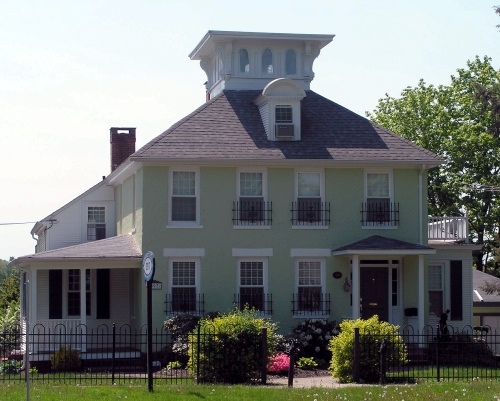
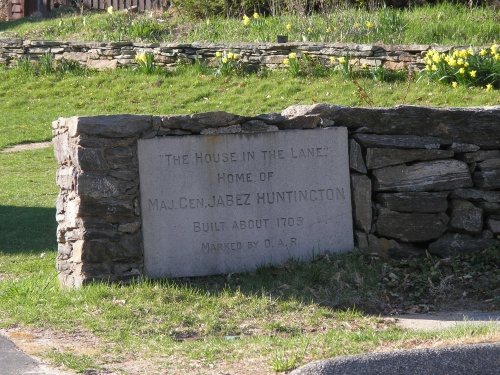
A portion of what would later be known as the Bradford-Huntington House was built in Norwich on the home lot of John Bradford sometime prior to 1691 (perhaps as early as 1660, although a D.A.R. marker on the property gives the date as 1705). The house was bought by Capt. Joshua Huntington, a merchant, in 1719 (or by his father, Simon Huntington, in 1691). In later years he would enlarge and update the house in the Georgian style, adding a gambrel roof and a new chimney. The house was later owned (1745), and expanded with the addition of a rear ell, by his son, Jabez Huntington, who became Major General of the Connecticut militia in 1776, the same year George Washington spent a night in the home during the Revolutionary War. Later, Huntington experienced mental strain from his efforts and resigned in 1779. He died in 1786 and is buried near his house in the Old Norwichtown Cemetery.

Joseph Carpenter’s Shop (1772)

joseph-carpenter-shop.jpg

Joseph Carpenter was a silversmith in Norwich whose shop, built in 1772, still stands on East Town Street, on Norwichtown Green. The shop, where Carpenter also made clocks, may be the only frame silversmith shop surviving in New England. The building is now owned by the Society of the Founders of Norwich and is currently used as a law office.

Today I have also added five new buildings to this blog’s sister site, Historic Buildings of Massachusetts! Please check them out!!!

The Hurd House (1660)

hurd-house.jpg

The Hurd House in Woodbury is a combination of what were originally two smaller houses. The older, north section, dates to around 1680 and was the home of John Hurd, who became the town’s miller in 1681. The south section, which may have originally been the home of Hurd’s son, was added to the older structure in 1718, to increase the overall size of the house. The two original houses were of the end-chimney type, while the structure resulting from the combination has a central chimney. By 1779, a lean-to was added, making the house a saltbox, although this was later removed. In 1967, the house was acquired by the Old Woodbury Historical Society.

A new feature is being launched today at Historic Buildings of Connecticut. I plan to do a series of articles discussing some of the different architectural styles found in Connecticut. I will be using buildings which have appeared on this site as examples, sometimes with different photos than those which have appeared here before. The first of these articles is on Colonial Houses, which can be found at the url address:
https://historicbuildingsct.com/?page_id=502. This and later articles to come will be indexed on the Architecture page (also listed in the bar above the site banner), so please check there for future additions!

The Dr. Daniel Sheldon House (1785)

daniel-sheldon-house.jpg

Dr. Daniel Sheldon, who was once described as having “long held a very high rank among physicians of this state,” began his career in Washington (CT) and later settled in Litchfield. His house in that town, built in 1785 on North Street, has a mansard roof and an uncommon design for eighteenth-century Connecticut houses. The house was lived in until 1889 by his daughter, Lucy Sheldon Beach, who had attended the Litchfield Female Academy and lived to age of 100.

The Benjamin Tallmadge House (1775)

tallmadge-house.jpg

The house originally erected by Thomas Sheldon around 1775, on North Street in Litchfield, is more commonly associated with Benjamin Tallmadge, who purchased it when he arrived in Litchfield in 1782. Tallmadge was an aide to George Washington during the Revolutionary War and served as the general’s intelligence deputy, as well as founding a notable spy ring in New York. Tallmadge married Mary Floyd, daughter of William Floyd, a signer of the Declaration of Independence. In Litchfield, he became a merchant (in partnership with Oliver Wolcott, Jr. and Julius Deming) and was president of Phoenix Bank (later the First National Bank of Litchfield). Tallmadge altered his Georgian house with the addition of two columned porches on the north and south ends. He later completed a memoir of his life and may also have been the model for Col. Davenport in Harriet Beecher Stowe’s autobiographical novel Poganuc People.