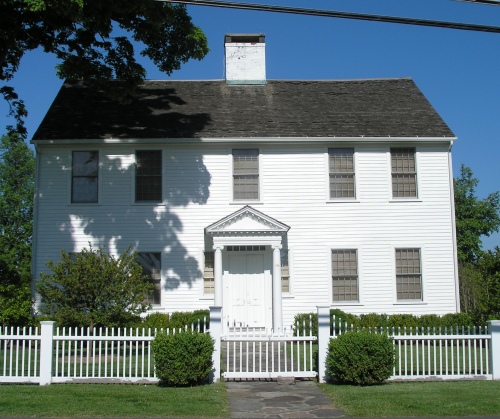
Ozias Lewis House (1806)

The Ozias Lewis House was built in 1806 on South Street in Litchfield. The entrance portico with Ionic columns is believed to have been removed from the Tapping Reeve House, further up South Street, in the nineteenth century. During the 1930s restoration of the Reeve House, a replica of the portico was added. Both Reeve (1783) and Lewis (1819) served as Justices of the Peace for Litchfield County.

The Benjamin Taylor House (1830)

benjamin-taylor-house.jpg

The house built for Benjamin Taylor, a Hartford merchant, on Main Street in Glastonbury in 1830, represents a transition from the Federal to the Greek Revival styles, but is still primarily Federal. The property had earlier been owned by Abraham Phelps, a blacksmith whose shop was located behind the building. For many years the building housed the Blacksmith’s Tavern, during which time the elaborate staircase was added. The restaurant closed in 1997 and the building now houses offices.

Also today, two new entries have been added to Historic Buildings of Massachusetts: The Nathaniel Hawthorne Birthplace and the Old State House.

Downey House (1842)

downey-house.jpg

The early Italianate Downey House, on the corner of Court Street and High Street in Middletown, represents the transition from the Greek Revival to the Italian villa style. It was built in 1841-1842 for Elihu W. N. Starr, a member of a well known family of sword and gun manufacturers, but was sold to the son of Samuel Russell in 1853. It was later used (1889-1911) as the Misses Patten’s School for girls and was purchased by Wesleyan University in 1922. It was named Downey House in honor of Dr. David G. Downey, a president of the University’s board of trustees.

The Exchange Building (1832)

exchange-building.jpg

The Exchange Building, on Church Street across from New Haven Green, was built in 1832 to serve as a commercial structure with a simple repeated Greek Revival window pattern. The builder, Atwater Treat, may have followed a design of Ithiel Town. The Exchange, New Haven’s first building constructed specifically as a commercial one, featured an open ground floor for shops. The building had a number of later changes, including the removal of the original cupola, which was eventually replaced by a billboard. In 1990, the building was restored, with a rebuilt cupola and and stone columned facade on the ground floor.

Herbert J. Mills House (1899)

herbert-j-mills.jpg

The house built in 1899, on Summer Street in Bristol for Herbert J. Mills, is an example of how a historic home can suffer from later unsympathetic alterations. Mills, who was the president of the H.J. Mills Box Shop company, lived in a Queen Anne-style house that still stands. With the exception of the decoration of the front entry porch, the rest of the exterior has lost most of its original stick style decoration and roof brackets. The integrity of the house’s tower has also been compromised by an addition on the north side of the building.

The Thomas Coit House (1782)

thomas-coit-house.jpg

The house of merchant Thomas Coit, on Broadway in Norwich, was built in 1782 in a grand Georgian style, although some of the building’s elaborate decoration was added later under the influence of the Colonial Revival movement. Coit was a partner in a privateering firm during the Revolutionary War and in 1784 was Collector of Revenue in Norwich, serving under Christopher Leffingwell, from whom he had purchased the land to build his house. In 1798, he moved to Canterbury and the house was sold to Deacon Jabez Huntington. Records show that both of these first two residents of the house were slave owners.