Redwood (1778)

redwood.jpg

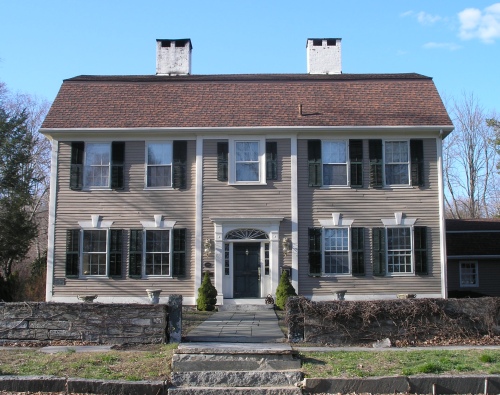
David Trumbull, a brother of Jonathan Trumbull, Jr and the artist John Trumbull, hired the builder Isaac Fitch to construct his house in Lebanon. Known as “Redwood,” the David Trumbull House was built in 1778-1779. He also had Fitch make reproductions of expensive English furniture for the house. Serving as commissary of the Colony of Connecticut during the Revolutionary War, David Trumbull provided supplies for General Rochambeau‘s army at Newport, Rhode Island in 1780 and supplied food and housing for the Duke de Lauzun‘s cavalry legion during their 1780-81 encampment in Lebanon. Redwood became Lazun’s headquarters during this period. David Trumbull’s son, Joseph Trumbull, was born in the house in 1782. He would later become the governor of Connecticut from 1849-1850. The building is now home to Lebanon Green Vineyards.

The Jedediah and Ebenezer Huntington House (1765)

Huntington House

Jedediah and Ebenezer Huntington were brothers who served in the Revolutionary War. Sons of General Jabez Huntington, they successively occupied a house, built in 1765, on East Town Street in Norwich. Jedediah Huntington fought at Bunker Hill and eventually became a general. He married Faith Trumbull, the daughter of Governor Jonathan Trumbull. After the war, He became the Collector of Customs at New London and moved there. His brother, Ebenezer Huntington, then lived in the Norwich House from 1789. Ebenezer had also served in the war and later served as a Federalist Congressman in the House of Representatives. The semicircular window over the door and keystones over the first floor windows were later Federal style additions to the house.

Yale Divinity School (1931)

yale-divinity-school.jpg

As Yale University expanded and acquired property along Prospect Street in New Haven, it became possible to design new campus quadrangles. The buildings of the Yale Divinity School were constructed in 1931 and designed by the architectural firm of Delano & Aldrich of New York. While based on Thomas Jefferson‘s plan for the University of Virginia, the Yale Divinity School quadrangle has much harder lines and sharper angles.

Sterling Memorial Library (1927)

sterling-memorial-library.jpg

Designed by James Gamble Rogers to resemble a Gothic cathedral, but with a sixteen-story tower of book stacks, Yale’s Sterling Memorial Library is an imposing structure with rich ornamentation. Construction began in 1927 and the building was completed in 1930. There have been various additions made to the library over the years, including the 1968-1971 construction of the underground Cross Campus Library (now renamed the Bass Library). In 1992, the section of High Street in front of the library was closed to vehicles and was landscaped.

Elias Sprague House (1821)

elias-sprague-house.jpg

A late example of a Colonial-style house in what is known as the Cape Cod style, the Elias Sprague House in Coventry was built in 1821 and is located on South Street, not far from the Nathan Hale Homestead and the Strong=Porter House. Very little is known about the house’s builder, Elias Sprague. The home is now a property of the Coventry Historical Society, although that organization is currently seeking to sell the house in order to maintain its other buildings.

1643 Boulevard, West Hartford (1900)

1643-boulevard.jpg

Another example of an “American Foursquare” home, the house at 1643 Boulevard in West Hartford was built around 1900 in what was the town’s first modern subdivision, begun in 1896. The area is now the Boulevard-Raymond Road Historic District. The house’s current owners won a 2007 West Hartford Historic Preservation Award for their construction of a new one-story addition to their Colonial Revival-influenced home which is compatible with the original structure and matches it seamlessly.