
The 1901 Henry R. Hovey House, on Prospect Avenue in Hartford, is a Colonial Revival structure, featuring Georgian and Federal elements. Hovey was an employee of the Aetna Life Insurance Company.
The 1901 Henry R. Hovey House, on Prospect Avenue in Hartford, is a Colonial Revival structure, featuring Georgian and Federal elements. Hovey was an employee of the Aetna Life Insurance Company.

A Queen Anne style home, which also features elements of the Gothic Revival, Shingle and Colonial Revival styles, the Henry Dwight Bradburn House, on Prospect Avenue in Hartford, is an eclectic mix. The house dates to 1900, the year Bradburn retired as manager of the Nonotuck Paper Company of Holyoke, Mass. The house bears a strong resemblance to the W. F. Clark House in Springfield, Massachusetts.

This week we look at houses on Prospect Avenue, the border between Hartford and West Hartford. An eclectic mix of large houses were constructed here in the later nineteenth century. One of the earliest is that of Burdett Loomis, an inventor and manufacturer of gas plant machinery. A civic leader in Hartford, in 1873 he also opened a trotting horse park on New Park Avenue. This would later evolve into Charter Oak Park, which early in the twentieth century would feature Luna Park, a popular amusement park. In the late nineteenth century, Prospect Avenue was considered to be in the countryside, and around 1885, Loomis bought a c. 1845 Greek Revival farmhouse and transformed it into his country estate by adding a new Queen Anne-style section on the front.

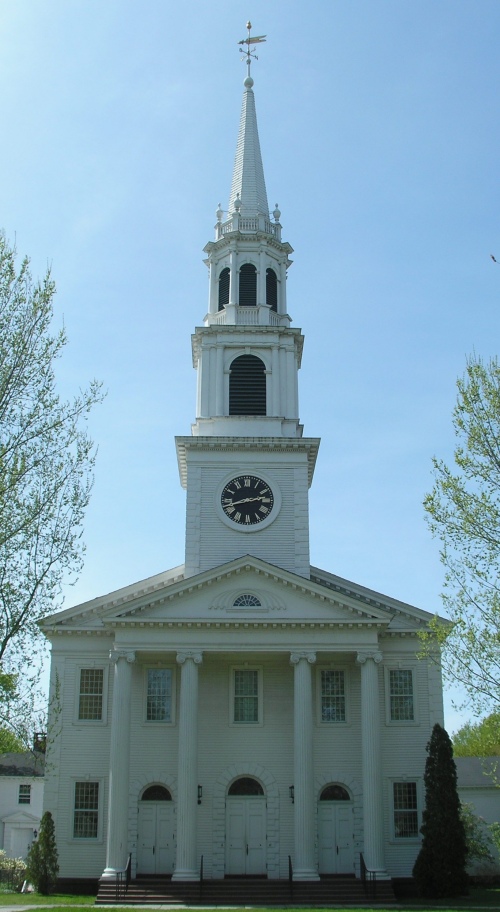
Lyme’s First Ecclesiastical Society‘s first Meeting House was constructed in 1665-6 and the first minister was Moses Noyes. A second was built in 1689 and in 1738, both earlier structures were dismantled to build the even larger third Meeting House. All three were located on Johnny Cake Hill. When the third church was destroyed after being hit by lightning in 1815, the fourth Meeting House was built in 1816-17 on Lyme Street in Old Lyme. Its architect was Samuel Belcher, who also designed the John Sill and William Noyes houses on Lyme Street. The fourth Meeting House burned on July 3, 1907–the 92nd anniversary of the burning of the third meetinghouse. It was replaced in 1910 by the current Meeting House of the First Congregational Church of Old Lyme, a replica of its predecessor. The American impressionist artists who frequented Lyme in the early twentieth century often painted the church, most notably Childe Hassam.

The Daniel Chadwick House, on Lyme Street in Old Lyme, was built in 1830 in the Greek Revival style and includes a widow’s or captain’s walk. It was the home of a notable sea captain involved in trade with London. He died tragically by taking his own life in 1855. Chadwick‘s son, also named Daniel Chadwick, was a notable lawyer. The bays and porches on either side of the house are later additions. The house is also currently for sale.

Located further south on Lyme Street in Old Lyme from the house of William Noyes, Jr. is a house built the same year (1817) and designed by the same architect (Samuel Belcher). The Federal style house, whose original carpenters were shipbuilders, was constructed for John Sill, a “customs runner” who secreted his smuggled goods in hidden closets in the house. With Sill’s arrest in 1820, the house was bought by William Noyes and in 1822 by Charles Johnson McCurdy, a Yale graduate, politician, ambassador and judge. In 1944, an extensive restoration was undertaken by owner C. Whitney Carpenter with the local architect, Robert I. Carter, who later bought the home. In 1983, the house was sold by Carter’s children to the Lyme Academy College of Fine Arts. It now houses offices and gallery space. More information can be found in this pdf file of River and Sound.

Across Lyme Street in Old Lyme from the Bee and Thistle Inn is the house Joseph Noyes had built for his son, Dr. Richard Noyes, in 1814, the year Richard married Martha Noyes of Stonington. The Colonial Revival dormer windows were added in 1922. The house remained in the Noyes family until the 1930s. From 1939 to 1946, the house was home to the Madison Military Academy, a college preparatory school for boys. Afterwards it was the White Farms Inn and is now a private residence.

You must be logged in to post a comment.