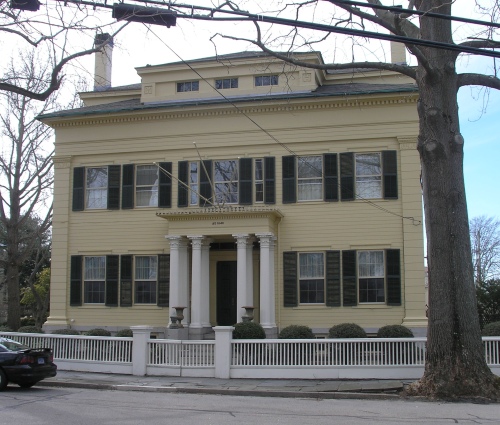
Peck Tavern (1680)


peck-tavern.jpg


The Peck Tavern, where George Washington once danced, is located where Sill Lane branches off from US 1 in Old Lyme. It may have been built as early as 1680, although the main block achieved its present form by about 1769, when John Peck acquired the tavern. The building served as an inn and tavern from the mid-eighteenth century into the nineteenth and remained in the Peck family until 1904. In the 1930s, the building was used by the Old Lyme Guild, a non-profit arts and crafts organization.  In recent years, the house served as a bed & breakfast.

First Congregational Church, Canton Center (1814)

first-church-canton-center.jpg

A separate Ecclesiastical Society for western Simsbury was established in 1750, although a meetinghouse was not constructed until 1763. In 1806, it became the First Ecclesiastical Society of Canton when that section of Simsbury was incorporated as its own town. In 1814, a second and larger meetinghouse was constructed on the site of the first, on Cherry Brook Road in Canton Center. In 1873, the church was remodeled inside and Gothic stained glass windows were added. Since 1967, the windows and interior have been restored to an approximation of the earlier style. The church’s address is 184 Cherry Brook Road.

Also, if you have not yet read my latest article on architecture, it is now available! The subject is Greek Revival Houses!

The William Pendleton House (1831)

william-pendleton.jpg

The William Pendleton House, on Main Street in Stonington Borough, is a Greek Revival style house, which retains elements of the Federal style. It was built after 1831 (perhaps as late as 1840) for Pendleton, who was a merchant. The gable may have been added later. During Prohibition, the house’s basement was used as an illegal bar, or speakeasy, and the period decor and original bar have been preserved by later owners.

Stonington Harbor Lighthouse (1840)

old-lighthouse-museum.jpg

Stonington’s first lighthouse was built in 1824, but after an 1838 inspection, it was found the building was deteriorating and had moved 25 feet due to erosion. Reusing stones from the first building, a new stone lighthouse, with a 35-foot tower, was built in 1840 by John Bishop further up Stonington Borough’s peninsula. This lighthouse served until 1889. By that time, a privately owned signal on Stonington’s newly constructed breakwater had proven to be more effective than the old lighthouse, so a new cast-iron Stonington Breakwater Light (replaced in 1926) was built. The earlier Harbor Light continued to be used as the new lighthouse keeper’s home until a house was built in 1908. In 1925, the old building was sold at auction and then donated to the Stonington Historical Society. Since 1927, the Stonington Harbor Lighthouse has been open to the public as the Old Lighthouse Museum, with exhibits about Stonington’s maritime history.

Avon Old Farms Inn (1757)

avon-old-farms.jpg

The oldest section of what is now the Avon Old Farms Inn, at the intersection of Routes 10 and 44 in Avon, is a house built by Nathaniel North in 1757, on land which had been granted to his father, Thomas North, after his service in King Phillip’s War. Thomas’ father, John North, had arrived in the vicinity of Northington (the north part of Farmington, now Avon) in the 1630s. The house was later owned by Nathaniel North‘s great-grandson, John North, a blacksmith who added the 1832 stone blacksmith shop, which is now connected to the house. Across Route 44, once stood Marshall Tavern, a former stagecoach stop, which was demolished in 1933 to improve traffic safety at the intersection. The North House was also used to accommodate travelers, becoming the Old Farms Inn in 1923.