Nicholas Callahan House (1762)

nicholas-callahan-house.jpg

Dated to 1762 or 1776, the Nicholas Callahan House, on Elm Street in New Haven, faces New Haven Green and is located between the First Methodist Church and Hendrie Hall. Callahan was a loyalist and during the Revolutionary War the house became a meeting place known as Tory Tavern. It was eventually confiscated by the town in 1781. The two-story porch around the house’s front entrance was added in the later nineteenth century and altered again in the twentieth in the Federal style. In 1910, the house was acquired by Elihu, a Yale Senior Society. The following year, the house was remodeled by Everett V. Meeks, who was the head of Yale’s Department of Architecture and later the Dean of Yale’s School of Fine Arts from 1920 to 1947

Edward S. Coe House (1876)

edward-coe-house.jpg

The Edward S. Coe House, on Main Street in Cromwell, was built in 1876. Coe was the son of the Middletown butcher, Samuel Coe. He married Elizabeth Strickland Savage, a daughter of Ralph Bulkely Savage. By 1869, Edward Coe was treasurer for the J. & E. Stevens Company, founded by his uncles, John and Elisha Stevens. He eventually became president of the company (1898-1907). He was also president of the Cromwell Dime Savings Bank and was Cromwell‘s delegate to Connecticut’s 1902 Constitutional Convention. Coe’s house is in the Italianate style, which was favored by other members of the Stevens Family.

George Park Fisher House (1865)

fisher.jpg

The late Italianate house of Rev. George Park Fisher, on Hillhouse Avenue in New Haven, was built in 1865. Rev. Fisher was a professor at Yale Divinity School and the author of History of Christian Doctrine (1896), among other books and essays. The house was later rented (1907) and eventually purchased (1910) by Louis H. Bristol. Yale acquired the house in 1935. Since 1977, it has housed Yale’s Economic Growth Center.

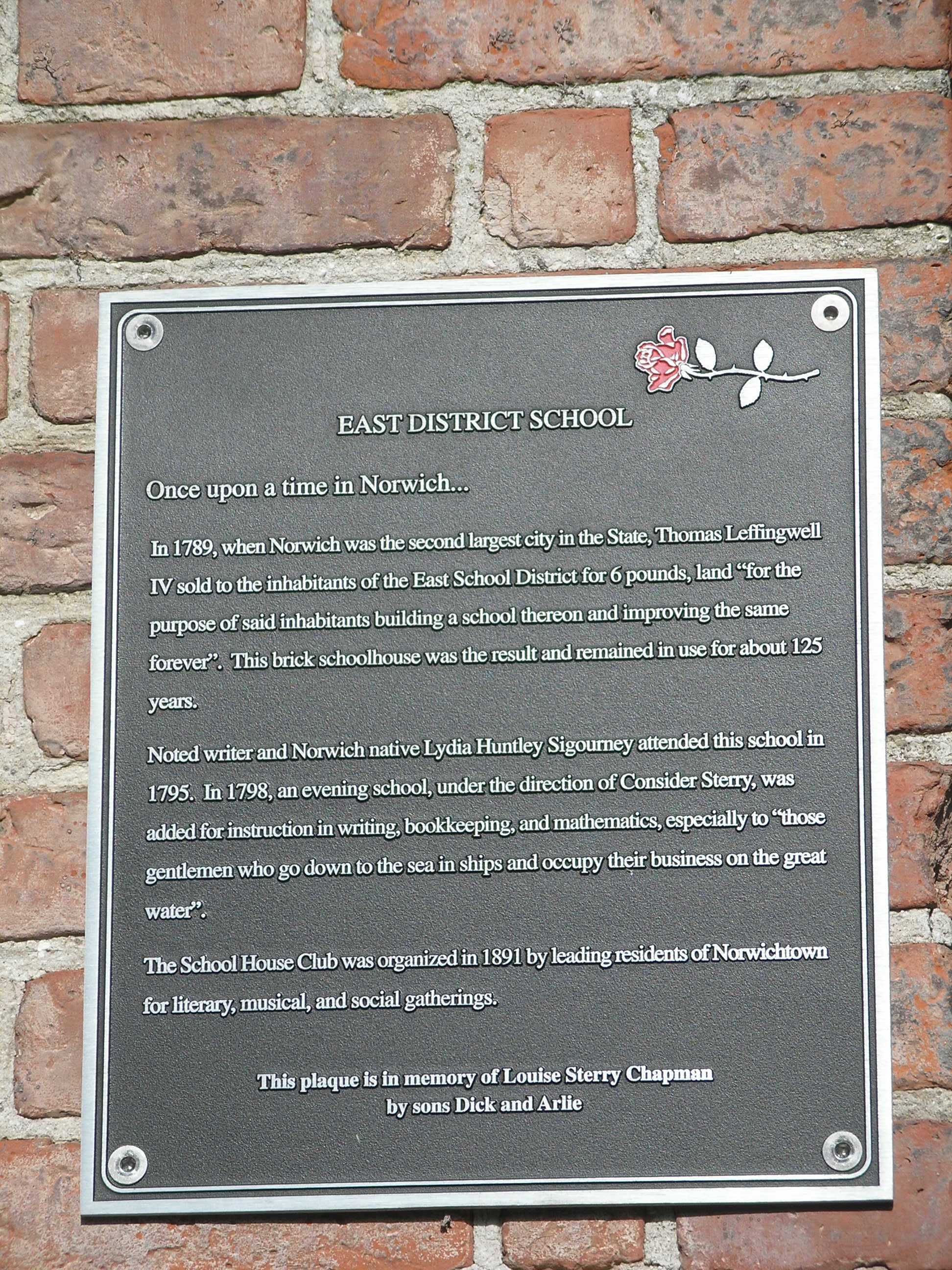
East District School (1789)

east-district-school.jpg

The brick East District School in Norwich was built in 1789, on land donated to the town by Thomas Leffingwell IV. It was used for about 125 years and its students included Lydia Huntley Sigourney, who attended in 1795. The school was quite progressive, with boys and girls being taught the same subjects. Starting in 1891, the building was used by the School House Club for cultural and social events. Located on Washington Street, it is now a historical museum.

Capron-Philips House (1864)

capron-philips-house.jpg

The Italianate-style Capron-Philips House, at 1129 Main Street in Coventry, was built sometime in the 1860s. It served for many years as a post office and later as an apothecary shop (or drugstore). The house is on a corner at an important and once quite busy intersection. A large elm stood nearby, in the middle of Mason Street, until 1938. It was known as the Meetinghouse Tree because notices were posted on it.