Fayerweather Gymnasium (1894)

fayerweather-hall.jpg

Wesleyan University‘s Fayerweather Gymnasium was built in 1894. Funds for its construction were provided through a bequest from Daniel B. Fayerweather, who was not otherwise connected to Wesleyan, but who was inspired to donate to Methodist institutions. Designed by J. Cleaveland Cady, the Romanesque Revival style building had later additions, including a 1913 east wing, built to accommodate a swimming pool, and a rear addition in 1979. No longer used as a gymnasium, Fayerweather Hall has recently been restored to its 1894 dimensions to complement the adjacent construction of the new Usdan University Center.

Oliver Smith House (1761)

oliver-smith-house.jpg

The Oliver Smith House, on Main Street in Stonington Borough, perhaps the oldest surviving house in town, was built in the early 1760s (after 1761). Smith, a merchant and one of the defenders of Stonington during the American Revolution, was the last owner of Venture Smith. Born under the name Broteer Furro, Venture was an African prince enslaved at the age of six and brought to America. Eventually buying his freedom when in his 30s from Oliver Smith, Venture went on to purchase land and became prosperous by farming, fishing and shipping goods. In the 1790s, Venture Smith dictated his life story to a schoolteacher named Elisha Niles. This autobiography was then published as A Narrative of the Life and Adventures of Venture, a Native of Africa but Resident above Sixty Years in the United States of America, Related by Himself (1798).

Immanuel St. James Church (1843)

immanuel-st-james-episcopal-church.jpg

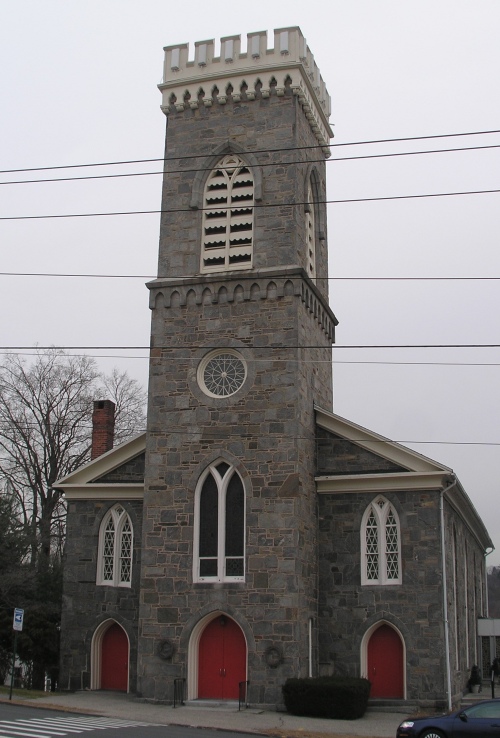
On the other side of Derby Green from the Sterling Opera House is Immanuel St. James Episcopal Church, on Minerva Street. Built in 1843, the building had two predecessors: the church on Elm Street in what is now Ansonia, at the Old Episcopal Graveyard (which was later moved across the street and attached to the Humphreys House), and its successor on Derby Avenue, which was called St. James Church. When the third building was constructed in 1843, some families continued to worship at the old church and organized Christ Church parish in Ansonia. In 1970, St. James Church in Derby began a Joint Ministry with Immanuel Church in Ansonia, and the two merged in 1991. The stone church was was built by the stonemason Harvey Johnson and the carpenter Nelson Hinman. The land for the church was donated by Sheldon Smith and Anson G. Phelps. A rectory was constructed next door in 1853.

Sterling Opera House (1889)

sterling-opera-house.jpg

The industrial village of Birmingham, initially developed by such entrepreneurs as John I. Howe, Anson Greene Phelps and Sheldon Smith, continued to industrialize and was incorporated as the City of Derby in 1893. With growth came labor unrest. In 1901, after seventy woman in the underwear room of the Paugussett Mills had been on strike for 54 days, Samuel Gompers, president of the American Federation of Labor, arrived in Derby at the invitation of Stephen Charters, head of the local carpenters union. In one day, Gompers negotiated a settlement and the next night announced the results to a packed audience at the Sterling Opera House, on Elizabeth Street, facing Derby Green. The Italianate-style Opera House, named for Charles Sterling of the Sterling Piano Company, was completed in 1889 and was in use until 1945. Many famous individuals, from Harry Houdini to Amelia Earhart, appeared at the Sterling during its time as a vaudeville palace. The two lower floors were used as the Derby city hall and police station until 1965. The building was designed by H.E. Ficken (who was also involved in creating Carnegie Hall). He modeled the Hall’s triangular seating plan on the ideas of German composer Richard Wagner as realized in the famous Bayreuth Festspielhaus in Bavaria. The Sterling became known for its excellent acoustics. Planning for the restoration of the building, begun several years ago. Work began and then stalled for some time, but continued renovations of the exterior are now underway.

James Stokes House (1830)

stokes-house.jpg

The homestead of James Stokes is on Elm Street in Ansonia. The current house, completed around 1830, either replaced or incorporated an earlier one on the site, built in 1778. Stokes married Caroline Phelps, the daughter of Anson Greene Phelps, who founded Ansonia. Born in Simsbury, Phelps had become a successful businessman and manufacturer in New York. In the 1830s, Phelps joined with Sheldon Smith to found a manufacturing village in Derby called Birmingham (now the City of Derby). Facing obstacles in his attempts to expand Birmingham to the north in the 1840s, Phelps founded a new manufacturing settlement on the east bank of the Naugatuck River, in the older part of Derby which was named “Ansonia” after its founder. Phelps established a copper wire mill in 1845, which merged with Birmingham Copper Mills in 1854 and later became Ansonia Copper & Brass. Ansonia separated from Derby in 1889, later incorporating as a city in 1893. Anson G. Phelps was active in the Congregational Church and contributed to many philanthropic causes. His daughter, Caroline Phelps Stokes, and son-in-law, James Stokes, used their Ansonia house as a summer home and Anson Phelps often visited. Stokes’s son, Anson Phelps Stokes I, was a merchant, banker and multimillionaire; his grandson, Anson Phelps Stokes II, was a philanthropist; his great-grandson, Anson Phelps Stokes III, was an Episcopal Bishop. Another son of James Phelps was William Earl Dodge Stokes, a multimillionaire who developed much of New York’s Upper West Side and built a famous hotel called the Ansonia on Broadway. James Phelps’s daughter, Caroline Phelps Stokes, a philanthropist whose will established the Phelps-Stokes Fund, donated a library to the City of Ansonia.

John I. Howe House (1845)

howe-house.jpg

As resident physician in the New York City Almshouse, Dr. John Ireland Howe observed how English residents laboriously made pins by hand. In 1831, Dr. Howe invented a pin-making machine and founded the Howe Manufacturing company in New York in 1835 to produce pins. In 1838, he moved the company to Birmingham, a section of Derby which would later become the City of Derby. The Howe Pin Company grew as Howe perfected his methods with additional patented inventions. In 1910, Howe‘s son donated his original Pin Machine to the Smithsonian. Howe’s stone house, constructed in 1845 on Caroline Street in Derby, was perhaps built by Lucius Hubbell, who constructed other stone houses in Derby and Shelton. The house, now owned by the Derby Historical Society, will eventually house the Lower Naugatuck Valley Industrial Heritage Center.

General David Humphreys House (1698)

david-humphreys.jpg

Located across from the Old Episcopal Burying Ground, on Elm Street in Ansonia, is the house where General David Humphreys was born in 1752. The house was built in 1698 to be the home of the new Congregational Minister of the Town of Derby (Ansonia was then part of Derby). It was first occupied by the Reverend John James, who sold the house in 1706 to the Reverend Joseph Moss. In 1735, the Reverend Daniel Humphreys bought the house from Joseph Moss’s widow, Abigail Moss. At some point in the 1730s, the house was enlarged to roughly its current size. Humphreys was a Congregational minister, but lived across the street from Derby’s Episcopal church, with its cemetery. Later, when Derby’s second Episcopal Church was built down the street to replace the original smaller building, the old church building was moved across Elm Street and attached to the Humphreys House for use as a summer kitchen. Rev. Humphreys died in 1787. His son, David Humphreys, never owned the house, but visited it as his family’s ancestral homestead. During the Revolutionary War, David Humphreys served as an aide-de-camp and close adviser to George Washington and, after the Battle of Yorktown, he was honored by receiving the surrendered British standards and presenting them to Congress. After the War, Humphreys served as a diplomat in Europe and General Tadeusz Kosciuszko, the Polish Revolutionary hero, visited him at the house on Elm Street. Returning from Spain, Humphreys brought back with him America’s first Merino sheep, going on to found the Humphreysville (now Seymour), where wool textiles were manufactured. David Humphreys was also a poet and a member of the literary group known as the “Hartford Wits.” His writings were collected in The Miscellaneous Works of David Humphreys (1804).

The house was not owned by David Humphreys, but by his brother Elijah, who had married Anna Mansfield, the daughter of the Episcopal minister, Richard Mansfield. Elijah, who died at sea, willed the house to his son, Elijah, Jr., who sold it to his sister, Betsey, and her husband, Thomas Vose, a sea captain and business partner of David Humphreys. The house had other owners over the years, eventually being converted into three apartments. Preserved by the Humphreys House Association, in 1961 the house was turned over to the Derby Historical Society. Restored beginning in 1976, it was first opened to the public as a museum in 1980.