Joseph Porter, who worked for the Sperry & Barnes meat-packing plant (on Long Wharf) and was an original board member of the Free Public Library, lived in an 1879 Italianate house on Wooster Street in New Haven.
Joseph Porter, who worked for the Sperry & Barnes meat-packing plant (on Long Wharf) and was an original board member of the Free Public Library, lived in an 1879 Italianate house on Wooster Street in New Haven.

The Giles Hall House, built in 1760, is on South Elm Street in Wallingford. The house is near the site of the birthplace of Giles Hall‘s brother, Lyman Hall. After graduating from Yale, Lyman Hall became a physician in South Carolina and later settled in Georgia. He was a supporter of the Revolution and was a signer of the Declaration of Independence for the State of Georgia.

One of Connecticut’s few examples of an Octagon house (which was popularized by Orson Squire Fowler in the 1850s) is in the Yalesville section of Wallingford. The house, located at 31 New Place Street (and one of two on the street) was built around 1856. (Edits to this entry are in bold).

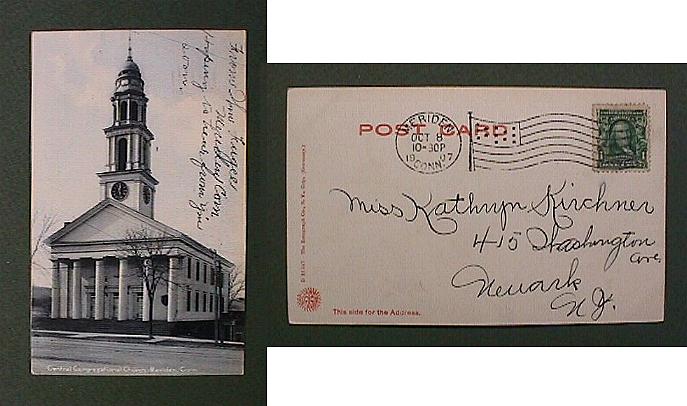
The first Congregational church to be built in Meriden was erected in 1727 in the south-eastern section of town. This was succeeded by a new building in 1755, in the center of town. This was then replaced by a new church, erected in 1830 nearby, at the corner of Broad and East Main Streets. This is the oldest surviving church building in Meriden. It was originally the home of the First Congregational Church, but the church split in 1848. With the center of population in the town moving westward, three-quarters of the congregation left to form a new First Congregational Church, while the remainder continued at the old location, which was renamed Center Congregational Church. (more…)

The former High School in Meriden, which now serves as the Board of Education building, was built in 1885. The building is on Liberty Street, near the Town Hall, and is a good example of the Romanesque style, with a prominent Roman-style rounded arch entrance. The school had actually begun classes in 1881, as the New Central School, which rented the second floor of the German-American School on Liberty Street before the 1885 school building was completed.

Captain Joseph Riggs was an active citizen of Derby in the eighteenth century. He managed the area’s first lottery, which raised money for two bridges to cross the Naugatuck River and a highway from Derby to Woodbury. Riggs was also a patriot during the Revolutionary War. The Riggs House, on Elm Street in what is now Ansonia, was built in 1760.

The town of Granby began as a settlement called Salmon Brook, which eventually separated from Simsbury. The Abijah Rowe House, built around 1732, is the oldest surviving building from the original settlement. It was built by Nehemiah Lee, who sold it to his son-in-law, Peter Rowe, in 1750. Three years later it was acquired by Peter’s brother, Abijah Rowe. Both brothers were blacksmiths and may have produced some of the house’s hardware. Rowe died in 1812 and the following year his heirs sold the house to Elijah and Joseph Smith. In 1903, it was sold by the Smith family to Fred M. Colton, a tobacco grower, whose daughters, Mildred Colton Allison and Carolyn Colton Avery, gave the house to the Salmon Brook Historical Society in 1966. It is now part of a campus of four historic structures open to the public.