St. Panteleimon Russian Orthodox Church (1972)

st-panteleimon.jpg

St. Panteleimon Russian Orthodox Church in Hartford was organized in 1958. It is a parish of the Russian Orthodox Church Outside Russia (ROCOR), founded by Russian refugees as a response to the rule of the Bolsheviks. Another Orthodox church in Hartford, All Saints Orthodox Church, is a parish of the Orthodox Church in America (OCA), which traces its origins to the church established in Alaska when it was still part of the Russian Empire. St. Panteleimon Church was built in 1972 and was designed by Dimitri Alexandrow with the architectural firm of Austin & Mead. Labor for the construction was provided by members of the congregation. Fr. Dimitri, who was the congregation’s priest and also a master icon painter, taught himself architecture in order to design the church, learning the type of masonry used in constructing Orthodox churches. He was later consecrated a monk, taking the monastic name of Daniel, and in 1988 was consecrated as Bishop at the Russian Orthodox Old Rite Church of the Nativity in Erie, PA. Bishop Daniel, who speaks a dozen languages, also wrote a book called, Selected Fables From the East, Translated by a Russian Priest. (more…)

Goodspeed Opera House (1876)

goodspeed-opera-house.jpg

The Goodspeed Opera House is a notable historic landmark along the Connecticut River in East Haddam. It was built in 1876 by William Goodspeed, a merchant and banker. Originally serving as a store, office and steamship docking point, as well as having a theater on its top two floors, the Goodspeed was built in the distinctive Second Empire style (with a mansard roof) to attract the attention of traffic along the river. The first performance at the Opera House was on October 24, 1877. After Goodspeed’s death in 1926, the building was used for various purposes, including being a World War I militia base, a general store and a storage facility for the Highway Department. Having fallen into disrepair, it was restored in 1959 by Goodspeed Musicals, a non-profit organization dedicated to musical theater. Rededicated in 1963, the Goodspeed Opera House has continued since then to be the home for performances of musicals and is one of several facilities currently owned by Goodspeed Musicals.

Storrs Congregational Church (1927)

storrs-congregational-church.jpg

The Congregaional Church in Storrs began as a the Second Ecclesiastical Society of Mansfield, separating from the First Congregational Church in Mansfield Center in 1737. The first meeting house was constructed in 1745-1746 at what is now the corner of North Eagleville Road and Route 195. A later church, built in the 1840s, replaced it and can be seen in many old photos of Storrs. The church was designed by builder-architect Edwin Fitch. It was here that the Second Commencement for the Storrs Agricultural School (which became the University of Connecticut) was held in 1883. That church was replaced by the current brick church, built in 1927. This church was built at the same location as its predecessors, in what was then the center of the campus. At the same time, UCONN purchased the Dunham Memorial Carillon and, not having a suitable tower to place it in, installed it in the church.

Beatrice Fox Auerbach House (1911)

beatrice-fox-auerbach-house.jpg

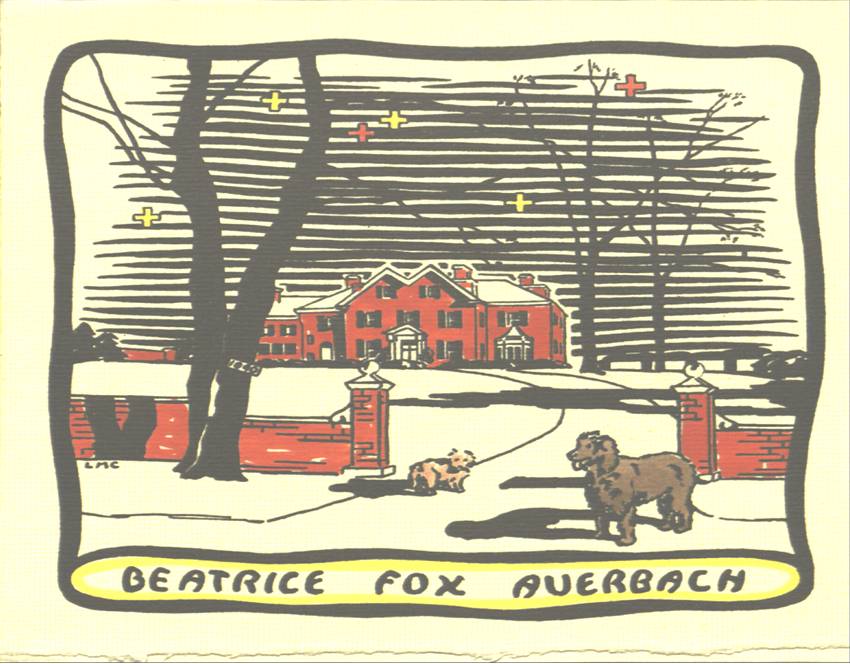
The residence of Beatrice Fox Auerbach, on Prospect Avenue in Hartford, was built in 1911 and was designed by the firm of LaFarge & Morris. Additions were made to the home in 1923. The Georgian Revival style house also features elements of the Tudor Revival, including the twin gables and a leaded casement bay window. Beatrice Fox Auerbach was the granddaughter of Gerson Fox, who in the 1840s had founded the store in Hartford that would evolve into the G. Fox & Company department store. Beatrice Fox‘s father, Moses Fox, succeeded his father as president of the company and Beatrice married George Auerbach, who eventually became the company’s secretary-treasurer. Her husband died in 1927 and after her father‘s death in 1938, she became the store’s president. Under her leadership, the company grew until it became the largest privately owned store in the country. She remained president until she sold her privately owned stock in 1965. Auerbach, who died in 1968, was also renowned civic leader and philanthropist. A biography by Virginia Hale has recently been published called A Woman in Business: The Life of Beatrice Fox Auerbach. In 1979 the house was given to the University of Hartford.

The Simon Shailer House (1827)

simon-shailer-house.jpg

Rev. Simon Shailer became minister of Haddam’s Baptist Church in 1822. In 1827, he built a house on Saybrook Road in Shailerville adjacent to a house he had constructed for his son that same year. The houses are very similar in their Federal style design, although the Simon Shailer House has a Victorian-era balustraded porch with a hipped roof. Another son of Simon Shailer, Nathan Emery Shailer, also became a Baptist minister. After Rev. Simon Shailer died in 1864, his widow and daughter lived there and it is now owned by a descendant.

The Russell Shailer House (1827)

russell-shailer-house.jpg

Around 1827 in the Shailerville section of Haddam, where many homes were built by the close-knit Shailer family, Russell Shailer built a Federal style home after his marriage to Huldah B. Arnold. At first, his father, Rev. Simon Shailer, continued to own the land on which the house was built and built a home for himself at the same time next door. When Simon, a Baptist minister, died in 1864, Russell, who was a deacon in the church, received full title to the property. Behind the house was the Shailer and Knowles factory, where stamped and pressed metal products were manufactured from the 1870s to 1914. The houses of both father and son continue to be owned by a descendant of Russell Shailer.

Hayden Chandlery (1813)

hayden-chandlery.jpg

Captain Richard Hayden‘s Chandlery in Essex was built in 1813 and originally stood at the corner of Main Street and Novelty Lane. Constructed in the Federal style, it served as a chandlery (a store selling supplies and equipment for seamen and ships). Built next to Hayden‘s shipyard, the building continued to be used as ship’s store, although by the early twentieth century the upper floor housed a tenement. The first floor windows and the projecting windows on the second floor are later additions. The building was moved to its present location in 1949 by the then owners of the Griswold Inn. The chandlery and nearby steamboat dock warehouse were purchased by the Connecticut River Foundation in 1974, in order to preserve the historic waterfront. Renamed the Connecticut River Museum, the institution restored the chandlery in 1975 to display exhibits. Thomas A. Stevens, a former director of Mystic Seaport, died in 1982 and left his library to the museum. That same year, the warehouse had been converted into a museum building and the chandlery was again renovated, this time to hold the Thomas A. Stevens maritime research library.