Bill Memorial Library (1890)

bill-library.jpg

The Bill Memorial Library in Groton, adjacent to Fort Griswold Battlefield State Park, was founded by Frederic Bill, a publisher and linen goods manufacturer, who was born in the part of Groton which is now the town of Ledyard and who retired to a farm in Groton on the Thames River. The library, dedicated to the memory of Bill’s sisters, Eliza and Harriet, began in 1888, as a room in Groton’s First District Schoolhouse. The Bill Library building, designed by the Worcester architect, Stephen C. Earle, was dedicated in 1890. Bill expanded the library in 1907, enlarging the main reading room and providing space for a natural history museum. The library was again expanded in 1994. After the death of his first wife, in 1894, Bill married Julia 0. Avery, the libary’s first librarian.

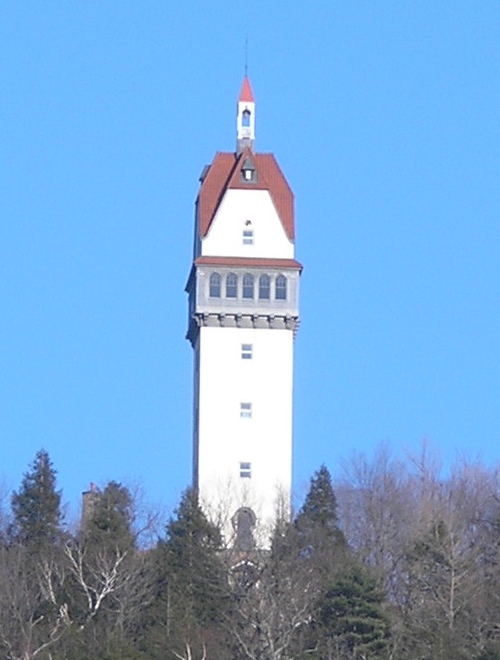
Heublein Tower (1914)

heublein-tower-01.jpg
YouTube player

The 165-foot Heublein Tower, in Talcott Mountain State Park in Simsbury, is a very notable Connecticut landmark which provides spectacular views of Hartford and the Farmington River Valley. It was built as a residence for Gilbert Heublein, a food and drink magnate and manufacturer of A1 Steak Sauce, and was modeled on castles in his native Bavaria. In 1875, a young Heublein was hiking on the mountain with his fiancee and said, ”Someday Louise, I’m going to build you a castle on this mountain.” The Tower, constructed to withstand 100 MPH winds, was designed by Smith and Bassette and built by T. R. Fox and Son in 1914. The rest of the residence was added around 1925. The tower later opened to the public as part of the state park and many visitors hike up to visit it each year. There have been a number of restorations of the building, most recently through the efforts of the Friends of Heublein Tower.

New London Courthouse (1784)

new-london-court-house.jpg

New London County Courthouse was built in 1784 on Huntington Street at the head of State Street in New London. It was designed by the Lebanon builder, Isaac Fitch, and at first the building served as both town hall and courthouse. Originally built closer to State Street, the courthouse was moved back when Huntington Street was widened in 1839. Dudley St. Clair Donnelly designed a rear addition, built in 1909, and a modern addition by Hirsch and Persch was constructed in 1982. The New London Courthouse is one of America’s oldest courthouses still in use.

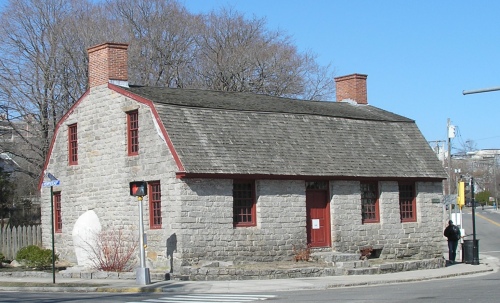
The Nathaniel Hempsted House (1759)

huguenot-house.jpg

The Nathaniel Hempsted House is a stone, gambrel-roofed house on Jay Street in New London. It was built in 1759 by Nathaniel Hempsted, the grandson of the diarist Joshua Hempsted, whose house is located just behind it. Like the William Coit House, the Nathaniel Hempsted House was once on the waterfront, before Bream Cove was filled in. The building was once known as the Old Huguenot House, because it was believed that Huguenots (French Protestants) helped to build it. Actually, it was Acadians (Catholic French Canadian refugees) who were more likely involved in the construction. The house was later sold out of the Hempsted family, but was eventually acquired by Connecticut Landmarks to join the adjacent Joshua Hempsted House as a museum.

The Joshua Hempsted House (1678)

hempstead-house.jpg

Joshua Hempsted is a well-known citizen of colonial New London because he kept a detailed diary for nearly fifty years, from 1711 until his death in 1758. Hempsted was a farmer, surveyor, carpenter, gravestone carver and local official who was born and lived in a house at 11 Hempstead Street, which had been built by his grandfather in 1678. Joshua added the east section of the house in 1728. It is New London’s oldest surviving house and was occupied by the Hempsted family until 1937. With the death of Anna Hempstead Branch, the house was left to the Antiquarian and Landmarks Society, which restored the house in 1956. Today, along with the adjacent house of Joshua Hempsted’s nephew, Nathaniel Hempsted, the Hempsted Houses are a Connecticut Landmarks site open to the public.

Custom House, New London (1833)

customs-house-museum.jpg

The United States Custom House, on Bank Street in New London, was built in 1833 and was designed by Robert Mills, architect of the Washington Monument in Washington, DC. The wood doors are made from planks from the USS Constitution. When the Amistad was brought to New London in 1839, the ship was moored near the Custom House and when it was sold, in 1840, its cargo was auctioned off in the building. The New London Maritime Society was formed in 1983 to save the Greek Revival-style building. It established the New London Custom House Maritime Museum in what continues to be the oldest continuously-operating custom house in the country.

New London City Hall (1856)

new-london-city-hall.jpg

New London‘s City Hall, on State Street, was originally constructed in 1856 in the Italianate style. This building then had a more residential appearance, in keeping with the houses that lined State Street in the mid-nineteenth century. By the early twentieth century, however, large commercial buildings dominated the street and many in the city government wanted a more imposing Municipal Building to assert civic pride. City Hall was therefore substantially remodeled in 1912. The original design, by W.T. Hallett of Norwich, was replaced with an imposing classical Beaux-Arts exterior, designed by the New London architect, James Sweeney.