Deep River Congregational Church (1834)

deep-river-congregational-church.jpg

The Saybrook Colony, later the town of Saybrook, eventually divided into several towns. Lyme broke off as early as 1655, with Chester, Westbrook, Essex and Old Saybrook (the earliest settled area of Saybrook) following in the nineteenth century. The second Congregational Church to be founded in what had been the Saybrook Colony (and the earliest in what is now the town of the Essex) was established in Centerbrook in the 1720s. The residents of the area of Saybrook called Deep River attended this church until 1833 (Centerbrook remained part of the town of Saybrook until it was added to Essex in 1859). Deep River’s own Congregational Church was built in 1833. Worship was held in the church as soon as it was completed, although it was not officially dedicated until it was entirely paid for the following year. The town of Saybrook was renamed Deep River in 1947. Earlier this year, the Church celebrated its 175th anniversary.

Capt. James Monroe Buddington House (1854)

james-m-buddington-house.jpg

The 1854 Greek Revival home (with later Victorian additions) of Captain James Monroe Buddington, is on Monument Street in the Groton Bank neighborhood of Groton. Capt. Buddington was a whaling captain, famous for his recovery of the HMS Resolute. The Resolute was a British ship that, in 1852, was part of a four ship expedition sent to the Arctic to investigate the fate of the lost John Franklin Expedition, which had been searching for the Northwest Passage to Asia. The Resolute became lodged in ice in the Canadian Arctic and in 1854, after a year-and-a-half of being trapped, the ship was abandoned by her crew. Capt. Buddington, on the whaling ship George Henry, found the deserted Resolute, which had become freed from the ice and was drifting, having traveled nearly 1200 miles! He sailed the lost ship back to New London, arriving on Christmas Day, 1855. The US government restored the ship, which was returned to Britain and presented to Queen Victoria amid much fanfare. The Resolute would continue in service until 1879. When she was decommissioned, Queen Victoria had several desks made from her timbers and one was presented to President Rutherford B. Hayes in 1880. The famed Resolute Desk has been used by many presidents since then, frequently as the President’s desk in the Oval Office.

The Landers House (1910)

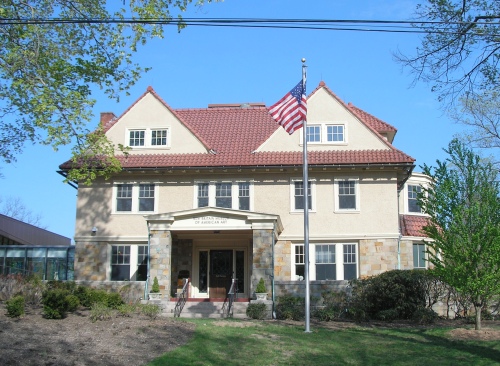
landers-house.jpg

Landers, Frary & Clark, a New Britain company which manufactured cutlery, was founded in the 1850s by George M. Landers. The company (pdf) was known for such products as the Universal Food Chopper/Grinder. George M. Landersson, Charles Smith Landers, married Grace Judd, the daughter of Loren F. Judd, of North & Judd, a company which manufactured saddlery hardware. Their son was also named George M. Landers. Grace Judd Landers later lived in a house which on Lexington Street in New Britain. It was built around 1910 for William H. Hart, president of Stanley Works, and sold to Mrs. Landers upon the death of Hart’s widow in 1929. It is located on the edge of Walnut Hill Park, designed by Frederick Law Olmsted. The style of the house combines elements of the Spanish Mission style (the use of stucco and stone and the Spanish style roofing tiles) and the Craftsman style (the gables and overhanging eaves with decorative brackets).

In 1935, Grace Judd Landers bequeathed the house to the the Art Museum of the New Britain Institute, now the New Britain Museum of American Art. The building was remodeled as an art museum based on designs by William F. Brooks, of the firm Davis & Brooks, and opened in 1937. In 2007, a new museum building was opened, connected to the Landers House, which has again been renovated and now houses an art lab, library and art studio.