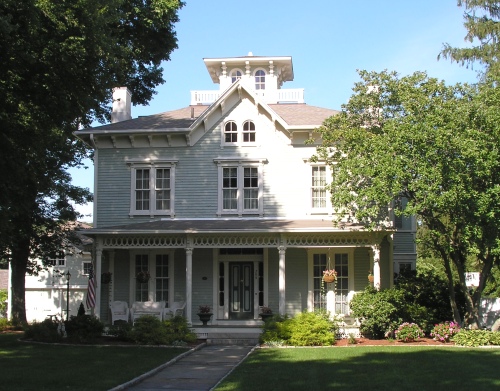
Whitehall Mansion (1771)

whitehall-mansion.jpg

The earliest structure built on the original site of Whitehall Mansion, located in the section of Mystic which is in the town of Stonington, was constructed around 1680 by Lt. William Gallup. A tavern and stagecoach stop stood on the site in the 1750s. Whitehall Mansion, named after an ancestor’s home, Whight House, in Essex, England, was built in 1771-1775 by Dr. Dudley Woodbridge (who, in his youth, had made an interesting sketch of buildings in Deerfield, Massachusetts). A secret room in the attic may have housed runaway slaves. Dr, Woodbridge died in 1790 and the house was later owned by the Rodman and Wheeler families. The Mansion‘s last resident, Florence Grace Keach, donated the house to the Stonington Historical Society in 1962 in order to save it from demolition when Interstate-95 was being constructed. The house was moved approximately one hundred yards north and restored. For a time, it was open for tours, but was purchased by the Waterford Hotel Group in 1996 and is now the Whitehall Mansion Inn.

Stratford Shoal Lighthouse (1877)

stratford-shoal.jpg

Stratford Shoal Light marks a dangerous reef located in the middle of Long Island Sound. It was first marked for navigation by a pair of spar buoys in 1820. A lightship was placed there in 1838, but it frequently drifted off its station. Stratford Shoal Lighthouse, constructed on a small, unincorporated, man-made island, was completed in 1877 to replace the lightship. Automated in 1970, it is still an active aid to navigation. Also known as Middle Light, the lighthouse is halfway between Port Jefferson, New York and Bridgeport, Connecticut. Although the State of New York ceded the territory on which the lighthouse was built, it is classified as a Connecticut lighthouse on official maps. The lighthouse can be seen distantly from the Bridgeport-Port Jefferson Ferry. (more…)

St Josaphat’s Ukrainian Catholic Church (1975)

st-josaphats-ukrainian-catholic-church.jpg

In 1951, a time of Soviet persecution of Ukrainian Catholics in their homeland, Ukrainian exiles settling in the New Britain area founded Saint Josephat’s Ukrainian Catholic Parish. The growth of the parish led to the purchase, in 1955, of a former Assyrian Church on Beatty Street, soon enlarged with materials from a dismantled six-family building from East Hartford, that had been purchased by the parish. In 1966, a house was purchased on Eddy Glover Boulevard to become a rectory and, in 1974, there was a ground breaking on the same Boulevard for the building of a new church. The church was designed by the James P. Cassidy architectural firm of West Hartford and parishioners of St. Josephat’s provided most of the labor for its construction. Completed in 1975, the church has three gold and blue domes, copied from those in St. Sophia Church of Holy Wisdom in Kyiv, the capital of Ukraine. In 1985, St. Josaphat’s Ukrainian Catholic parish and St. Mary’s Ukrainian Orthodox parish worked together in having a new section of Route 9 through New Britain named the Taras Shevchenko Expressway, in honor of the great Ukrainian poet. In 1991, the parish celebrated the independence of Ukraine from the old Soviet Union.

The Nehemiah Hubbard House (1744)

nehemiah-hubbard-house.jpg

Across from the Harriet Cooper Lane House in Middletown is the Nehemiah Hubbard House, a center-chimney Colonial saltbox, built in 1744. Nehemiah Hubbard, Jr., who was born in 1752 and was a later owner of the house, was a fourth-generation descendant of early settlers of Middletown. A prominent merchant, he served as Deputy Quartermaster for Middletown during the Revolutionary War and was the first president of the Middletown Bank. He was also the original land-owner in what would become Hubbard, Ohio. Hubbard used his Middletown house and extensive property, which was away from the center of town, for his farming operations and it remained in his family into the twentieth century. For a time, Thomas McDonough Russell, Sr. lived in the house and in 1916, it was acquired by Colonel Clarence Wadsworth. Restored in 1929, the house remained in the Wadsworth family until 1952. Still a private home, the property has a garden established in 1956.

Patricelli ’92 Theater (1868)

patricelli-92-theater.jpg

Wesleyan University‘s Patricelli ’92 Theater was originally called Rich Hall and was built in 1868 as the college library. It was designed by Henry Austin and David Russell Brown. In 1928, Olin Library opened and Rich Hall was converted to become a theater, funded by a donation from the class of 1892. The theater was renovated in 2003 with a gift from Robert Patricelli (’61) in honor of Leonard J. Patricelli (’29). Wesleyan’s student-run theater, Second Stage, is based in the theater.

The Mather-Douglas House (1811)

mather-douglas-house.jpg

The Mather-Douglas House was built around 1811-1813, on South Main Street, off South Green in Middletown. It is a Federal style house with later Italianate additions. Built by a Mather, a later owner of the house was Benjamin Douglas, who was a factory-owner and politician. He was a founder of the W. & B. Douglas foundry company (Wesleyan’s Douglas Cannon was named after him) and he was a member of the state general assembly and mayor of Middletown from 1849 to 1855. He was an abolitionist and there is “strong circumstantial evidence” that his house was a stop on the Underground Railroad.