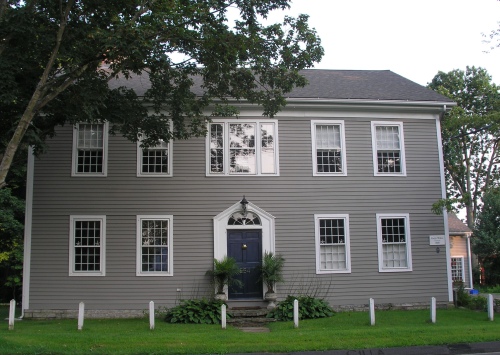
Elizabeth Apthorp House (1837)

apthorp-house.jpg

In 1838, Elizabeth Apthorp moved from her first home on New Haven’s Hillhouse Avenue, which she had been sharing with her half-sister, Abigail Whelpley, to another one nearby, again arranged by James Hillhouse and newly completed the year before. The Apthorp House was designed by A.J. Davis. He described the house as an Etruscan Villa, although its overall shape conformed to the Greek Revival style and the original focus of the facade was an Egyptian Revival porch. The building has been constantly added to over the years with new and reused elements in a variety of styles. In the early twentieth century, the house was occupied by the family of former Yale president Timothy Dwight. It is now owned by Yale and is one of the buildings housing the Yale School of Management. It was renovated in 2001.

Kensington Congregational Church (1774)

kensington-congregational-church.jpg

The Second Church of Farmington was gathered in 1712, in what is now the Town of Berlin. The first meeting house was located on the road that came to be called “Christian Lane.” The congregation was officially given the name of Kensington in 1722. A new and larger meeting house was built around 1733 a mile south of the first one. The congregational society was divided in 1754 with the creation of new society in New Britain. The original society was again divided between east and west sections in 1772. The west section retained the name Kensington, the east was known as Worthington. Both societies continued to share the old meeting house until the separate Worthington church was completed in 1774. The Kensington Society then built its own new church, over a mile west of the old one, which was dedicated on December 1, 1774. The two communities of Kensington and Worthington later joined in 1785 to form the Town of Berlin (New Britain remained a part of Berlin until 1850). Over the years, the Kensington Congregational Church has been expanded to the rear and adapted in the Greek Revival style.

Eugene Boss House (1882)

Boss House

Eugene Boss rose from being a bookkeeper for the Willimantic Linen Company (later the American Thread Company) to becoming the mill’s agent (or manager), a position he held from 1879 to 1916. He was, literally, boss at the mill. The company had a private rail network between its buildings and the train was pulled by an engine, the Helen B, named after Boss’ daughter. Boss’ house in Willimantic, on Windham Street, from which he could look down on the company’s mills, was built in the 1880s.

Charles Ives Birthplace (1780)

charles-ives-birthplace.jpg

Historic Buildings of Connecticut’s 850th building is the Charles Ives Birthplace in Danbury. Ives, born in 1874, was an unconventional composer who combined traditional and revolutionary elements. The original timber frame of his childhood home was built in 1780 by Thomas Tucker, but this building burned in the 1820s. The remains of the structure were purchased by Isaac Ives and rebuilt as a Federal-style house. Charles Edward Ives‘ father George Edward Ives, the youngest band master in the Union Army during the Civil War, was a music teacher who taught his son to embrace unusual combinations of sounds. In 1894, the younger Ives left Danbury to attend Yale. He would go on to form a very successful insurance company, while also composing modernist musical works which would not be fully appreciated by the public until later in the twentieth century. Ives married Harmony Twitchell, the daughter of Mark Twain’s friend, Rev. Joseph Twitchell. The house where Charles Ives had been born was moved from its first location, on Main Street, to Chapel Place in 1923 and again to Mountainville Avenue in 1966. It was later restored by the Danbury Museum and opened to the public in 1992.

Curtis Wilcox House (1815)

Curtis Wilcox House

In 1800 [the sign on the house indicates c. 1815], Capt. Curtis Wilcox built a house on the Boston Post Road in Madison and lived there with his wife, Wealthy Hill, the daughter of Reuben Hill and Hannah Scranton. Wilcox became Madison’s first postmaster and his house was the first post office (see pdf file). In 1823, twelve prominent citizens of Madison (then called East Guilford) gathered at the Wilcox House where, under the leadership of Frederick Lee, they started to remedy the community’s lack of its own wharf by pledging a thousand dollars for the construction of West Wharf, completed in 1824. Curtis Wilcox was appointed the first wharfmaster (see pdf file) and many ships were constructed there.

Sereno H. Scranton House (1833)

scranton-house.jpg

When Sereno H. Scranton of Madison married Susan Roxanna Doud in 1833, his father, Jonathan Scranton, presented the couple with a new Greek Revival home on the Boston Post Road. Sereno Scranton was a prominent citizen of Madison, who owned many merchant ships and served as a state representative and senator. He was also president of the Shoreline Railroad. Today, the house is the Scranton Seahorse Inn.