Nathaniel Foote House (1702)

nathaniel-foote-house.jpg

The oldest house in Colchester is the Nathaniel Foote House, which has been moved several times, but is now located on Norwich Avenue. The house was begun in 1699 by Nathaniel Foote of Wethersfield, who was involved in the development of Colchester as a new community. Foote intended to settle in town, but ill health prevented him from completing the new house, which was finished in 1702 by his son, Nathaniel, shortly before his father’s death. It was soon occupied by the elder Nathaniel’s widow and four youngest children. In the early nineteenth century, the house stood on the Hartford Turnpike and was used as a post office. In 1896, the then neglected house was on Broadway and was bought by Mrs. Frederick G. Bock, who repaired it and gave it to the Colonel Henry Champion Chapter of the Daughters of the American Revolution. The D.A.R. moved the house to its present site in 1925 and restored it for use as a historical museum and chapter house.

Bates-Scofield Homestead (1736)

bates-scofield-homestead.jpg

The Bates-Scofield Homestead is a colonial saltbox-style house, built around 1736 in Darien for John Bates, who lived there until 1774. The house was later deeded to John Bates, Jr. Before Darien’s first meetinghouse was built, services were held in the Bates House. After the Bates family, the house was owned by the Scofield family for almost a century, starting with Ezra Scofield in 1822. By 1964 the house faced demolition, until it was given to the Darien Historical Society and moved to a new site to become a museum. In 2005, the 1827 Scofield Barn was also donated to the Society and dismantled. In 2008, the barn was reunited with the house and joined to it by a new connector building.

Fayerweather Island Lighthouse (1823)

fayerweather-island-light.jpg

In the eighteenth century, what is today the Black Rock neighborhood of Bridgeport developed as an active port. In 1808, Black Rock Harbor’s first lighthouse, made of wood, was built on the southern end of Fayerweather Island. This was destroyed in an 1821 hurricane and replaced, in 1823, by a stone tower, designed to withstand future rough weather. Fayerweather Island Light, also known as Black Rock Harbor Light, had a number of long-tenured lighthouse keepers. Stephen Moore began as keeper in 1817, but he was later injured and unable to tend the light. His daughter, Catherine Moore, who had begun assisting him as a girl, then took on the full duties of keeper, although her father retained the official position until he died, at age 100, in 1871. Kate Moore then officially became keeper, retiring in 1878. The lighthouse was decommissioned in 1933 and became part of Bridgeport’s Seaside Park. The tower eventually fell prey to vandals and the adjacent keeper’s house, built in 1879 after Kate Moore retired, burned down in 1977. There was a preservation effort in 1983, but eventually the island was again neglected and the lighthouse vandalized. A new preservation group eventually formed and, in 1998, the structure was restored and now has with graffiti-resistant paint and vandal-proof steel panes for the windows. Black Rock Harbor Light was also relit, using solar panels. The island is today attached to land by a stone breakwater.

Carroll Building, Norwich (1887)

flatiron-building-norwich-ct.jpg

Lucius W. Carroll was a leading Norwich merchant and businessman who had a store on Water Street. In 1887, as a real estate venture, he constructed a commercial building to be leased to a variety of businesses. Located at the intersection of Main and Water Streets in Norwich, the Carroll Building is also known as the Flat Iron Building, because its floor plan, accommodating the triangular area where it was built, resembled an iron, like that of the famous Flatiron Building in New York, built in 1902. The building‘s display windows are separated by cast iron columns by A. H. Vaughn & Sons, proprietors of the Norwich Iron Foundry. Below are additional images of the building, which show how the Worcester architect, Stephen C. Earle, had to contend with the site’s uneven ground. (more…)

Wheeler Block, Colchester (1872)

old-town-hall.jpg

The Wheeler Block (also called the Old Town Hall) in Colchester was built as a commercial building by businessman Joshua B. Wheeler in 1872. Wheeler was a Mason and the third floor meeting room was used as a Masonic Lodge through the 1940s. In 1910, at a time when the town’s schools were overcrowded, the building became the Ransom School and was later used for town offices. At present, the building is vacant.

The Jesse Hurd House (1812)

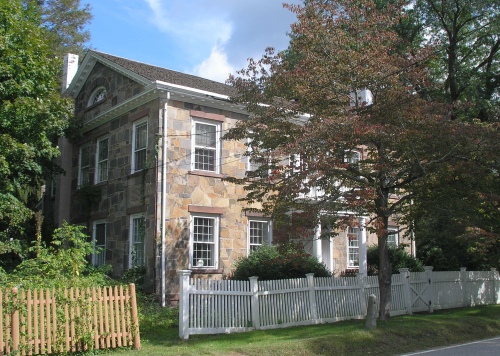
The Jesse Hurd House, built of stone with bold Federal detailing, is the most impressive of the homes built in Middle Haddam (in East Hampton) during its period as a prosperous shipbuilding center. Jesse Hurd (1765-1831) was a prosperous shipbuilder and merchant who played a dominant role in the economic development of Middle Haddam. He built many ships for his partners, the brothers, George and Nathaniel Griswold, who ran the largest merchant shipping house in New York. Hurd owned shares in his vessels and cargoes, building cheaply in Middle Haddam and selling his shares in New York. In 1828, he patented new ship hoisting machinery which he had invented himself. This machinery more easily enabled the scraping and repairing of hulls. Hurd also joined the Griswolds in establishing the New York Screw Dock Company, a dry-dock facility on the East River which utilized the new technology. His impressive house in Middle Haddam, built around 1812, was most likely designed by a master architect/builder, whose name is currently not known. Shipbuilding in Middle Haddam began to decline after Hurd’s death in 1831.