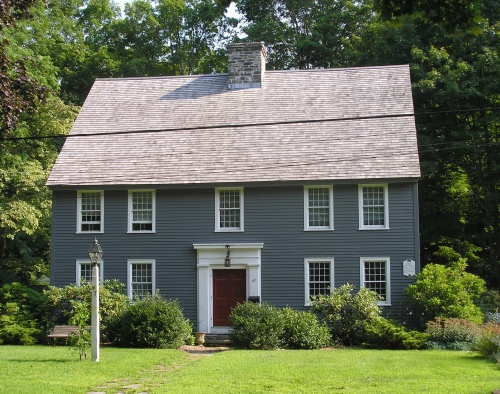
The Hull-Hitchcock House (1764)

amos-hull.JPG

The Dr. Amos Hull House, built in 1764, is at 744 South Main Street in Cheshire. Dr. Hull used the house as a home and office. He served in the Revolutionary War, dying in camp in 1776. His widow, Martha Hitchcock, then married Dr. Gould Norton, who occupied the house, practicing medicine and running a tavern. The house was then owned by Pliny Hitchcock, who died in 1864 and was a stonemason and one of the leading farmers of Cheshire. In the 1930s, the house was extended by one bay (adding one window) to the right. By 2002, the Hull-Hitchcock House and the nearby John Hull House were in deteriorating condition and in danger of being torn down, until developers who acquired the properties agreed to restore both houses. Readers of Historic Buildings of Connecticut might also be interested in reading today’s post at Historic Buildings of Massachusetts, which features the Joseph Moore House, located in what is known as the Southwick Jog, the section of Massachusetts which extends into Connecticut’s northern border.

The First Dr. John Redfield House (1768)

dr-john-redfield.jpg

Dr. John Redfield, who had studied medicine with Dr. Benjamin Gale of Clinton, settled in Guilford and in 1768 built the first of two houses he would occupy in the town. His first house was on Park Street and, in later years, a Victorian porch was attached in the front. In 1937, the house was disassembled to make way for a new town hall parking lot. In 1942, the house (without the Victorian porch) was rebuilt on Broad Street for Judge George C. Conway. The house has a particularly steep roof which provides enough space for two attic windows in the gable. Historic Buildings of Connecticut now has a page on Facebook. If you are a Facebook user, you can become a fan!!

The Congregational Church of East Hampton (1948)

congregational-church-east-hampton.JPG

A succession of Congregational Church buildings have stood on the same spot in East Hampton. The congregation was established in 1746 as the Third Society of East Middletown (the Second Society was in Middle Haddam, now the Second Congregational Church of East Hampton). East Middletown later became Chatham, which later became the towns of Portland and East Hampton. The first church building was constructed in 1755 and the second a century later. This church was destroyed by fire in 1941 and the current church, built in the same Greek Revival style as its predecessor, was completed in 1948.

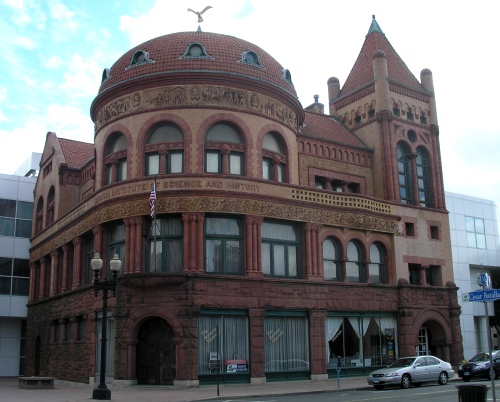
Barnum Museum (1893)

This is Historic Buildings of Connecticut’s 900th post, excepting the two April Fools posts, which some people have taken too seriously! What is that famous quote often attributed to P.T. Barnum? Well, with that in mind, let’s keep to the Barnum theme! The Barnum Museum is a place worth celebrating in an anniversary post, as it is a surviving legacy from one of Connecticut’s most important historical figures. P.T. Barnum had his famous American Museum in Manhattan, but this later burned. Barnum built four successive mansions in Bridgeport, where he served as mayor in 1875, but only a few traces of these survive today. The museum in Bridgeport which today bears his name was built in 1893 as the Barnum Institute of Science and History and originally housed a resource library and lecture hall. The building, which reflects the influence of Byzantine, Moorish and Richardsonian Romanesque architecture, was constructed of stone and terra cotta after Barnum‘s death using funds he had bequeathed for the purpose. The original societies which occupied the building ceased operation during the Great Depression and the city of Bridgeport assumed ownership in 1933. In 1943 the museum was closed for remodeling, reopening in 1946 as a city hall annex. In 1965, the city offices were removed and the building was again remodeled to reopen as the P. T. Barnum Museum in 1968, with exhibits about Barnum and the history of Bridgeport. The museum, which since 1986 has been operated by the Barnum Museum Foundation, was renovated in 1986-1989 and is today the only museum dedicated to the life of P. T. Barnum

Ralph Isham House (1820)

ralph-isham.JPG

Around 1820, Ralph Isham, a merchant, built an impressive Federal style house on Colchester Green, next to the home of his father, Joseph Isham. The house was next owned by Henry Burr, a full partner in the Hayward Rubber Company, who had married Isham’s daughter, Lucretia. After her death in 1857, Burr continued to own the house, but rented it out. Among the tenants was the Justice of the Peace and house carpenter, Judge William Finley. The house had other residents over the years, but has more recently been used for commercial purposes.

The Joseph Parmelee House (1748)

joseph-parmelee-house.jpg

The Joseph Parmelee House is on Water Street in Guilford and was built in 1748. Joseph Parmelee (1721-1804) was married three times, to Obedience Spencer, Abigail Cruttenden, and Mary Deming. At one time, the house had a lean-to, but this was later removed and other additions were then attached. The front door is surrounded by an impressive Greek Revival enframement, which was added later and has double pilasters on either side.

Wilton Little House (1888)

wiltion-little-house.jpg

The Wilton Little House, at 122 Windham Street in Willimantic, was built around 1896 [edit (7/28/2014: 1888 according to the Willimantic Victorian Neighborhood Association] and is a fine example of the Queen Anne style. Addendum (7/28/2014): Little was an employee of of Hillhouse & Taylor. In 1896, Little sold the house to George P. Phenix, the second Principal of the Willimantic State Normal School (serving 1893 to 1904), which is now Eastern Connecticut State University. The property was next sold in 1904 to Henry T. Burr, who served as the school’s third Principal, from 1904 to 1918. Burr Hall at eastern was named in his honor.