Deacon John Moore House (1664)

John Moore, ordained a deacon in 1651, was one of the original settlers of Windsor, arriving in 1635 with the Dorchester group, led by the Reverends Maverick and Warham. Moore was a woodworker associated with the “Foliated Vine Group” of seventeenth-century chests. Moore’s house, built around 1664, originally stood on the east side of Broad Street Green. In the late eighteenth century, the large house of William Loomis was built on the west side of the Green and the old Deacon Moore House was moved and attached to the rear of the new house as a kitchen ell. By the end of the nineteenth century, the combined house was owned by Horace Clark, who detached the ell around 1897 and moved it to 37 Elm Street. In its new location, the Moore House originally had its gable end to the street, but was later moved to face the street. The house originally had the large center chimney typical of First Period Colonial houses.

The Williams-Salter House (1711)

The oldest surviving house in Mansfield Center is the Williams-Salter House, built around 1711. It was first the home of Rev. Eleazer Williams, Mansfield’s first settled minister and the son of Rev. John Williams, who was famously taken to Canada, along with five of his children, after the Raid on Deerfield in 1704 (Eleazer was away at school at the time). Eleazer Williams resided in the house until his death in 1742. He was succeeded as minister by Rev. Richard Salter, who married Williams’ daughter Mary in 1744 and purchased the privately-owned parsonage in 1745. Rev. Salter and his brother, John Salter, who also settled in Mansfield, were from a prominent Boston family. Richard Salter, one of the most respected ministers in Connecticut, served in Mansfield until his death, in 1787. The property also has a notable English-style barn.

The James Curtiss House (1737)

The James Curtiss House is a saltbox home on Maiden Lane in Durham. Curtiss purchased the land on which his house stands in 1722 and the house was built sometime between 1737 and 1761, when deeded half of his property to his son, Nathan Curtiss. Nathan was killed in the Revolutionary War in 1776 and his son, James, who inherited the property, was killed in an explosion at the gunpowder manufacturing mill he operated. His widow lived in the house until 1819, but his children migrated to New York and Michigan. In the 1820s, William H. Walkley bought out the shares of the various Curtiss inheritors.

American Legion Hall, Granby (1847)

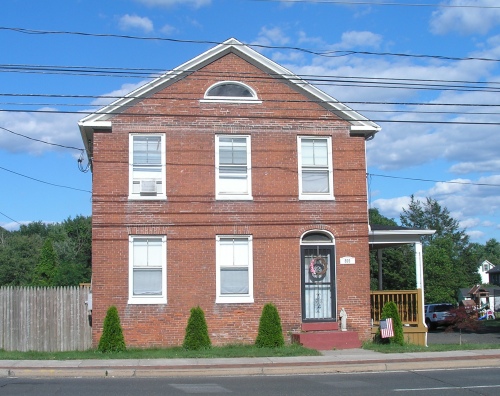
This Fourth of July we’re looking at the American Legion Hall in North Granby. In 1845, in his History of Simsbury, Granby, and Canton, Noah A. Phelps wrote that “There is a society of Universalists in North Granby. The members meet every other Sunday for worship, and have taken measures to erect a house for their religions meetings.” By 1848, as explained in The Universalist Miscellany, Volume 5, No. 8, “The Universalist Church recently erected in Granby, Ct., was dedicated on the 1st of December [1847]. Sermon by Bro. H. B. Soule, of Hartford. The church is a very neat building, and will seat three hundred persons.” The Universalist congregation disbanded in 1911 and the former church served as a school until 1949. It then became an American Legion Hall.

Samuel Richards House (1792)

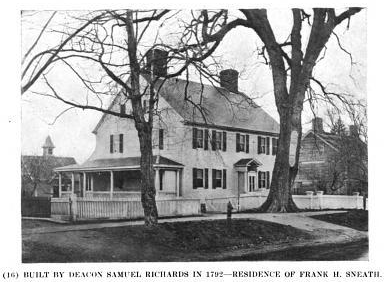
In 1736, Timothy Hawley sold land along Main Street in Farmington to Ezekiel Tompson. A house may already have been standing on the property and then been expanded into its present form by Thompson, or he may have built the house himself. Whichever the case, the house was in existence by 1783, when it was inherited by Ezekiel‘s son, Isaiah Thompson, who sold it that same year to Deacon Samuel Richards, who had served as a captain in the Revolutionary War and was the first postmaster of Farmington. In Farmington, Connecticut, the Village of Beautiful Homes (1906), it is said that the house was built by Richards in 1792 and this has been the date traditionally given for its construction. The house was next owned by Abner Bidwell, a merchant involved in the construction of the Farmington Canal.

Old Town Hall, Fairfield (1794)

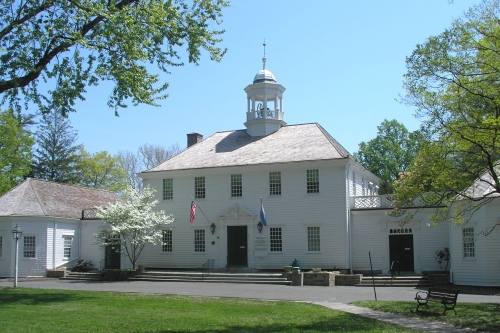
The Old Town Hall in Fairfield was built in 1794 as a county courthouse, replacing its predecessor, built in 1769 and burnt by the British in 1779. That structure had replaced the earliest courthouse in town, built in 1720. According to the Centennial Commemoration of the Burning of Fairfield, Connecticut (1879), the 1769 building “had only recently been erected in place of one standing before where Mr. Hobart’s store now stands. A noted thief named Fraser, confined in the jail then connected with it, had set that building on fire on the 4th of April, 1768. Hence had come the rebuilding, and the erection of a separate prison which was located where St. Paul’s church now stands.” The 1794 building also served as the Town Hall and in 1870, it was aggrandized by being converted into the Second Empire style. In the late 1930s, the building was again remodeled and restored to a Federal-style appearance by local architect Cameron Clark, with two new wings added on either side. Town offices moved out when a new building, Independence Hall, was completed in 1979.