90 Bank Street, New London (1860)

The stone Romanesque Revival block of connected buildings at 90-94 Bank Street in New London were built around 1860 (a sidewalk plaque indicates 1876). The commercial building was used by A.B. Currier, an auctioneer, around 1873 and was later home to Darrow & Comstock, ship chandlers. The New London Day newspaper began publishing on the building’s second floor in 1881. More recently, the building has housed Roberts Audio Video store, with the upper floors being used as a residence.

American Brass Company Headquarters (1913)

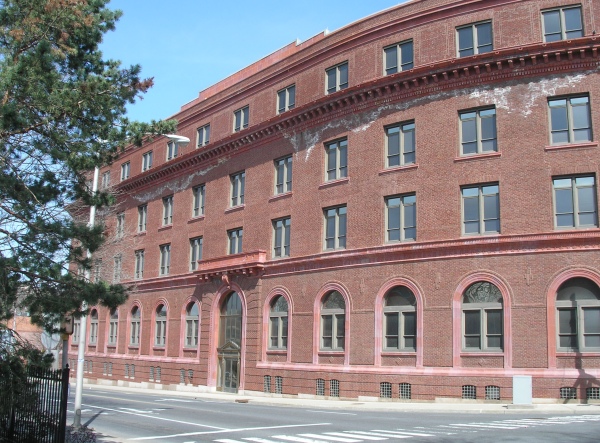
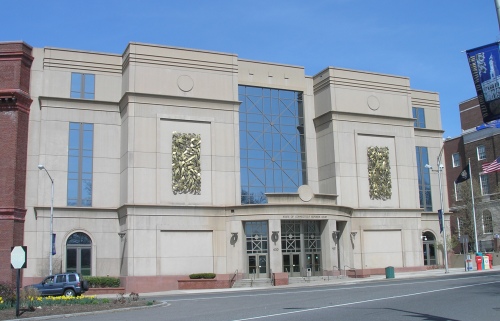
For much of its existence, the American Brass Company was the largest brass manufacturer in the country. The company was founded in 1893, with the consolidation of five existing brass mills in the Waterbury area. Purchased by the Anaconda Copper Company in 1922, it lost its individual name and identity in 1960. The American Brass Company’s Headquarters building in Waterbury, built in 1913, has a brass-clad entryway. The structure rounds the curved corner of Grand and Meadow Streets. Today, the building is part of the Waterbury Superior Court House complex, with the main entrance now located in a large addition, built in 1998.

Church of Christ Congregational of Norfolk (1813)

Rev. Joseph Eldridge describes the erection of the first meeting house in Norfolk in the History of Norfolk (1900):

In dimensions it was fifty feet by forty, and of suitable height for galleries, without a steeple. In 1759, two years previous to the settlement of Mr. [Ammi Ruhamah] Robbins, [Norfolk’s first minister, who also served as an army chaplain during the Revolutionary War] the house was raised and covered. In 1761, the year of his ordination, it was underpinned and the lower floor laid. Such was its condition when he was ordained in it. In 1767 the gallery floor was laid; 1769 the lower part of the house and the pulpit were finished. January 2, 1770, it was, in the words of the time, dignified and seated; that is, the places to be occupied by those of various ages determined, and individuals located in them, as is done now. The next year the galleries were completed, and a cushion for the pulpit procured. The outside was painted the color of a peach blossom.

This meeting house, which was painted white in 1793, was taken down in 1813 and a new meeting house, designed by David Hoadley, was constructed. As Frederic S. Dennis explains, in The Norfolk Village Green (1917):

in 1814 the second Meeting House was finished, 60 by 45 feet in dimensions, and with a steeple and bell. This was built near the site of the original and was erected under the supervision of Michael F. Mills, who was appointed as agent by the society to build the best house he could for $6,000. It is still in existence; but after the death of Rev. Joseph Eldridge [in 1875] the interior was beautifully decorated and painted, a new platform and pulpit erected, electric lights installed, a new organ donated, Munich stained glass windows placed behind the pulpit, all through the great generosity of the Eldridge and Battell families.

As Dennis further writes:

The Meeting House as it now stands is a model of colonial church architecture. Its symmetry, its proportions, its graceful steeple, its artistic Sir Christopher Wren spire, its site on the knoll overlooking the Green, its beautiful interior decoration, its magnificent organ, make it one of the most attractive and beautiful in New England. One feature is most unusual to find in a Congregational church, a cross at the apex of the spire. It is “the only Puritan Meeting House whose spire from the first was surmounted by a cross and the same cross still points skyward.” This cross was evidently placed on the steeple in [1814] according to dates found in Rev. Thomas Robbins‘s diary.

Nineteenth-century Italianate alterations to the front facade of the Church of Christ Congregational of Norfolk were removed in 1926 and replaced with the current two-story pillared front porch, the gift of Alice Eldridge Bridgman, completed in 1927.

Chauncey Jerome House (1832)

The house of Chauncey Jerome, on South Street in Bristol, has seen many changes over the years. Chauncey Jerome was a clockmaker and entrepreneur who became the most successful of the many clock manufacturers in the Bristol area. His house in Bristol was built in 1832. He later he hired architect Joel T. Case to construct a tower and make other alterations to the building (the semicircular window in the front gable, for instance, was changed to a tripartite Palladian window). The house was later owned by Edward Dunbar. Threatened with demolition around 2000, the house was saved to become the Bristol Elks Lodge. The house has lost its tower, as well as other decorative features, and an unattractive modern addition has been constructed on the front. The Images of America series book entitled Bristol Historic Homes has an image on the cover of the house in its former glory.

The Mary L. Redfield House (1905)

The Shingled Colonial Revival house at 33 Mountain Road in Farmington was built in 1905 by the lawyer Robert L. Redfield for his aunt, Miss Mary L. Redfield. She had come to Farmington in 1892 with her brother Amasa. They lived in the Deacon Edward L. Hart House on High Street, until Amasa died in 1902. Mary Redfield soon moved to the new house on Mountain Road, where she lived with her friend, Miss Ada DeAngelis. Miss Redfield was struck by a car and killed in 1921. Miss DeAngelis continued to live in the house until 1932. In 1936, it became the home of Myron Clark.

30 Lewis Street, Hartford (1840)

The former house at 30 Lewis Street in Hartford, like the nearby houses at nos. 24 and 36, was probably constructed by the designer and builder Austin Daniels around 1840. Like the building at 36 Lewis Street, no. 30 was altered to conform to the Italianate style, around 1860. The building became the home of the University Club in 1906 and the front door was then moved to the side of the structure. In 1928, a five-story rear addition was constructed. In more recent years, the building has been converted into office space.