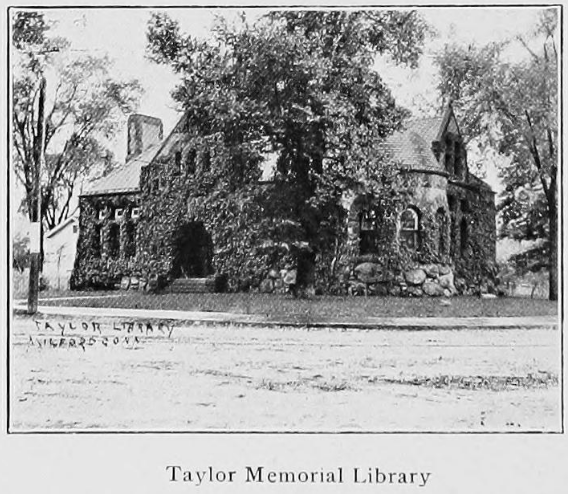
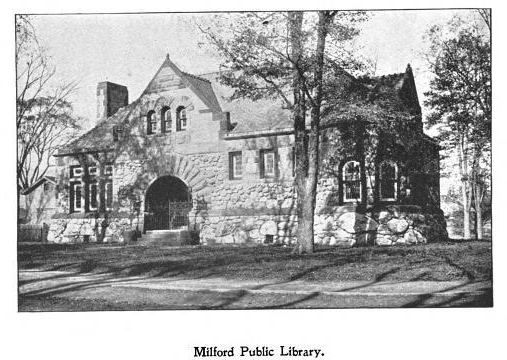
Taylor Memorial Library (1895)

The first library in Milford was established in 1745 and belonged to the First Church. The city’s first secular library began with the chartering of the Milford Lyceum in 1858. The Milford Lyceum Library was eventually dissolved in 1894, when the Taylor Memorial Library was founded. Dedicated in 1895, the Taylor Library was the gift of Henry Augustus Taylor, a financier and philanthropist. It is constructed of local fieldstone, red sandstone and yellow brick. The design of the Richardsonian Romanesque building was based on that of H.H. Richardson’s Crane Memorial Library in Quincy, Massachusetts. In 1976, the new Milford Public Library was opened at the corner of New Haven Avenue and Shipyard Lane, officially replacing the Taylor Library. The old library building was converted to office space and is now home to the Milford Chamber of Commerce.

Memorial Tower, Milford (1889)

Standing at the northwest end of Memorial Bridge, which crosses the Wepawaug River in Milford, is then 29-foot Memorial Tower. Built in 1889 to celebrate Milford’s 250th anniversary, the bridge and tower honor the city’s founders, whose exact resting places in Milford Cemetery are not known. The bridge and tower feature stones inscribed with the settlers’ names and dates. A collection of historical artifacts are also mounted to the structure, which was built on the site of the city’s first mill and features an original stone from the mill. An inscription on the tower honors Robert Treat, a notable early settler and governor of the Connecticut Colony. Over the tower‘s entrance is a stylized portrait of a Native American and a representation of the mark of Ansantawae, sachem of the Wepawaug or Paugussett nation, Milford’s original inhabitants.

Mount Carmel Congregational Church (1840)

Mount Carmel Congregational Church is located on Whitney Avenue, in the Mount Carmel neighborhood of Hamden. The parish, established in 1758, had previously worshiped in a meetinghouse which stood a little north of the current church. That building was first used in 1761, but was not fully completed until after the Revolution. After it burned down, the present Greek Revival-style church was constructed in 1840, after several years of debate on where to build it.

Moorlands (1836)

Moorlands is the name of the circa 1836 house that was the Fairfield home of Henry Sheaff Glover, who also resided in New York City. In later years, after their father’s death, Dawson Coleman Glover, married Elizabeth Fowler (1913) and Harriet Coleman Glover married Gardner Willard Millett (1914). Their brother, John Le Roy Gover, attended Yale in 1914-1916. The house, at 290 Beach Road, was built on the site of the Buckley Tavern, built around 1740-1750. According to Benson J. Lossing’s Pictorial Field-Book of the Revolution, vol. I (1851), when the British forces of Major General William Tryon landed and burned Fairfield in 1779, the Buckley Tavern was saved:

Tryon made it his head-quarters. The naval officer who had charge of the British ships, and piloted them to Fairfield, was Mrs. Buckley’s brother, and he had requested Tryon to spare the house of his sister. Tryon acquiesced, and, feeling his indebtedness to her brother, the general informed Mrs. Buckley that if there was any other house she wished to save she should be gratified. After the enemy left, the enraged militia, under Captain Sturges, placed a field piece in front of the dwelling, and then sent Mrs. Buckley word that she might have two hours to clear the house, and leave it, or they would blow her to atoms. She found means to communicate a notice of her situation to General Silliman, who was about two miles distant. He immediately went to the town, and found one hundred and fifty men at the cannon. By threats and persuasion he induced them to withdraw. The next day Colonel Benjamin Tallmadge, with his regiment, arrived from White Plains, and, encamping on the smoking ruins, made Tryon’s quarters his own

Observing the Buckley House not long before it was replaced, John Warner Barber wrote in his Connecticut Historical Collections (1836) that:

At the time of the invasion of the British, a 24 pound shot which was fired from Black Rock, entered the chimney. In the entrance at the door, are still to be seen the marks of twenty seven bullets, on the stair way. The heat was so great during the conflagration, that all the window glass in front of this house were broken.

Irwin House (1953)

The Irwin House is a mid-century Modern house, designed by Victor Christ-Janer and constructed by builder Robert Roles as a speculative house in 1953. Located on Wahackme Road in New Canaan, the house is named for its first owner, William A. Irwin, Jr., who purchased it in 1954. A fire in 1972 caused substantial damage to the house, but it was rebuilt following the original plans. Alterations were made in the 1980s to the house’s porches and balcony.

Gores Pavillion (1959)

In 1959, Landis Gores designed a pool house (referred to as a cabana) in New Canaan for Jane Irwin, daughter of IBM founder Thomas J. Watson, and her husband, John Nichol Irwin II, a lawyer and ambassador to France. Completed in 1960, the Irwin Pool House is a Modernist structure with a symmetrical cruciform-shaped plan. In 2005, the Irwin family sold their estate, including the Pool House, to the town for use as a park. The pool was removed and the Pool House, now known as the Gores Pavillion, is being restored. It will be used as a center for the arts, to be called The Gores Pavilion for the Arts at Irwin Park.