
Built around 1825, the house at 39 Robert Street is Plainville’s best example of a house built in the Federal style. The house was moved from its original location, at the corner of Farmington and New Britain Avenues, to make way for a super market.
Built around 1825, the house at 39 Robert Street is Plainville’s best example of a house built in the Federal style. The house was moved from its original location, at the corner of Farmington and New Britain Avenues, to make way for a super market.

Gamaliel King (1795-1875) was a New York City architect who designed four houses in Stonington, by the shores of Lambert’s Cove. The house of James Ingersoll Day was lost due to the Hurricane of 1938, but the other three survive. One is the Nathaniel B. Palmer House of 1852 and another is Cove Lawn, built in 1856 for Captain Theodore Dwight Palmer. The third is Linden Hall, also known as the Stanton House, built in 1857 to 1859 for brothers Joseph Warren Stanton and Charles Thompson Stanton.

Traditionally called the Gen. Daniel Baldwin House, the house on Main Street at Church Hill Road in Newtown, consists of an earlier section in the rear, dating to 1712 and built by Job Sherman, and the Federal-style front section, built in 1791 by Joseph Nichols. The house was later owned by David Van Buren Baldwin, grandson of Caleb Baldwin, who operated the nearby Baldwin Tavern. It has the most elaborately detailed facade of the eighteenth-century houses in the Newtown Borough Historic District.

St. Mark’s Episcopal Church in New Britain began in 1836 and the first church building was located on East Main Street. This small wooden structure, later relocated to become St. Mary’s Schoolhouse, was succeeded by a more elaborate wood second church, built in 1848 on the corner of West Main and Washington Streets. Enlarged in 1859, it was replaced by the current granite church, built in 1921 and consecrated the following year. The church has stained glass windows that were originally in the second church building, as well as ones commissioned from the studio of William Morris.

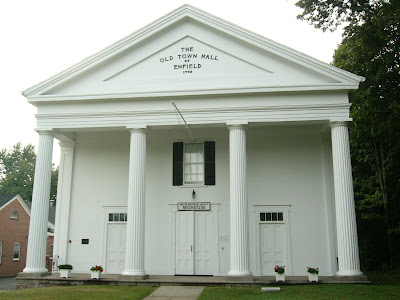
The Old Town Hall of Enfield was originally built in 1775 as the Enfield Congregational Church’s third meeting house. By 1848, the building had become overcrowded and the current church was built the following year. With funds from businessman businessman, Orrin Thompson, the old meeting house was converted into the town hall. The building was altered with the removal of the steeple and the addition of a Greek Revival-style front portico. A new town hall was built in 1892 and the old building was neglected until 1923, when it became a community house. The building was later threatened with demolition, but between 1972 and 1980 it was restored by the Enfield Historical Society and then opened as the Old Town Hall Museum.

The Cooley School is a one-room schoolhouse built around 1870. It was originally located on the corner of East Street and Cooley Road in North Granby. At that time, the school’s outhouse was just across the state line in Southwick, Massachusetts. The school was closed in 1948 and the furniture was auctioned off. In 1972, the school was given to the Salmon Brook Historical Society by Merrill Clark, whose mother had once taught at the school. Since 1980, the school, now a museum, has been been located with the Historical Society’s other buildings on Salmon Brook Street.

The Greek Revival-style house at 63 Park Street in New Canaan was constructed by local builder Hiram Crissey in 1836. The most famous resident of the house was Maxwell E. Perkins, the legendary editor of such writers as F. Scott Fitzgerald, Ernest Hemingway, Marjorie Kinnan Rawlings and Thomas Wolfe. Perkins bought the house, which is half a block from New Canaan Metro-North Station, in 1924 and lived there until his death in 1947. His widow Louise lived in the house until her death in 1965: she had fallen asleep smoking in bed and started a fire which gutted part of the building. It was then subdivided into apartments by the Perkins’ daughter. In 1973, the house was acquired by Richard and Sandra Bergmann, who restored it over seven years. Richard Bergmann is an architect whose firm is based in the house.


You must be logged in to post a comment.