Eliphalet Walker House (1855)

The Walker House, at 250 Ellsworth Street, in the Black Rock section of Bridgeport, dates to around 1855. It is said to have been built by Oliver Walker, a partner in the Walker-Rew Shipyard, but is named for Eliphalet Walker, also a shipyard owner. The house, which is Black Rock’s most striking Italianate-style home, was extensively renovated seven years ago, when the rear third of the house was removed and completely rebuilt.

Seaside Institute (1887)

The Seaside Institute is a Richardsonian Romanesque building, erected in 1887 at the corner of Lafayette and Atlantic Avenues in Bridgeport. Designed by Warren R. Briggs, it was built by the brothers, Drs. I. D. Warner and Lucien C. Warner, across Atlantic Street from their corset factory. With seven eighths of their 1,200 employees being women, the Seaside Institute was built to provide the female workers with various amenities. As described in Volume II of Rev. Samuel Orcutt’s A History of the Old Town of Stratford and the City of Bridgeport (1886),

It comprises a Restaurant, Free Reading Room, Library, Bath Rooms, a large Public Hall, and Rooms for Evening Classes. It is a very elegant and substantial building of granite, brownstone and pressed brick, costing $60,000

The Seaside Institute‘s dedication ceremony was attended by Frances Folsom Cleveland, wife of President Grover Cleveland. Much lauded at the time for its role in remedying what was called “the problem of the working-girl,” the Institute continued to serve its original purpose until changing times led to its dissolution in 1929. The building was next owned by the Bridgeport Herald and, since 2007, has been home to Bridgeport International Academy, a private high school. (more…)

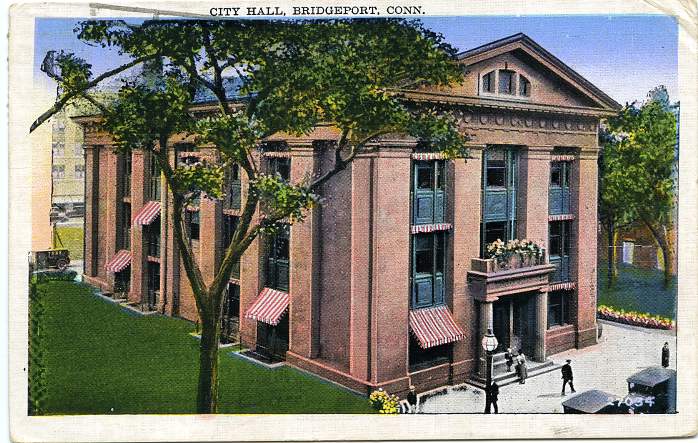
Bridgeport’s Old City Hall (1854)

This is Bridgeport Week!

The old City Hall of Bridgeport was constructed of Portland brownstone in 1853-54 between State and Bank Streets at a cost of $75,000. The Greek Revival building, designed by Alexander Jackson Davis to resemble a Greek temple, served as both City Hall and as the Fairfield County Courthouse. The original county seat and courthouse had been located in Fairfield, but when a larger building was required, it was decided to move the county seat to Bridgeport, which was experiencing considerable growth at the time. An alternative location for the courthouse was Norwalk, but Bridgeport offered to pay for the courthouse and a jail. The completed building had a large ground floor used as City Hall and two upper floors for court and county business. There was also an auditorium, called Washington Hall, used for public meetings. It was here, on March 10, 1860, that Abraham Lincoln gave a speech to a standing-room-only crowd.

The building served as courthouse until a new and larger one was constructed in 1887-1888 near the corner of Golden Hill and Main Streets. The old building, which continued to be used as City Hall until the 1960s and still contains city offices, was significantly remodeled in 1905. Bridgeport architect Joseph Northrop altered the building, toning down some of Davis’ romantic touches to make the structure conform more to the Neo-Classical style. The building’s dome had already been removed in the later nineteenth century and Northrop additionally altered the entablature and cornice. The first floor and entrance were also lowered to street level. In 1966, the former City Hall was renamed McLevy Hall after Bridgeport mayor, Jasper McLevy. The city is now consolidating its offices and plans to sell McLevy Hall to a developer.

United Church of Stonington (1834)

The United Church of Stonington was formed in 1950 as a union of the Second Congregational Church and First Baptist Church. The church building on Main Street in Stonington Borough was built in 1834 as the Second Congregational Church of Stonington. Richard Anson Wheeler, in his History of Stonington (1900), describes the formation of the church:

The First Congregational Society of Stonington, after several unsuccessful attempts to divide itself into two societies by metes and bounds, called a meeting to assemble on the 28th day of September, 1833, and after mature deliberation took a new departure and adopted a plan for organizing a new church and society in Stonington, viz.: “That whenever forty members of the First Society should withdraw and organize a new Congregational Society at the Borough and elect society officers, and shall give notice to the old society of their doings within thirty days from the day of the meeting, the new society shall then be regarded as organized and receive $1,825 of the old society’s fund.” The conditions were immediately complied with at the meeting. Forty-five members of the society withdrew, formed a new society, and took their money and invested it in a new meeting-house. As soon as the new society was formed, ninety-three members of the First Church seceded and organized the Second Church in connection with said society Nov. 11th, 1833.

The church’s clock, in a recently restored steeple, is owned and regulated by the Borough government.

Prentice Pendleton House (1820)

Prentice Pendleton, originally from Middlebury Vermont, built a house in 1819-1820 on Main Street in Essex. He had married Almira Pratt of Essex, but sold the house after her death in 1826. It was later owned by Captain Cornelius Doane. Part owner of the ship Cotton Planter, Capt. Doane was a pioneer in the Mobile packet and cotton trade. In the 1850s, he turned his attention from the declining shipping industry to the commercial development of Essex, where he became president of the Saybrook Bank in Essex. Starting in the later nineteenth century, Main Street in Essex began to develop as a retail area and the Doane House was owned by several local businessmen. In the twentieth century, a small store was attached to the house on the east.

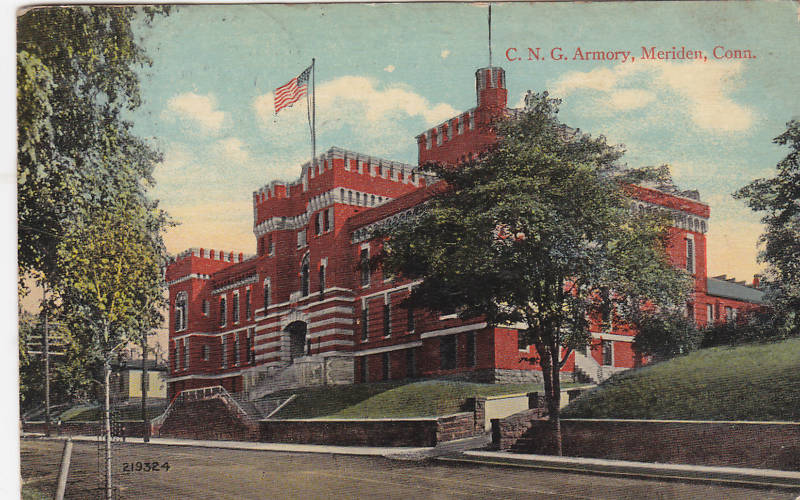
Meriden Armory (1908)

The imposing Meriden Armory on East Main Street was built in 1908. Once home to a National Guard unit, the Armory hosted dances and sporting events, including Meriden native Max E. Muravnick‘s first professional boxing match. The National Guard closed the Armory in 1998 and sold it to a private developer. The building has remained closed and is difficult to market due to its deteriorating condition and lack of parking.