The Academy, Orange (1878)

The first Academy building in Orange was constructed about 1821, across from Orange Green. In 1878-1879, a larger building replaced it. The second floors of both successive buildings were used for the school, while the first floors were used as assembly rooms by the town. In the twentieth century, town offices began moving into the building, which was enlarged to the rear. Administrative use by town government continued until a new Town Hall was built in 1967. The building next served as offices for the town’s Board of Education until 1989. Since then, the Academy has been leased to the Orange Historical Society for use as a museum.

Crosley F. Fitton House (1865)

The Crosley F. Fitton House, built around 1865, is at the corner of Elm and Prospect Streets in Rockville, Vernon. Crosley Fitton, born in England, was brought to the United States at the age of three. As described in Illustrated Popular Biography of Connecticut (1891), he

became a woolen manufacturer, as was his father before him. Twenty-six years ago he came to Rockville, and for twenty-four years he has been the agent of the Rock Manufacturing Company, being the oldest in continuous service of all who have held official connection with the manufacturing establishments of Rockville. As a woolen manufacturer he ranks among the most able in New England, and during his connection with the Rock Company it has enjoyed continued success and prosperity under his management. The mills have been enlarged, the most improved machinery obtained, the force increased, and woolen goods manufactured equal to any produced in the country. Mr. Fitton [d. 1891] was always a hard worker, and often the first man at the mill in the morning and the last to leave at night.

Woodward House (1740)

On the northwest corner of Bethlehem Green is a saltbox house built in 1740 by Samuel Church. In 1797, his daughter Betsy Church married David Bird and the house became known as the Bird Tavern. According to The History of the Descendants of Elder John Strong, of Northampton, Mass. (1871), by Benjamin W. Dwight, their son, Joshua Bird, was “for 30 years a woolen manufacturer at Bethlehem (1820-50), and for 20 years past (1850-70) a farmer there, a deacon in Ihe Cong. Ch. for 25 years (1845-70), a state senator (in 1859).” He also helped fugitive slaves and his house was a stop on the Underground Railroad. The house also served as the town’s post office. James W. Flynn, who purchased the house around 1900, served as postmaster and town clerk in the early twentieth century. Flynn and his wife Mary later shared the house with their foster child, Mary E. Toman. She married Charles Woodward, the son of a local farmer, and the couple inherited the house. It later passed to other owners, but in recent years was restored to become a restaurant called the Woodward House.

Holy Ghost Orthodox Church, Bridgeport (1937)

In the 1890s, a group of Slavic immigrants, who had settled in Bridgeport, sought to leave the Greek Catholic Church (affiliated with Rome) and join the Orthodox Church in America. After meetings with Fr Alexis Toth (canonized in 1994 as St. Alexis of Wilkes-Barre) and Bishop Nicholas of San Francisco, Holy Ghost Orthodox Parish was established in 1894. The church was dedicated on Palm Sunday, 1895, with Fr Toth celebrating the first Divine Liturgy. Tsar Nicholas II of Russia donated six bells to the church. They had been cast in honor of his coronation in 1896. Upon arrival in New York, the bells were held up in customs for payment of a large import duty, but a special bill was passed by Congress and signed by President McKinley allowing the bells to enter the United States duty free. The parish grew and a new church was built at 1510 E. Main St and dedicated on Palm Sunday, 1937. It was rededicated in 1981, with the sealing of the relics of St. Herman of Alaska, brought by His Grace, Bishop Gregory of Sitka, Alaska, replacing the missing relics of St. Barbara.

Hotel Barnum (1928)

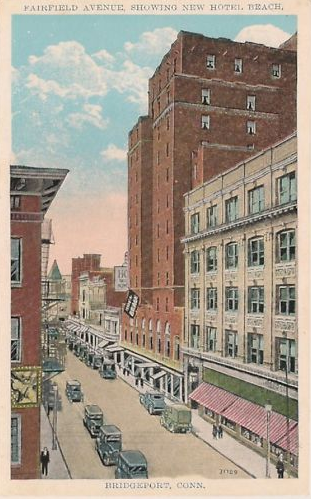
The striking 14-story Art Deco building at 140 Fairfield Avenue in Bridgeport was built in 1928 as the Hotel Beach. Named for Francis E. Beach, the local merchant who owned the land on which it was constructed, the name was changed within a year to the Hotel Barnum, named after P. T. Barnum. The hotel has an interesting terraced profile and is an Art Deco design, with eclectic elements, including English brickwork, Egyptian detailing and an Italian palazzo front. The building was designed by the firm of Thomas, Martin and Fitzpatrick and was lauded in the press upon its construction for bringing a “cosmopolitan” style to the city. In later years it was a residential hotel and then became an apartment building known as the Barnum House.