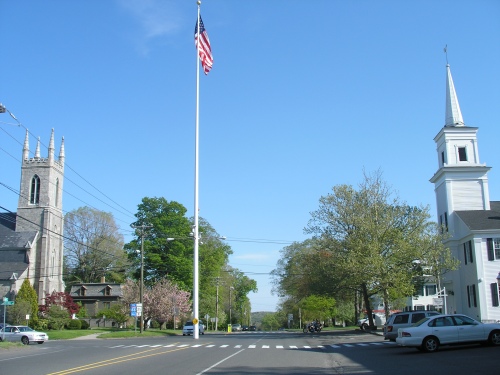
256-270 Broad Street, Bridgeport (1879)

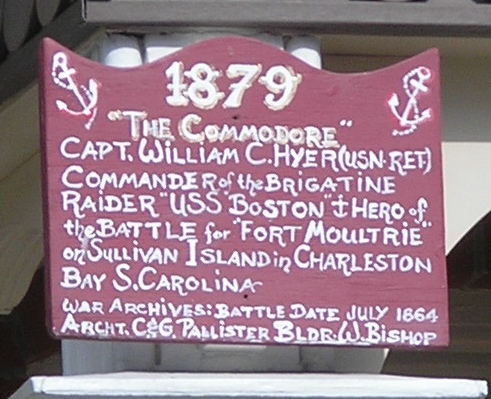
A block of brick row houses at 256270 Broad Street in Bridgeport, which date to around 1879, have been attributed to the architectural firm of Palliser & Palliser and the builder W. Bishop. The houses combine elements of the Victorian Gothic, Queen Anne and Romanesque styles in their eclectic facades. George and Charles Palliser built a number of such brick row houses in different parts of Bridgeport in the early 1880s, but this style of urban housing did not catch on in the city. One of this row of houses has a sign out front indicating that it was the home of Capt. William C. Hyer, who commanded a brigantine in fighting in 1864 at Fort Moultrie, Sullivan’s Island, South Carolina.

George Richardson House (1887)

The George Richardson House is a Queen Anne-style residence built in 1887 at 311 Barnum Avenue in East Bridgeport. The house’s architect was Henry A. Lambert. There appear to be two prominent George Richardsons associated with Bridgeport at this time. The house was built for George Richardson, originally a railroad engineer in Troy, NY. He became superintendent of the Consolidated Safety Valve Company, which he founded with his partner, Richard H. Ashcroft, in Boston in 1879. The company moved to Bridgeport six years later. Both men had earlier patented new safety valve designs in the 1860s. The house was later owned by George E. Nothnagle of the George E. Nothnagle & Son furniture store in Bridgeport. (more…)

Black Rock School (1860)

The Black Rock School in Killingworth is a one-room schoolhouse built around 1860. In the mid-nineteenth century, it was one of Killingworth’s eight district schoolhouses, which were in use until 1949. Originally located on Route 148, the school was later moved by the Killingworth Historical Society to its current address, on town property, at Route 81 and Recycle Way, where it is now a museum. The Society also owns the Union district school on Roast Meat Hill Road and recently accepted the donation of the Pine Orchard School, which has also been moved from Route 148 to town property, in this case, Parmelee Farm, where it will eventually be rebuilt.

Newtown Meeting House (1812)

Newtown’s first meeting house was built in 1720 on Main Street, where the flagpole stands today. In 1792, this building was moved 132 feet to the middle of West Street. As explained in Newtown’s History and Historian, Ezra Levan Johnson (1917):

Nothing more appears on the society minutes about the meeting house, either for its adornment or repairs, until 1792, when the Church of England people having the consent of the town to build a church for public worship on the ground where the town house was standing, provided they would remove the Town house to some other site, without expense to the town. The meeting house standing near to. and in front of, the Town house made an objection to putting the Church of England house there without removing the meeting house also, and it was proposed to them that their house be removed to the opposite side of the north and south road

The meeting house was replaced with a new one in 1812, which was improved over the years. Quoting from the same book as above:

During the Rev. Jason Atwater’s ministry, between 1845 and 1852, the exterior of the building was very much improved, the belfry was closed in, a new steeple was built, the building newly covered and painted. Twelve hundred dollars were spent in renovating the exterior and in 1852 the basement was fitted up, the main floor raised to its present level, [and] new seats and a pulpit were provided for the audience room

By 1873, the meeting house looked much as it does today. In 1988, the Newtown Congregational Church moved to a new building and sold the old meeting house to the town. The Heritage Preservation Trust of Newtown, Inc. then restored and now maintains the Meeting House, which serves as a place for concerts, meetings, weddings and other events.

Williams Memorial Institute (1891)

The Williams Memorial institute opened as a high school for girls on Broad Street in New London in 1891. The school was privately endowed by a bequest from the estate of Harriet Peck Williams as a memorial to her son, Thomas W. Williams II, a mechant who died in 1855. After New London High School opened in 1951, the Institute became a college preparatory school. The Williams School moved to the campus of Connecticut College in 1954. The Richardsonian Romanesque-style former school building, designed by the firm of Shepley, Rutan & Coolidge, became a courthouse of the Connecticut State Judicial system in 1972. The state purchased the building in 1997. It has recently been renovated.