Charlotte Pettibone Winslow House (1879)

The Stick-style house at 348 Hopmeadow Street in Simsbury was built in 1879 on the site of a c.1679 house, built by John Pettibone, Sr. The house was later owned by Rosetta Pettibone Bestor (1769-1825), wife of Dr. John Bestor. After her death, it was purchased by John Owen Pettibone in 1826. A large landowner, he was a probate judge of Simsbury and served in the State Senate. After his death in 1876, the property passed to his niece, Charlotte Pettibone Winslow, who tore down the old house and built the present one. She was the widow of Rev. Horace Winslow, who had retired and moved to Weatogue. According to the Commemorative Biographical Record of Hartford County (1901):

Mr. Winslow was married, May 8, 1850, at the Church of the Puritans, New York City, by the pastor, the Rev. George B. Cheever, D.D., to Charlotte Henrietta Pettibone, daughter of the late Capt. Jonathan and Mrs. Fanny Rosanna (Phelps) Pettibone, of Simsbury, Conn. Mrs. Winslow has for more than fifty years been a worthy and sustaining helpmate to her husband, and has always been interested in his work. She is of a kind and lovable disposition, and her devotion to her husband and children is unsurpassed. She was born at Weatogue, Simsbury, and was only three years old when she attended her first school, was a pupil of various private schools, and was graduated at the age of sixteen at Hartford Female Seminary, with first rank in her class. She also took courses in French, Music and Art while residing in Hartford, and later at New York City, being for a time a pupil at the private school of Madame Okill. About the year 1844, Miss Delia Bacon, of New Haven, sister of Rev. Leonard Bacon, D.D., conducted a class of young ladies in higher branches of study, This class Miss Pettibone joined, giving special attention to the Bible, to Shakespeare, and to philosophy, and the few months spent in New Haven were most delightful and profitable, as Miss Bacon was a lady of rare ability and attainments.

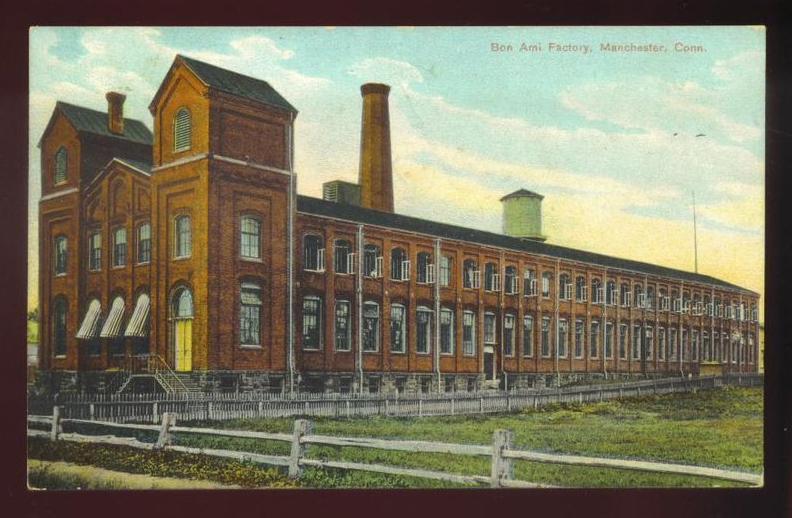
Bon Ami Factory (1888)

Bon Ami

The former factory building at 71 Hilliard Street in Manchester was built in 1887-1888 and was first occupied by the Mather Electric Company. After starting as a producer of dynamos, the company began to manufacture light bulbs. The Edison General Electric Company sued the Mather Company for patent infringement and the latter was eventually put out of business. The factory was then rented by other industrial tenants. In 1903, it was purchased by the Bon Ami Company (earlier the Orford or Robertson Soap Company), which had been renting space in the building since their first factory on Oakland Street in Manchester burned down in 1899. The company produced the popular Bon Ami Soap in the factory until 1959. The building then housed other businesses. In 1980, Bob Bell purchased part of the property, which became home to what is now New England Hobby. Since 1999, the Time Machine hobby shop has also been located in the building, making it the largest hobby retail location in New England. (more…)

Old Riverton Inn (1796)

The Old Riverton Inn, Barkhamsted, traditionally goes back to 1796, although the building probably dates to around 1804. It was originally opened by Jesse Ives as a tavern and inn, which he operated until 1856. Industry soon developed in Riverton and much traffic crossed the neighboring bridge across the Farmington River. The Old Riverton Inn (pdf) has remained open under various owners over the years and continues in business today. The building has undergone a number of changes and additions, including an Italianate-style porch. It retains original Federal-style features as well as Colonial Revival alterations. (more…)

Steiger Building (1927)

The Steiger Building is located on the southeast corner of Trumbull and Pratt Streets in Hartford. It was built in 1926-1928 and was the second major Hartford building built by Albert Steiger of Steiger’s Department Stores. The new building was designed by Smith & Bassette to correspond in architecture and building materials with the earlier Steiger Store, built in 1920-1921 on Main Street, at the other end of Pratt Street. That earlier Main Street building has since been replaced by a parking lot, but the one on Trumbull Street survives today.

Mechanics and Farmers Savings Bank (1930)

Happy New Year from Historic Buildings of Connecticut!!! According to Vol. I of Waldo’s History of Bridgeport and Vicinity (1917), the Mechanics and Farmers Savings Bank of Bridgeport

received its charter in 1871, but was not officially organized until July, 1873, when the incorporators held their first meeting and elected a board of trustees; George W. Hayes, president; Andrew Burke and George Lewis, vice presidents; and Lyman S. Catlin, secretary and treasurer. It was started as an East Bridgeport bank and was located on West Washington Avenue, near East Main Street. From there the bank was moved to the basement of the Connecticut Bank Building, corner of Main and Wall streets, then to the Barnum Building, 407 Main Street, then to the City Bank Building, Wall Street, and finally to the new and attractive structure at 930 Main Street.

In 1930, the Bank constructed a new building, designed by Ernest G. Southey, in front of an earlier brick-faced building. Mechanics & Farmers Savings Bank failed in 1991 and the building has been vacant for many years. The Beaux Arts structure, which was owned for several years by the City of Bridgeport, was used in 2007 as a location for the film Righteous Kill, during which their was a minor fire in the bank’s lobby. Fletcher-Thompson Inc., an engineering and design firm that moved out of Bridgeport in 2002, plans to return to the city, renovating and moving into the former bank building by 2014.

Former Methodist Church, Rockville (1867)

The building at 26 Park Place in Rockville in Vernon, which now serves as a Senior Center, was originally dedicated in 1867 as a Methodist Episcopal Church. As related in William T. Cogswell’s History of Rockville (1872):

During the years from 1850 to 1860, the Methodist[s] built a comfortable meetinghouse in West street. This house took fire and burned on a Sabbath morning. The German Lutheran Church was a Baptist Church till after the Methodist Church burned. It was bought and occupied by the Methodist society up to the time of building the present Methodist Episcopal Church.

According to A Century of Vernon, Connecticut, 1808-1908, published in 1911:

The first service in the vestry of the new church was held on June 16, 1867. It was a love feast. The bell was raised to its place in the tower June 28, 1867. The vestry was inadequate to accommodate the congregations and the audience room of the church was dedicated on Tuesday, November 26, 1867, Bishop Simpson preaching the sermon.

The church was built in what was then a rapidly developing commercial area and the first floor originally contained the People’s Savings Bank. As further related in A Century of Vernon:

From the time that Messrs. White and Corbin took the front basement rooms of the church, long used as banks, it was the intention of those gentlemen that this property should revert to the trustees of the church. When Cyrus White died this had not been attended to and Lewis A. Corbin bought the banks. The subject was frequently mentioned by pastors and others, but it was not until the pastorate of Rev. W. J. Yates that it was definitely arranged. Then Mr. Corbin executed deeds which are duly recorded, conveying the banks to the trustees. He reserved the income during his life. Then a portion was reserved for a fund for contingencies, but at last all the income goes to the trustees. Certain annual contributions to benevolent interests are provided for and the balance may be used for the current expenses of the church.

The former church no longer has its original two steeples.

Uncas-Merchants National Bank (1910)

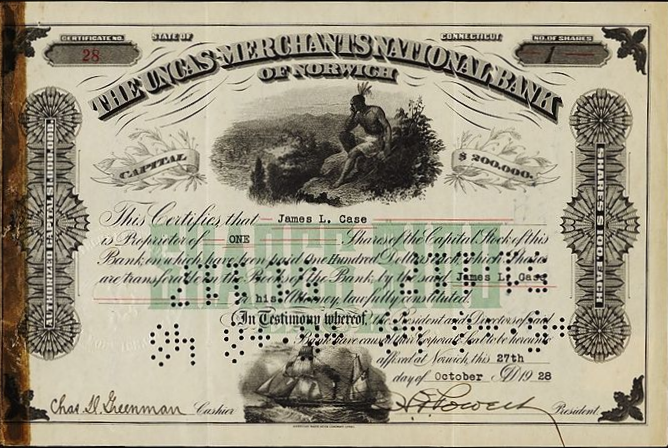
At 22 Court House Square in Norwich is the 1910 building of the Uncas-Merchants National Bank. It is located along what was Norwich’s “Banker’s Row,” with other bank buildings on either side. The building was constructed for the Merchants National Bank, which had been organized in 1823. In 1928, Merchants merged with the Uncas National Bank, which had been organized in 1852 and incorporated in 1855. Before the merger, the Uncas National Bank had been located in a 1913 building on Shetucket Street. The Uncas-Merchants National Bank merged with the Hartford National Bank & Trust in 1955. The bank building is now used as offices.